


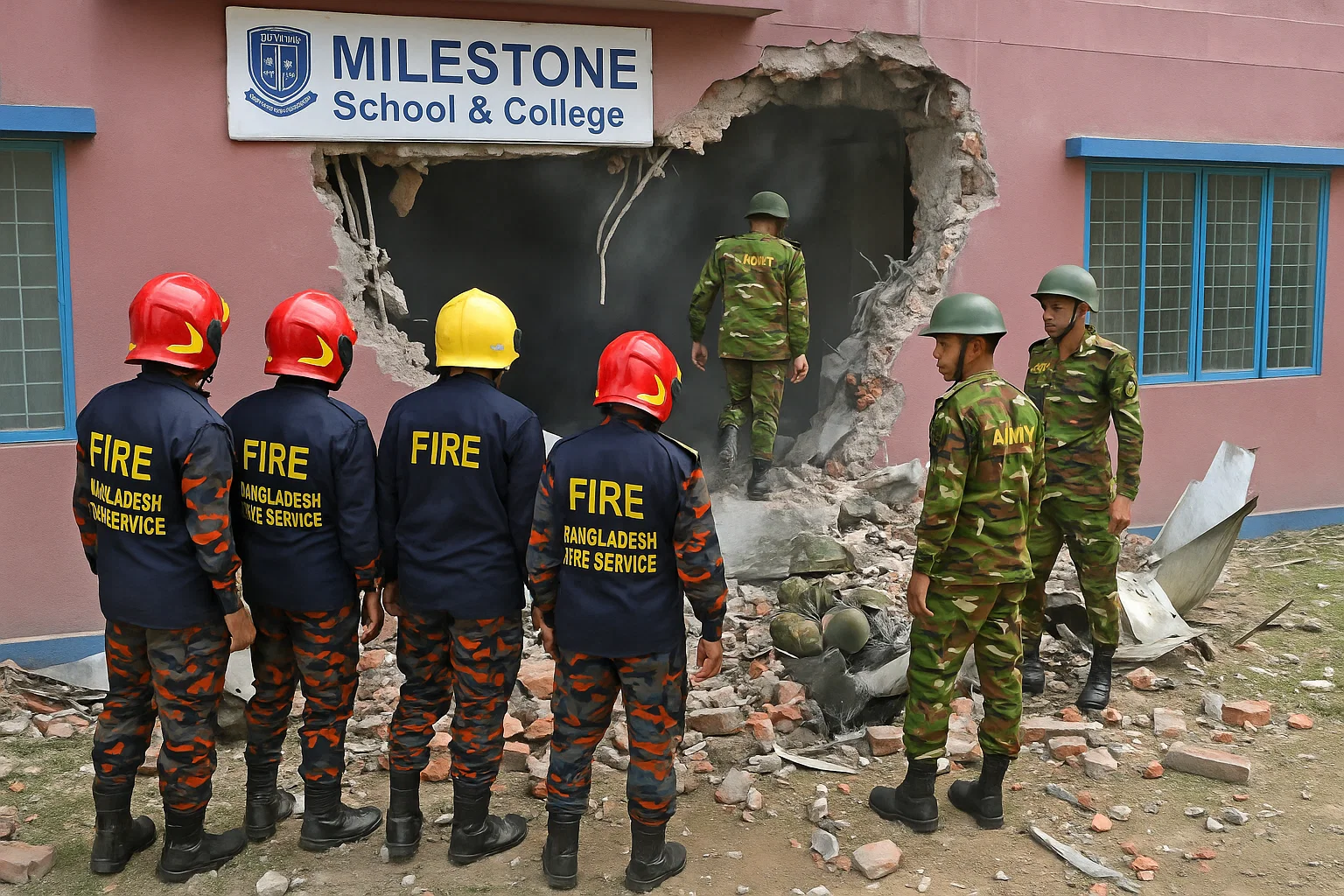
Dozens of children from the primary section of Milestone School and College in Dhaka, along with their parents and teachers, lingered in the two-storey building—some preparing to leave, others chatting and unwinding after the school day.
Then, suddenly, the lively atmosphere turned into chaos.
A mother, frantic and in tears, cried out for her child as rescue efforts cordoned off the campus. Around 1:30pm yesterday, a Bangladesh Air Force training jet crashed into the school’s Diabari campus in Uttara. The aircraft exploded on impact, killing at least 20 people, including the pilot, and injuring over 171 others, according to Inter Service Public Relations (ISPR) data released at 5:30pm.
Later that night, two more of the injured succumbed to their wounds at the National Institute of Burn and Plastic Surgery, raising the death toll to 22, said Resident Surgeon Shaon Bin Rahman.
This incident now stands as the deadliest training aircraft crash in recent memory. The toll could rise further, as many victims remain in critical condition with extensive burn injuries.
Moments after the impact, flames swept through several classrooms on the ground floor of the building, trapping children inside. The first floor held classrooms for grades three and four, and the jet crashed into a room used by third graders.
TV and social media footage showed thick smoke and flames billowing from the crash site, visible from a distance.
The F-7 BGI jet had struck the building’s front, tearing through walls and iron bars, with such force that it embedded deep inside, leaving only the rear engine visible amid the wreckage.
The scene was heartbreaking.
Children with scorched uniforms and blistered skin stumbled out, screaming and crying for help. Some collapsed. Others were carried out by adults—burned and barely conscious.
Rafsi Akter Rafia, a fourth-grade student, was among the injured receiving treatment at Uttara Crescent Hospital.
The area was filled with smoke, confusion, and urgent cries as residents, firefighters, and military personnel rushed to rescue survivors. Children were carried out on stretchers, in arms, and on rickshaw-vans, then loaded into ambulances. One harrowing video showed a boy with blistered skin walking, while another captured a father running with his burned daughter in his arms.
Victims were taken to several hospitals, including the Combined Military Hospital (CMH), Dhaka Medical College Hospital, Uttara Adhunik Hospital, and the burn institute. Many of the critically injured were airlifted by the Air Force.
Survivors were visibly traumatized.
A young girl, still clutching her pencil, was carried away by her guardian. “You could see the trauma on their faces,” said a witness.
Ariful Islam, a first-year HSC student, was in class on the seventh floor of a nearby building. “I saw the plane crash into the school building. There was a loud explosion, flames, and then screams.”
Tisha Sarkar Sreya, a ninth grader, narrowly escaped—she had left the affected building minutes before the crash. Traumatised, she waited nearby, calling her relatives.
SM Mahin, another HSC student, said, “Despite the smoke and heat, we saw children running out, badly burned. We helped as many as we could.”
Teacher Purnima Das shared her experience on Facebook: “I had just finished class and was walking to the teachers’ room when it happened. Most students had already left, but some stayed for extra classes or were waiting for parents.”
She continued, “Suddenly, the fire spread. I poured water on a few students in the washroom. Another teacher pulled me out as flames approached. A colleague collapsed, crying, ‘Save me.'”
Outside Dhaka Medical College Hospital, hundreds gathered to donate blood.
During an 8:00pm briefing, Professor Md Sayedur Rahman, special assistant for health and family welfare, said 88 injured were being treated at seven hospitals—25 critically. Seventeen bodies were held at various hospitals; ten were children, while the remaining seven remained unidentified but were also feared to be minors.
At the burn institute, ambulances brought a steady flow of patients. Medical staff struggled to manage the overwhelming number of casualties.
The Bangladesh Air Force launched an investigation. According to the ISPR, pilot Towkir Islam was on a routine training flight when the aircraft experienced a mechanical failure.
Despite efforts to steer clear of populated areas, the jet crashed into the school. It was Towkir’s first solo flight, following 100 hours of training in PT-6 aircraft.
This was Bangladesh’s worst aviation disaster in decades. The deadliest before this occurred in 1984, when a flight from Chattogram to Dhaka crashed, killing all 49 onboard.
The government has declared today a day of national mourning.
President Mohammed Shahabuddin and Chief Adviser Prof Muhammad Yunus expressed their condolences. Countries including India, Japan, Pakistan, Switzerland, the United Nations, and the European Union also offered support.
The Diabari campus of Milestone School and College, established about a decade ago, has 11 buildings and serves around 6,000 students. Attempts to contact Principal Mohammad Ziaul Alam were unsuccessful.
Brig Gen Muhammad Jahed Kamal of the Fire Service said the crash happened after classes had ended, though some children and guardians were still in the building.
At the burn institute, Law Adviser Asif Nazrul said this was an unprecedented national tragedy. He assured that the best medical care would be provided, including foreign treatment if necessary. “But what we lost today is irreplaceable,” he said.
The rescue operation was officially called off last night. Authorities confirmed no survivors or bodies remained in the school.
