


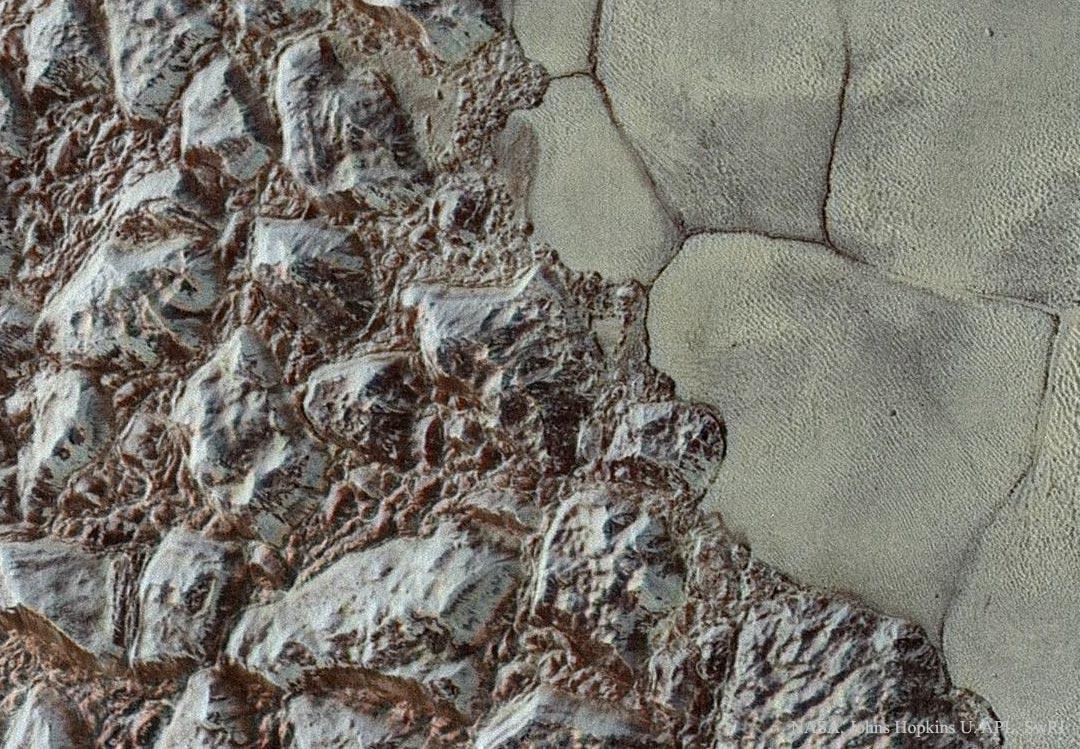
Scientists have identified the first confirmed evidence of landslides on Pluto after re-examining images collected by NASA’s New Horizons spacecraft during its historic 2015 flyby.
Researchers discovered six large areas where material appears to have collapsed and travelled down steep slopes. The findings were published in the scientific journal Icarus and provide fresh evidence that Pluto’s frozen surface has been shaped by complex geological processes.
Landslides have previously been observed on Earth, Mars, moons, asteroids and comets. Despite Pluto having mountains, impact craters and enough gravity for material to move downhill, scientists had not previously confirmed similar activity on the dwarf planet. Its largest moon, Charon, had already shown signs of slope failures.
The research team searched New Horizons photographs for familiar landslide characteristics, including steep scarps and deposits whose colour, brightness or texture differed from the surrounding terrain.
Six formations matched those features. All were found along steep inner walls of impact craters close to Sputnik Planitia, the enormous nitrogen-ice plain forming the western section of Pluto’s heart-shaped region.
One suspected landslide extends into Coughlin crater. Researchers believe a smaller impact near the crater’s rim may have destabilised the slope and sent material sliding into the larger depression.
The biggest identified landslide covers approximately 130 square kilometres—roughly twice the area of Manhattan—and is close to the upper size range normally recorded for landslides on Earth.
The formations descend between about 1,500 and 2,200 metres. Although their vertical drops are smaller than some landslides elsewhere in the solar system, Pluto’s deposits travelled unexpectedly long distances compared with landslides of similar height.
Scientists say the extended runout indicates that the moving material encountered relatively little friction. Further research will be needed to determine whether this behaviour was influenced by Pluto’s weak gravity, its icy surface materials or other environmental conditions.
Researchers believe many additional landslides may remain hidden in New Horizons data. However, finding them will require continued analysis of the spacecraft’s images and, potentially, another mission capable of studying Pluto in greater detail.
The discovery adds landslides to Pluto’s growing list of surprising geological features, which already includes flowing glaciers, convecting nitrogen ice, possible ice volcanoes and landscapes that appear far younger and more active than scientists once expected.
