


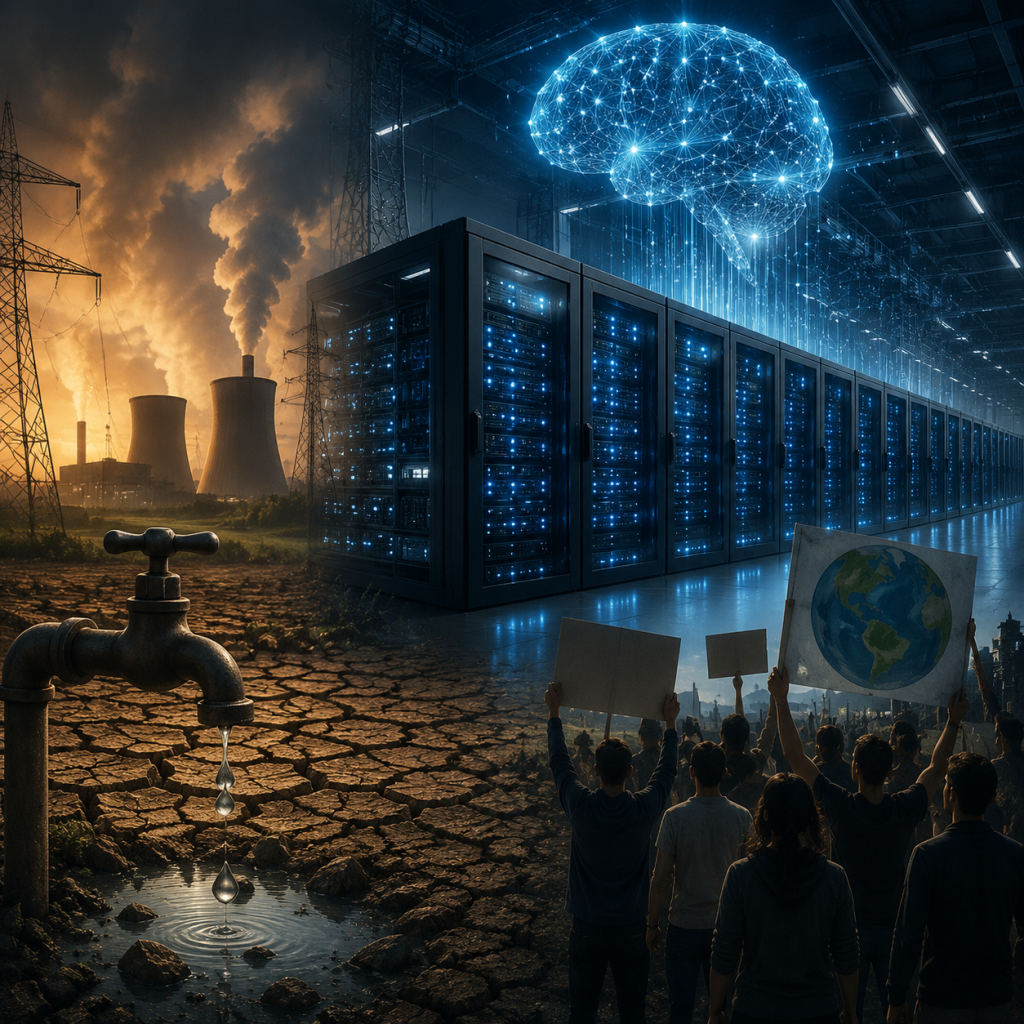
The rapid growth of artificial intelligence is intensifying concern about the environmental impact of the data centres required to operate increasingly powerful AI systems.
As major technology companies invest billions of dollars in new computing infrastructure, the public debate is expanding beyond innovation, productivity and economic opportunity. Growing attention is now being directed toward the enormous amounts of electricity and water consumed by data centres, their continued reliance on fossil fuels and the limited transparency surrounding some major developments.
Data centres already rank among the world’s largest electricity users. According to figures cited in a Financial Times report republished by the Australian Financial Review, global data centres consumed an estimated 448 terawatt-hours of electricity last year.
That total exceeds the annual electricity use of many countries. Demand is expected to increase sharply over the next several years as companies train and operate larger AI models, expand cloud-computing services and process growing volumes of digital information.
Industry projections suggest electricity consumption associated with global data centres could approximately double within four years if the current rate of AI expansion continues.
The source of that additional power has become one of the most significant concerns surrounding the sector.
The United States and China, which host many of the world’s largest data centre markets, continue to depend heavily on coal, gas and other fossil fuels for electricity generation. Unless the technology industry moves more rapidly toward renewable energy, the expansion of AI infrastructure could increase greenhouse-gas emissions and make national climate targets more difficult to achieve.
Technology companies have regularly announced renewable-energy agreements intended to offset the emissions associated with their operations. However, critics argue that these commitments do not always guarantee new data centres will receive clean electricity at every hour of the day.
AI facilities require a continuous and extremely reliable power supply. Interruptions can disrupt services and damage highly valuable computing equipment, prompting some developers to pursue private energy projects that operate independently from the public grid.
These arrangements can include dedicated gas plants, diesel generators and other forms of on-site or off-grid electricity generation.
Supporters argue that private power infrastructure can prevent large data centres from overwhelming existing electricity networks and reduce the risk of higher costs or outages for nearby households.
Environmental organisations and community groups, however, warn that the approach could allow technology companies to build major fossil-fuel facilities with inadequate public consultation.
Reports from the United States have raised questions about energy projects connected to AI data centres being approved through accelerated regulatory processes.
In Ohio, for example, certain projects may reportedly receive approval within 45 days without a public hearing. Critics say shortened approval periods give residents limited time to understand or challenge developments that could affect air quality, electricity systems, water supplies and surrounding communities.
Meta has been linked to proposals for substantial gas-powered infrastructure in Louisiana to support its expanding data centre operations.
The company and supporters of such projects argue that dedicated power generation can provide the dependable electricity required by advanced computing facilities without placing excessive pressure on the public grid.
Opponents contend that the developments risk locking in new fossil-fuel use for decades while avoiding the level of scrutiny normally expected for large industrial projects.
Public resistance to AI-related infrastructure is also growing.
Dozens of proposed data centre developments in the United States were reportedly blocked, delayed or subjected to additional review during the opening months of 2026.
Residents have raised concerns about heavy electricity demand, water consumption, constant industrial noise, backup-generator pollution and the lack of detailed information provided before projects are approved.
Some communities fear data centres could place additional pressure on already constrained electricity networks, potentially increasing household power costs or forcing utilities to accelerate expensive grid upgrades.
Others have objected to the physical scale of the developments, which can occupy large areas of land and contain rows of servers, cooling equipment, power systems and industrial machinery operating around the clock.
Water consumption has become another central issue.
Many data centres use large quantities of water to cool servers and prevent computing equipment from overheating. The amount required varies depending on the facility’s design, local climate, cooling technology and the source of its electricity.
A report from the United Nations University warned that global water consumption associated with AI could rise dramatically by the end of the decade.
By 2030, the report estimated that AI-related water use could be comparable to the basic annual household water requirements of approximately 1.3 billion people in sub-Saharan Africa.
The comparison has increased pressure on technology companies to provide more detailed information about where their data centres are located, how much water individual facilities consume and whether that usage is occurring in regions already facing water shortages.
Communities in dry or drought-prone areas are particularly concerned that industrial data centres could compete with households, agriculture and local businesses for limited water resources.
Technology companies commonly publish environmental or sustainability reports covering their overall energy use, emissions and water consumption.
Critics argue that these disclosures are often too broad to identify the environmental impact of specific AI services, computing workloads or data centre projects.
Company-wide figures may combine offices, warehouses, cloud services and other business activities, making it difficult for governments and the public to determine exactly how much of the environmental footprint is directly related to artificial intelligence.
United Nations Secretary-General António Guterres has called on major AI companies to disclose the carbon emissions, water consumption and land use connected to their data centre infrastructure.
Greater disclosure, supporters argue, would allow policymakers, investors and communities to compare projects, assess environmental risks and determine whether corporate climate commitments are being met.
The controversy is not primarily based on accusations that technology companies are acting illegally.
Instead, the criticism focuses on regulatory systems that may allow extremely large infrastructure projects to proceed without sufficient transparency, public consultation or accountability.
Major technology corporations can negotiate private electricity arrangements, purchase large areas of land and develop their own power infrastructure on a scale unavailable to ordinary residents or smaller businesses.
Critics say the imbalance makes it especially important for governments to ensure that local communities are consulted and that the environmental costs of the AI boom are not transferred to the public.
The expansion of artificial intelligence is therefore becoming far more than a story about software and technological progress.
It is increasingly a debate about climate policy, electricity generation, water security, land use and the authority of communities to influence major developments in their regions.
As demand for AI-powered services continues to rise, technology companies are likely to face greater pressure to prove that their data centres can operate without undermining environmental goals or placing unfair burdens on nearby communities.
The industry’s long-term acceptance may ultimately depend not only on what artificial intelligence can achieve, but also on whether the infrastructure supporting it is developed transparently, responsibly and sustainably.
