


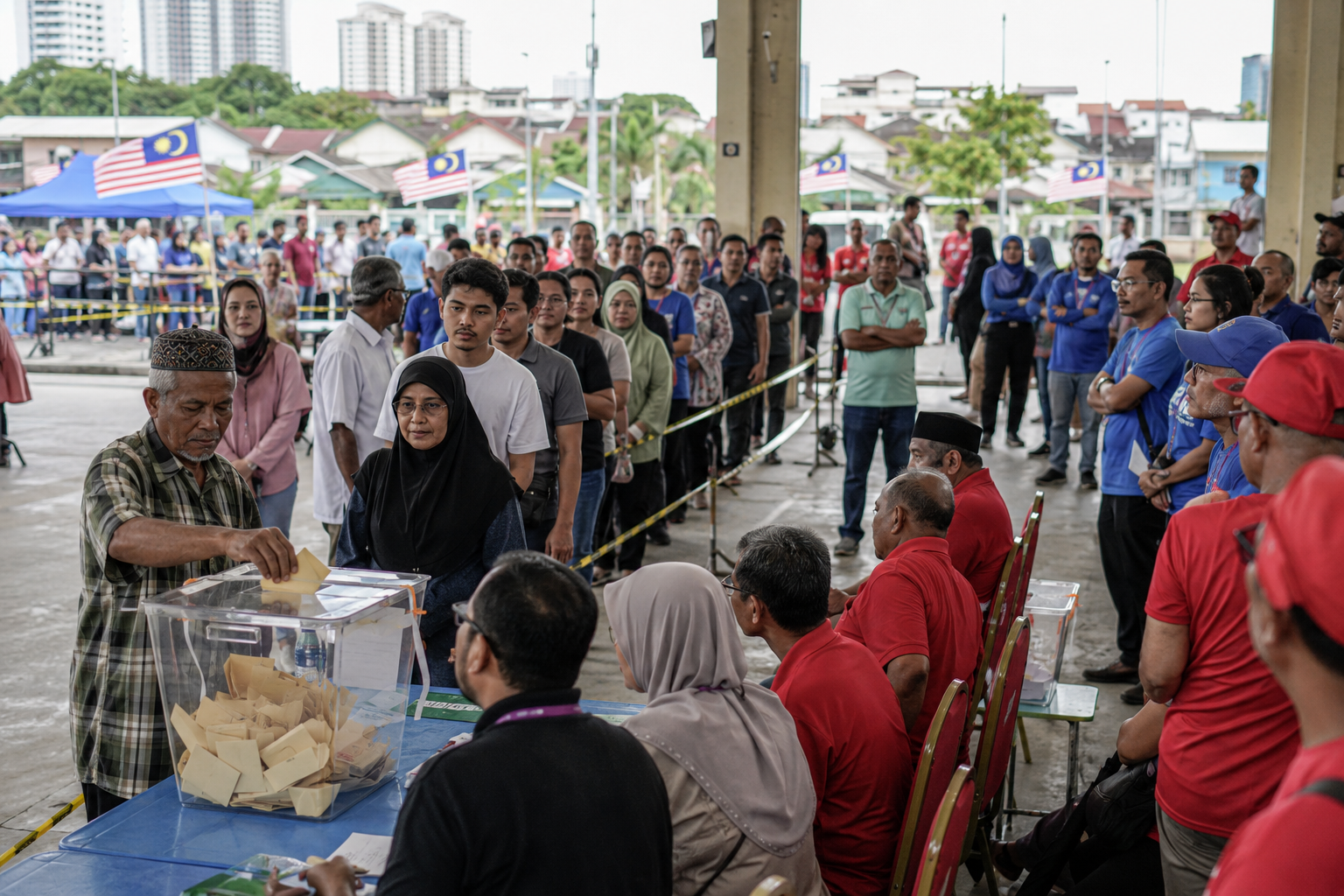
Early voting figures from Johor’s state election indicated stronger public participation than in the 2022 contest, raising the stakes for Malaysia’s leading political coalitions as they assess voter sentiment ahead of the next general election.
Polling opened at 8am on Saturday, July 11, 2026, across 1,076 voting centres. Around 2.7 million registered voters were eligible to choose among 172 candidates competing for the 56 seats in the Johor state assembly.
By 11am, voter turnout had reached 26.4 per cent, compared with 21.3 per cent at the same point during the 2022 state election. The Election Commission projected that approximately 70 per cent of eligible voters could participate, significantly exceeding the 55 per cent turnout recorded four years earlier.
Reports that bus and train tickets to Johor had sold out before polling day suggested that many voters living elsewhere were returning home to cast their ballots. Heavy traffic was reported on parts of the North-South Expressway as Johoreans travelled from the Klang Valley after work.
Hundreds of Johoreans working in Singapore also returned through Johor Bahru. Community groups arranged coaches from JB Sentral to destinations including Kluang, Batu Pahat, Segamat, Labis and Muar, helping voters reach their home constituencies.
However, participation was uneven across the state. Heavy morning rain affected voting in Muar, where Simpang Jeram and Bentayan recorded some of Johor’s lowest early turnout figures. Candidates in the area expressed concern that persistent poor weather could discourage people from visiting polling centres.
The election is being closely watched as an indicator of Malaysia’s broader political direction. The country’s next general election must be called by February 2028, and the performance of the major coalitions in Johor could influence their strategies, alliances and leadership calculations.
BN Seeks to Strengthen Johor Dominance
The UMNO-led Barisan Nasional coalition entered the contest hoping to expand on the 40 seats it secured in the March 2022 Johor election. Johor is regarded as UMNO’s birthplace and remains one of BN’s most important political strongholds.
Winning more seats would reinforce BN’s control of the state, but analysts said its total number of votes would provide an equally important measure of whether the coalition was genuinely rebuilding national support.
BN received slightly fewer than 600,000 votes in Johor during several recent elections. A meaningful increase would suggest that its traditional supporters, particularly Malay Muslim voters who moved towards Bersatu and PAS after 2018, were beginning to return.
The contest also tests UMNO’s effort to reunite former members and leaders through its “Rumah Bangsa”, or House of the Nation, initiative. Political figures who had previously become estranged from the party, including former ministers, have again appeared in BN-related campaigning.
BN candidates made visible efforts during the final campaign period to reach Chinese and Indian voters. In constituencies with sizeable non-Malay populations, candidates published videos and conducted walkabouts in markets, parks and neighbourhoods to demonstrate broader community engagement.
The campaign was nevertheless complicated by caretaker chief minister Onn Hafiz’s declaration that BN would not cooperate with the Chinese-majority Democratic Action Party if it formed the next Johor government. The statement revived debate over race, coalition partnerships and BN’s relationship with DAP at the federal level.
PH Faces Test of Voter Enthusiasm
The election also presents a major challenge for Prime Minister Anwar Ibrahim’s Pakatan Harapan coalition. PH has traditionally relied on high turnout, including strong participation from younger, urban, non-Malay and out-of-state voters, to compete against UMNO’s disciplined grassroots machinery.
A higher turnout could therefore benefit PH if its supporters remain motivated. The return of Johoreans from other parts of Malaysia and Singapore will be closely examined as an indication of whether the coalition can still mobilise its base for a state election.
However, PH’s long-standing campaign message portraying BN as corrupt and racially divisive has become more difficult to sustain since the two coalitions formed a federal unity government after Malaysia’s hung Parliament in 2022.
Anwar made several appearances during the closing stages of the campaign, urging Johoreans to return home and exercise what he described as their democratic power. He also repeated his government’s anti-corruption message during a late-night rally supporting the PH candidate in Puteri Wangsa.
For PH, the election is therefore not only about seats. It is also a test of whether its supporters will organise themselves and vote enthusiastically despite the coalition’s cooperation with its former rival, BN.
Divisions Weaken Perikatan Nasional
Opposition coalition Perikatan Nasional entered the election in a weaker position than it held in 2022. PN contested only 33 of Johor’s 56 seats and faced internal disagreements between its main component parties, Bersatu and PAS.
The two parties reportedly conducted largely separate campaigns despite running under the same coalition banner. The division reduced expectations that PN could form the state government and raised questions about its ability to present a united alternative to BN and PH.
Former prime minister Muhyiddin Yassin, who previously served as Johor’s chief minister and has represented the Pagoh area for decades, campaigned for Bersatu. Nevertheless, some of his appearances attracted limited crowds, suggesting that his personal influence may not be sufficient to overcome the party’s organisational problems.
Bersatu has also been weakened by defections linked to the emergence of Parti Wawasan Negara, led by former deputy president Hamzah Zainudin. Observers will watch whether Bersatu can retain support around Muhyiddin’s political base in central Johor.
PAS, meanwhile, hopes to show that it can extend its influence beyond its traditional northern strongholds. The Islamist party views the Johor election as part of a wider campaign to weaken Anwar’s federal coalition before the next national vote.
PN leaders have argued that a rejection of PH and DAP in Johor could create momentum for the Negeri Sembilan state election scheduled for August 1. Even without a realistic path to governing Johor, gains by PAS or Bersatu could strengthen the opposition’s national narrative.
Turnout Could Shape the Political Message
The final turnout figure will play a major role in interpreting the election. A decisive BN victory accompanied by increased support could demonstrate that UMNO is rebuilding its traditional base and improving its appeal beyond loyal party voters.
Strong PH performances in urban and mixed constituencies would indicate that Anwar’s coalition still possesses significant grassroots energy, despite concerns about reform progress and its partnership with BN.
For PN, maintaining or increasing support would show that the coalition remains capable of challenging Malaysia’s governing parties, even while dealing with internal divisions and leadership defections.
Johor’s election will determine the next state government, but its broader importance lies in what it reveals about Malaysia’s changing political loyalties. The results, turnout levels and vote shares will provide each coalition with valuable evidence as it prepares for the country’s next general election.
