


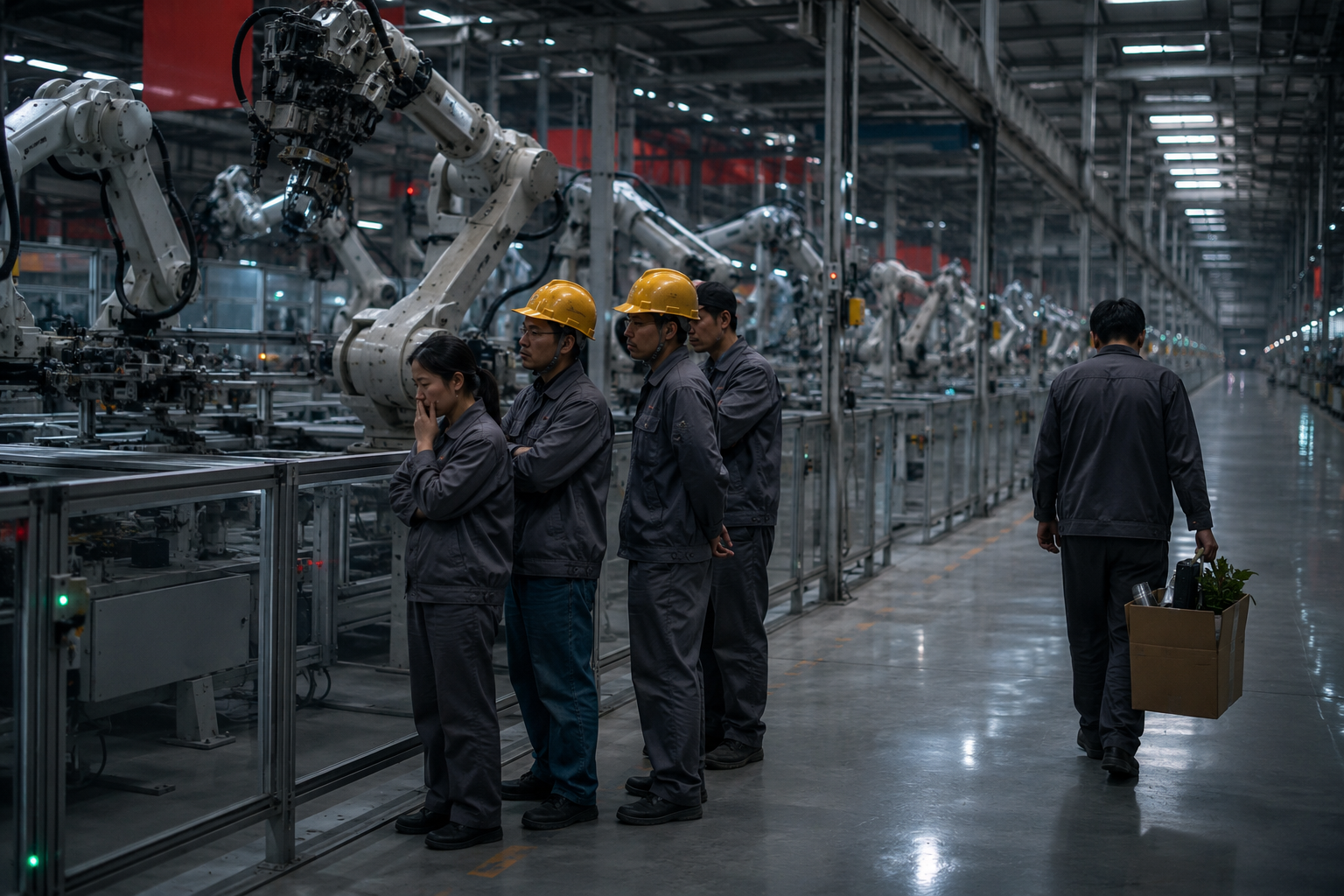
China’s rapid investment in robotics, artificial intelligence and advanced manufacturing is transforming its factories, but the shift is also reducing opportunities for millions of lower-skilled workers who once powered the country’s industrial expansion.
The effects are visible in Kunshan, an electronics-manufacturing centre near Shanghai that was once known for producing roughly one-third of the world’s laptops. For years, migrant workers travelled there from poorer regions of China to secure relatively stable positions assembling computers, smartphones and other devices for international technology companies.
Now, many of those workers are struggling to find regular employment. Some gather before dawn near labour markets in the hope of securing temporary factory, security or logistics jobs. Others spend their days resting in nearby parks after recruiters fill their daily quotas.
Among them is 31-year-old migrant worker Hu Xinbing, who previously held longer-term manufacturing contracts with major electronics suppliers such as Pegatron and Inventec. During busy periods, he could earn as much as 6,000 yuan, or about US$885, a month. As manufacturers introduced more automated machinery, however, jobs and wages were reduced.
Hu said factory tasks that once required large numbers of employees are increasingly being performed by robots. In May, he survived mainly on one-day security jobs paying between 60 and 120 yuan per shift, leaving him uncertain about whether dependable work would remain available in the future.
Kunshan’s local authorities have been encouraging investment in industries including artificial intelligence, robotics and flying vehicles. At the same time, traditional electronics manufacturers have faced weaker demand, geopolitical tensions and trade uncertainty, prompting some companies to automate production, reduce operations or move parts of their supply chains overseas.
China’s technological transition is central to its ambition to compete with the United States and become a global leader in advanced industries. The country already holds strong positions in electric vehicles, solar panels, batteries and industrial robotics. However, many of the new roles created by these sectors require technical training and higher levels of education.
This creates a difficult mismatch within the labour market. While China’s modern factories need engineers, programmers and equipment specialists, a large proportion of the country’s workforce has experience mainly in repetitive assembly and other labour-intensive tasks. New high-tech positions may therefore be unable to replace all the jobs disappearing from traditional production lines.
Many displaced employees are moving into unstable daily work instead. Peking University professor Zhang Dandan estimates that China’s manufacturing sector already has around 40 million gig workers. At some major factories, temporary labourers may account for as much as 80 per cent of the workforce.
Although some younger workers prefer the flexibility of short-term employment, gig workers generally receive fewer opportunities to develop skills, build careers or gain stronger workplace protections. Zhang has warned that temporary employment is likely to expand as smart manufacturing develops and has called for retraining programmes and greater protection of workers’ rights.
The growing insecurity can be seen at Zhenchuan Good Samaritan Park in Kunshan, which has become an informal meeting place for unemployed, exhausted and temporary workers. The park sits close to factories and a labour market where recruiters arrive from around 4am to select workers for daily assignments.
Some labourers sleep in low-cost dormitories nearby, while others remain in the park. Similar groups have appeared around labour markets in other manufacturing centres, including Shenzhen, reflecting the wider pressures facing migrant workers across China’s industrial regions.
Hu began working after leaving school following middle school and spent years assembling circuit boards, smartphones and other electronics. Although the factory work was physically demanding, it previously gave him a stable income and allowed him to save money each year.
When he returned to a gaming-laptop factory in 2024, he found that many employees who previously installed screws and components by hand had been replaced by robotic equipment. Remaining workers were assigned to load batteries, wires and other materials into trays before robotic arms completed the assembly process.
Hu estimated that some workshops employed only half as many people as before. The remaining jobs were not necessarily easier, as automated monitoring systems sounded alarms when employees moved too slowly. The quieter production lines also removed much of the social interaction that once existed among factory workers.
Despite his concerns, Hu said he admired many of China’s technological achievements, including robotic coffee machines, humanoid robots and drones that delivered food during pandemic lockdowns. His appreciation, however, is mixed with anxiety that he lacks the education and energy required to retrain for more technical work.
Chinese courts have recently ruled in some cases that companies cannot dismiss employees simply because artificial intelligence has made their positions unnecessary. However, those decisions have largely concerned office-based professionals and have offered limited protection to lower-skilled factory workers.
For workers such as Hu, the immediate reality remains a cycle of searching for short assignments. After one unsuccessful morning, he eventually found temporary work as a security guard at a Pokémon-themed event in Shanghai, earning about US$18 for a full day before returning to Kunshan to begin the search again.
China’s robotics drive may increase productivity and strengthen the country’s global competitiveness, but it also presents a major social challenge. Without large-scale retraining, accessible education and stronger employment protections, many of the workers who supported China’s rise as the world’s manufacturing centre risk being excluded from its high-tech future.
