


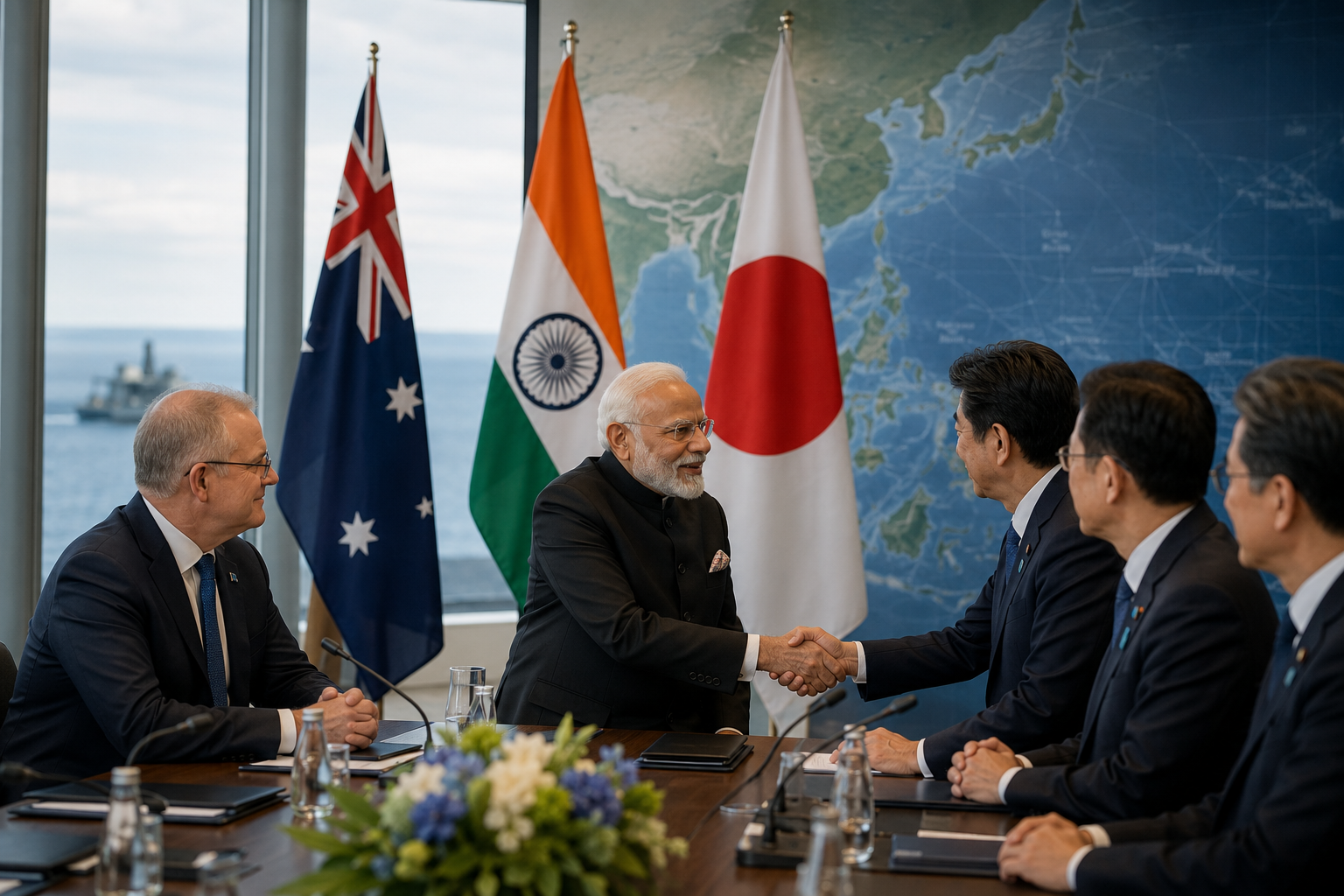
Indian Prime Minister Narendra Modi has used a three-country diplomatic tour to strengthen India’s economic, defence and energy relationships across the Indo-Pacific, as regional governments respond to China’s expanding influence and uncertainty over the future direction of United States engagement.
The tour produced agreements covering missile sales, uranium supplies, critical minerals, technology, maritime security and energy cooperation. Together, the deals highlight New Delhi’s ambition to take a larger strategic role in a region increasingly shaped by competition between China and the United States.
One of the most significant developments was India’s agreement to sell BrahMos supersonic cruise missiles to Indonesia. The arrangement reflects deepening defence ties between the two countries and India’s growing position as a supplier of military technology to regional partners.
Modi’s visit came amid heightened security concerns after China tested a nuclear-capable ballistic missile in the Pacific shortly before he arrived in Indonesia. The unusual launch prompted protests from several governments and renewed attention on Beijing’s increasing military reach across the region.
China’s missile test was also discussed when Modi met Australian Prime Minister Anthony Albanese in Melbourne. Indian Foreign Secretary Vikram Misri said both leaders expressed concern about the development and agreed that Australia and India should increase cooperation to preserve peace, security and stability in the Indo-Pacific.
India and Australia also announced agreements involving defence, uranium, critical minerals, energy and technology supply chains. Australia agreed to provide uranium for India’s civilian nuclear energy program, marking an important expansion of the two countries’ strategic relationship.
Australian Defence Industry Minister Pat Conroy defended the uranium agreement, saying the government was confident the material would be used for peaceful energy production. He described Modi’s visit as a landmark moment and said Australia wanted to work more closely with India as its global influence continued to grow.
The countries are also developing initiatives designed to secure critical minerals and reduce their dependence on China for strategically important resources and manufacturing materials. These efforts are becoming increasingly important as governments attempt to protect supply chains from political disputes, export restrictions and international conflict.
India and Australia have already expanded their cooperation through the Quad partnership, which also includes Japan and the United States. Defence coordination, maritime security, technology and resilient supply chains have become central elements of the relationship.
Modi has similarly strengthened India’s engagement with Japan and New Zealand. The agreements indicate that Indo-Pacific nations are increasingly building smaller partnerships focused on specific priorities, including semiconductors, minerals, defence and maritime security.
New Zealand Prime Minister Christopher Luxon described the emerging arrangements as small networks involving groups of countries with shared interests. After meeting Modi, Luxon said New Zealand would continue cooperating with China where possible while working with like-minded governments to protect its national interests.
The diplomatic activity comes as Washington urges regional allies and partners to assume more responsibility for their own security. Since returning to office, US President Donald Trump has pushed allies to increase their contributions while imposing tariffs on both partners and competitors. His administration has also removed the word “Indo” from the name of the US Indo-Pacific Command, although American officials maintain that its military mission has not changed.
Analysts believe these developments are encouraging regional governments to rely more heavily on one another. Ashok Malik, India chair at consulting firm the Asia Group, said China’s rise was creating a new strategic landscape and prompting countries to cooperate as the American footprint appeared to decline.
Modi has repeatedly promoted “mutual trust” as the foundation of India’s partnerships, describing it as one of the region’s most important strategic assets. The language supports New Delhi’s effort to present itself as a reliable partner for governments that want to diversify their international relationships without being forced to choose exclusively between Washington and Beijing.
Energy security has also featured prominently in India’s diplomatic discussions. Agreements with regional partners are intended to improve access to uranium, coal, gas and critical minerals at a time when conflict involving Iran has highlighted India’s dependence on Middle Eastern energy supplies and the vulnerability of major shipping routes.
Despite its efforts to diversify, India remains heavily dependent on China for industrial machinery, manufacturing components and rare-earth materials. New Delhi is therefore pursuing a careful strategy: expanding cooperation with Australia, Indonesia, Japan, New Zealand and other partners while cautiously attempting to stabilise its relationship with Beijing.
Modi’s latest diplomatic push shows how the Indo-Pacific is moving towards a more complex network of smaller security and economic partnerships. Rather than depending entirely on major-power alliances, regional nations are increasingly combining their resources to strengthen defence capabilities, secure essential supplies and manage the consequences of competition between China and the United States.
