
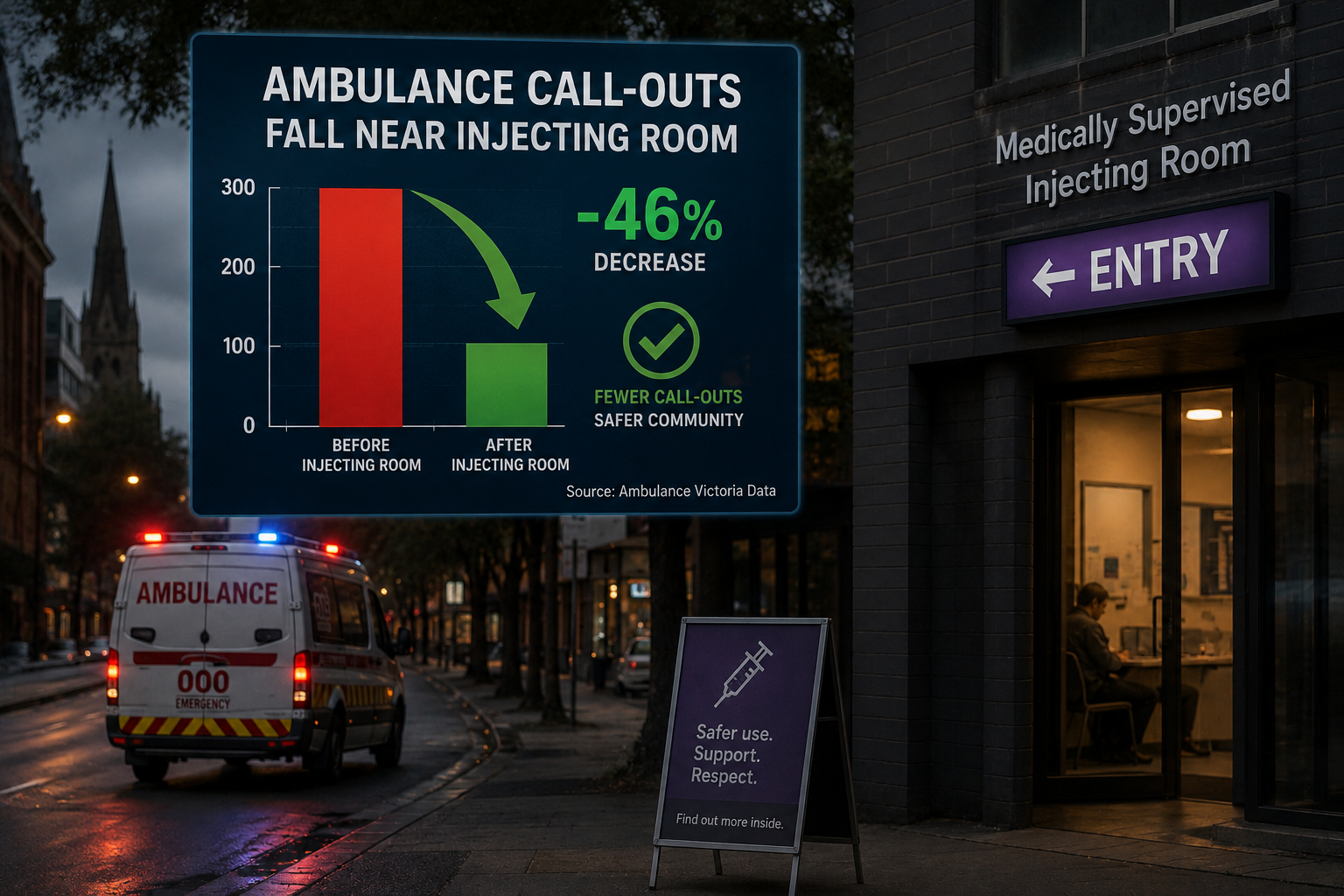
Heroin-related ambulance call-outs in Melbourne’s inner north fell by more than 70 per cent during the first five-and-a-half years of operation of Richmond’s medically supervised injecting room, according to newly published research.
The analysis found that ambulances attended about 48 heroin-related incidents each month in Richmond and Abbotsford when the facility opened in June 2018. By December 2023, the monthly figure had fallen to approximately 14, representing a decline of 70.7 per cent.
Researchers from Monash University and addiction treatment organisation Turning Point examined National Ambulance Surveillance System data covering about 24,000 call-outs across Victoria over nine years. Their findings were published in the International Journal of Drug Policy.
The injecting room was established at North Richmond Community Health on Lennox Street in response to a growing number of heroin overdoses around the Victoria Street drug market. Before it opened, heroin-related ambulance attendances in the area were not only high but continuing to rise.
Call-outs also declined elsewhere during the study period, but not as sharply. Central Melbourne recorded a fall of about 43 per cent, while the remainder of Victoria experienced a 36 per cent reduction. Researchers said the decrease was even more pronounced when the figures were adjusted for population.
When the Richmond facility opened, the surrounding area recorded about 123 heroin-related ambulance call-outs per 100,000 residents. That compared with 18 per 100,000 across the rest of Melbourne and 3.3 per 100,000 throughout Victoria.
Turning Point executive clinical director Professor Dan Lubman said ambulance data provided an important measure of drug-related harm because it captured overdoses that did not necessarily result in death. He said the most significant improvement occurred in the neighbourhood where the facility was operating.
According to Professor Lubman, the area’s heroin-related ambulance attendance rate had previously been more than six times that of central Melbourne but later fell to roughly three times the central-city rate. He argued that the service was reducing overdoses not only inside the facility but also in nearby streets, parks and laneways.
Since opening, the centre has managed thousands of overdoses without recording a death inside the facility. Independent reviews have estimated that the service saved dozens of lives. It also connects clients with addiction treatment, dental care, healthcare services and legal assistance.
Despite the decline in ambulance call-outs, heroin-related deaths remain a significant concern. Twenty-one people died from heroin overdoses in the City of Yarra during 2024, although the City of Melbourne had overtaken Yarra as the local government area recording the highest number of heroin-related deaths.
Statewide overdose deaths have also continued to rise. Victorian coronial data showed that 2024 was the state’s deadliest year for drug overdoses in a decade, with illicit substances becoming an increasingly significant factor.
Researchers suggested several possible reasons why ambulance attendances could fall while overdose deaths increased. One factor may be the wider availability of naloxone, a medicine that can reverse opioid overdoses and is available free of charge in Victoria. People may increasingly use naloxone without calling an ambulance, reducing recorded attendances.
The injecting room nevertheless remains highly controversial among residents, traders and local officials. Critics argue that the facility has failed to address public drug use, crime and neighbourhood amenity around its current location, which sits near public housing towers and a primary school.
The City of Yarra withdrew its support for the facility at its existing site in 2025, citing community safety concerns. Mayor Stephen Jolly said the new ambulance figures demonstrated the need for additional supervised injecting facilities across Melbourne, rather than concentrating demand in a single neighbourhood.
Jolly said public injecting remained common around the Richmond site and described conditions as extremely difficult for nearby residents. Crime data showed that Yarra’s criminal incident rate had fallen during the most recent 12-month period but remained above levels recorded in 2017 and 2018.
Supporters of the facility argue that expanding supervised services could spread demand more evenly and prevent other areas from experiencing the concentrated problems seen around Victoria Street. The research paper similarly concluded that the ambulance data supported consideration of additional supervised injecting facilities.
However, the Victorian government abandoned plans for a second injecting room in Melbourne’s central business district in 2024 following strong opposition from businesses and community groups.
The debate is unfolding as demand for addiction services continues to grow. The Victorian Alcohol and Drug Association reported that the waiting list for alcohol and drug treatment had more than doubled between September 2020 and May 2026.
The latest research provides strong evidence that Richmond’s injecting room coincided with a substantial reduction in heroin-related ambulance emergencies. At the same time, persistent overdose deaths, public drug use and community concerns show that the facility has not resolved the broader social and health challenges surrounding Melbourne’s illicit drug market.
