


Conor McGregor’s UFC Comeback Ends After 69 Seconds as Fresh Leg Injury Deepens Career Uncertainty
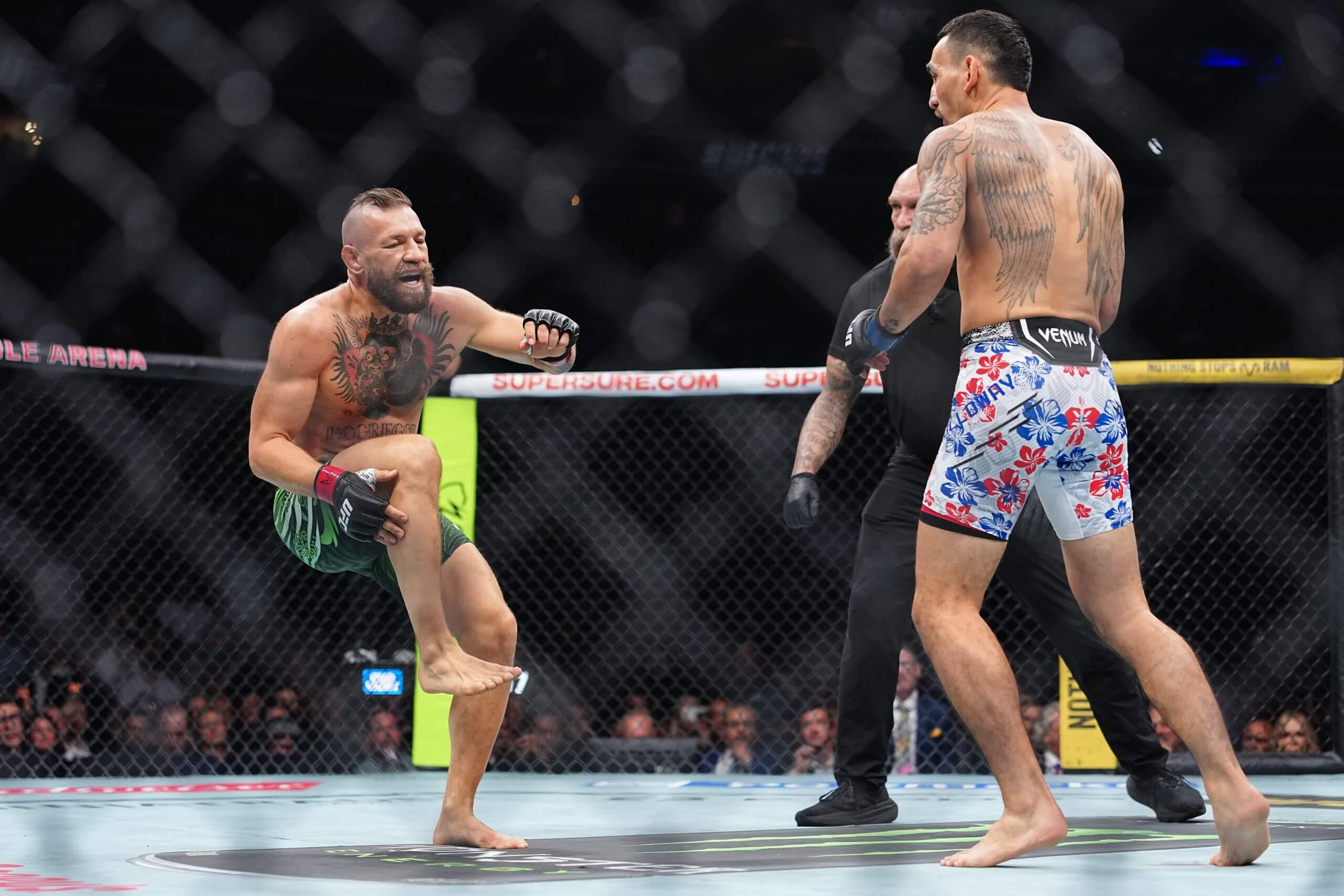
Conor McGregor’s long-awaited return to the UFC ended in another painful disappointment after an apparent leg injury forced his bout against Max Holloway to be stopped only 69 seconds into the opening round.
The former two-division champion had not competed in the UFC for five years and one day before stepping into the octagon at UFC 329 in Las Vegas.
His comeback had been promoted as a major opportunity to revive a fighting career increasingly overshadowed by injuries, legal controversy and years of inactive or cancelled appearances.
Instead, McGregor struggled almost immediately.
The 37-year-old slipped twice within the opening 40 seconds and began moving with a pronounced limp. He had attempted two jumping kicks early in the fight, landing awkwardly on both occasions.
As it became clear that McGregor could no longer compete safely, Holloway alerted referee Mike Beltran to the problem. The contest was then stopped just over a minute after it began.
The abrupt ending stunned the crowd at T-Mobile Arena, where many supporters had paid heavily to witness one of the most anticipated UFC returns in recent memory.
Boos could be heard as McGregor left the cage before Holloway’s victory was formally announced.
UFC suspects serious knee injury
UFC chief executive Dana White said after the event that doctors initially feared McGregor may have suffered a torn anterior cruciate ligament.
White stressed that the diagnosis had not been confirmed and said an MRI examination would be needed to determine the exact nature and severity of the injury.
He also said he did not believe McGregor entered the contest with an existing physical problem.
According to White, a pre-fight injury would likely have been noticed by medical staff or members of the fighter’s team.
McGregor left the arena without speaking to reporters. He was later seen outside the venue walking barefoot and shirtless while visibly limping toward a parking area.
In a subsequent social media statement, McGregor said he had not been injured before the fight and described his emotional state following the defeat as extremely dark.
The comments reflected the frustration of a comeback that had taken years to arrange but ended before either fighter could establish any meaningful rhythm.
Holloway noticed McGregor appeared different
Holloway said McGregor appeared unusual from the moment he entered the octagon.
The former champion expressed concern for his opponent and said McGregor did not seem like the same fighter he had encountered earlier in his career.
The bout was a rematch of their 2013 contest, which McGregor won by unanimous decision during his rise through the featherweight division.
Holloway entered the latest meeting as the betting favourite, largely because he had remained active while McGregor spent years away from competition.
However, the fight ended before Holloway could demonstrate a clear tactical advantage.
There were no significant exchanges, takedowns or extended combinations. The official result came almost entirely because McGregor was unable to continue.
For Holloway, the victory is unlikely to rank among his most memorable achievements.
For McGregor, it may become one of the defining images of his late career.
Another injury after devastating 2021 defeat
McGregor’s previous UFC appearance also ended with a serious leg injury.
During his 2021 trilogy fight against Dustin Poirier, he suffered a fractured left leg near the end of the first round.
That injury required surgery and began a lengthy rehabilitation process that contributed to his extended absence from the sport.
Before Saturday’s comeback, McGregor had repeatedly expressed confidence that his repaired leg was strong enough to withstand the demands of elite competition.
However, the latest incident immediately renewed questions about his physical durability and whether his body can continue to cope with high-level mixed martial arts.
The apparent injury occurred in a different area, with early speculation focusing on his knee rather than the previously broken lower leg.
Until imaging and medical examinations are completed, it remains unclear whether McGregor faces another lengthy rehabilitation or whether the damage is less severe than initially feared.
Comeback intended to restore focus on fighting
McGregor had hoped the Holloway bout would redirect attention toward his accomplishments inside the octagon.
Once the UFC’s biggest attraction, he became the first fighter in the promotion’s history to simultaneously hold championships in two weight divisions.
His rapid rise was built on knockout power, aggressive self-promotion and victories over opponents including José Aldo, Eddie Alvarez and Chad Mendes.
However, the peak of his competitive career ended several years ago.
His 2018 defeat to Khabib Nurmagomedov was followed by a chaotic post-fight confrontation involving members of both teams.
McGregor later lost twice to Poirier in 2021, including the bout in which he fractured his leg.
Away from the cage, his reputation has also been affected by a series of controversies and legal matters.
In 2024, McGregor lost a civil case brought by a woman who accused him of rape in a Dublin hotel. He denied the allegation and maintained his innocence. Irish prosecutors had previously decided not to pursue a criminal case, citing the higher standard of proof required for a conviction.
The civil court ordered McGregor to pay damages exceeding $250,000.
His return against Holloway was therefore presented as a chance to re-establish himself primarily as a professional fighter rather than a celebrity surrounded by controversy.
The 69-second ending instead intensified doubts about whether he can still produce meaningful moments in competition.
Five-year absence proves difficult to overcome
White acknowledged that returning after five years away from the sport was always going to be difficult.
Mixed martial arts evolves rapidly, and inactive fighters often struggle with timing, conditioning and the pace of live competition.
McGregor’s early movements appeared less controlled than those seen during his championship years.
His jumping kicks were ambitious but resulted in unstable landings, while Holloway appeared calm and composed despite the unusual circumstances.
McGregor was competing at welterweight for the fourth time in his career, far above the featherweight division where he first became a UFC champion.
The larger weight class may have reduced the extreme weight cutting required earlier in his career, but it also placed him against opponents carrying greater size and physical strength.
He did not remain in the contest long enough to show whether his striking speed or power could still be effective at 170 pounds.
Questions remain over medical exemption reports
McGregor’s return had also attracted scrutiny before fight night.
A report published in June said surgeon Dr Neal ElAttrache, who treated McGregor’s broken leg, supported an application for a special exemption related to the fighter’s use of substances normally prohibited under anti-doping rules.
The report alleged that McGregor had taken banned performance-enhancing substances during his recovery, citing unnamed people said to have direct knowledge of the situation.
The matter added further controversy to a comeback already surrounded by debate over McGregor’s long absence and eligibility to compete.
Saturday’s injury has now overtaken those questions, with immediate attention shifting to his medical condition and whether another return is realistic.
Fans leave frustrated after heavily promoted event
The atmosphere following the stoppage was marked by confusion and disappointment.
Many spectators had expected a dramatic main event between two of the UFC’s most recognisable fighters.
Instead, the fight ended before the crowd had settled into the contest.
Some fans expressed anger as they left the arena, while the usually energetic post-fight atmosphere was replaced by frustration.
Holloway attempted to lighten the mood with a joke about making opponents weak at the knees, but the audience responded quietly.
The lack of meaningful action made the result particularly difficult for supporters who had spent large sums on tickets, travel and accommodation.
The event had been promoted for years as McGregor’s return to the stage where he became a global star.
Its ending offered almost none of the spectacle promised.
Rematch plans now appear uncertain
Before UFC 329, Holloway had suggested that he would be willing to face McGregor again in December, creating a third contest between the pair.
McGregor dismissed the suggestion before the fight, describing it as financially motivated and disrespectful.
Following the injury, however, any discussion of another meeting has become highly uncertain.
McGregor’s immediate priority will be obtaining a confirmed diagnosis and determining whether surgery is required.
Even if the injury is treatable, his age, inactivity and history of serious physical damage may complicate another comeback.
White said the UFC currently has more questions than answers regarding McGregor’s future.
The promotion will need to consider his recovery timeline, medical clearance and whether there remains a competitive matchup capable of generating public interest.
A career increasingly defined by unfinished returns
McGregor’s late career has repeatedly been shaped by plans that failed to produce the expected outcome.
Potential fights were announced, discussed or delayed, while his return date continued to move further into the future.
When he finally stepped back into the cage, the comeback lasted barely more than a minute.
The result left fans wondering not only what might have happened against Holloway, but whether McGregor will ever compete again.
At his peak, McGregor transformed the UFC’s popularity and became one of the most commercially successful athletes in combat sports.
His confidence, precision striking and ability to generate attention helped bring mixed martial arts to a wider global audience.
Yet the closing stage of his career has delivered injuries, inactivity and controversy rather than championship performances.
The latest setback may not formally end his time in the UFC, but it has deepened the uncertainty surrounding a fighter who has not recorded an octagon victory since 2020.
For now, McGregor’s future depends on the result of medical examinations and his willingness to undertake another difficult recovery.
After years of anticipation, his comeback produced only 69 seconds of action—and another painful question about whether the former champion’s greatest days are permanently behind him.
