


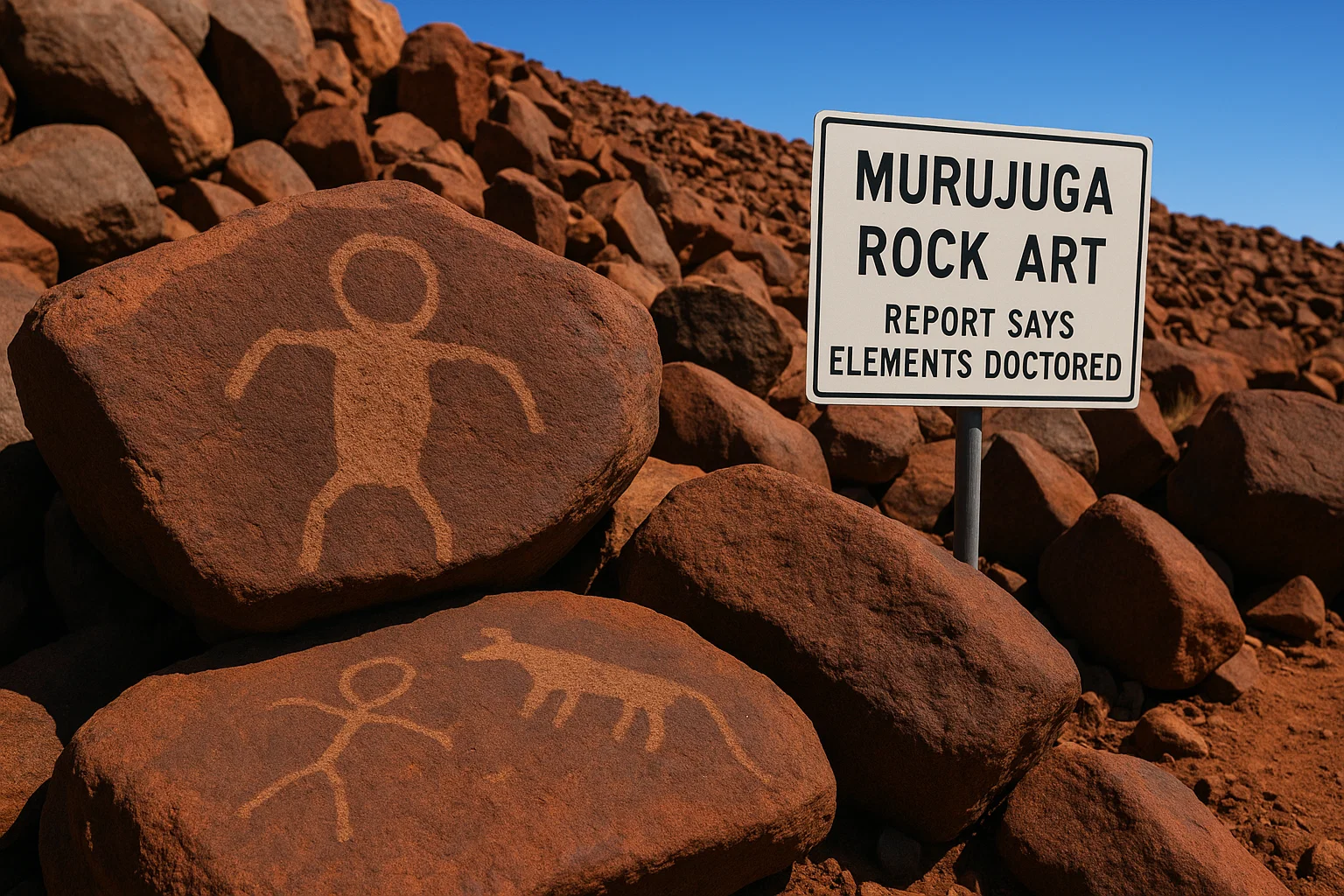
A prominent rock art expert has accused the Western Australian government of releasing misleading information to support Woodside’s bid to extend its North West Shelf gas project, calling official documents a “disgrace to Australian science.”
Last Friday, the WA government released an 800-page report on the Burrup Peninsula’s (Murujuga) ancient rock art — one of the most significant and densely concentrated collections of petroglyphs in the world. The report indicated that artwork closest to industrial facilities had suffered the most degradation, with recent industry activity identified as the cause.
However, Professor Benjamin Smith, an archaeology expert from the University of Western Australia, claims that the executive summary — which he believes was prepared by the government — omits those findings and instead attributes the damage to industrial emissions from the 1970s, distancing it from Woodside’s more recent operations.
Speaking outside parliament on Tuesday, Professor Smith condemned the summary as propaganda and said it should not inform Environment Minister Murray Watt’s upcoming decision on whether to approve the gas plant’s operation through to 2070.
“This document is not worth the paper it is written on,” he said. “It’s a disgrace to science in this country.”
According to Professor Smith, the report clearly shows that current emissions are damaging Murujuga’s ancient rock art — even at relatively low atmospheric levels. He described how samples of rock exposed to pollutants became porous, like “Swiss cheese,” and said recent emissions were five times higher than those in the 1970s and 80s, when the now-defunct Dampier Power Plant was operating.
WA Premier Roger Cook has rejected claims that modern industry is causing harm to the rock art, reiterating the government’s position that the majority of degradation occurred decades ago due to older infrastructure.
“The science has said that modern industrial developments do not have a long-term impact,” Premier Cook said.
Professor Smith accused the government of shifting blame to the past to downplay current damage, noting that no such rock degradation was evident in samples from 1994 — which he described as a potential “smoking gun.”
He also criticized the lack of transparency, alleging that Curtin University scientists who contributed to the report have been “gagged” and are not permitted to speak publicly.
The Murujuga Aboriginal Corporation also expressed concern, stating that traditional owners are unable to formally oppose industrial developments on culturally significant land and that the state government has shown no willingness to change this.
Professor Smith concluded that if the project is approved, it must come with stringent conditions to reduce emissions to near zero.
“This could be the most important environmental decision of our lifetime,” he warned. “What’s at stake is the biggest carbon bomb in the southern hemisphere — and the preservation of one of the world’s most precious rock art sites.”
