


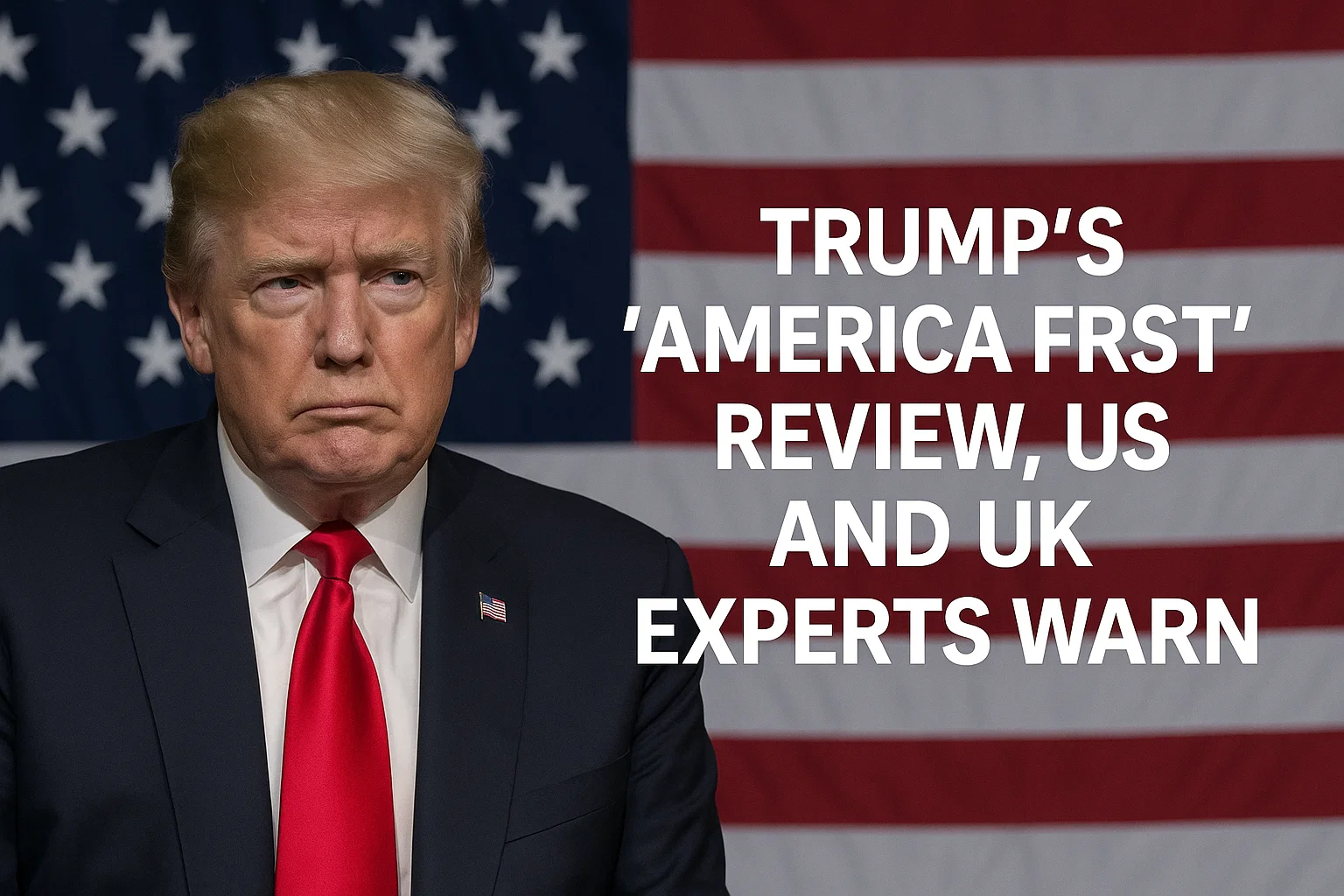
Top defence figures on both sides of the Atlantic warn that the AUKUS agreement — Australia’s most significant defence undertaking to date — faces challenges far beyond a simple policy review to determine if it aligns with Donald Trump’s “America First” priorities.
Officials have told Four Corners that long-standing alliances are being eroded by Trump’s erratic behavior and disregard for allies, the UK’s shift in focus toward European security, and doubts about whether either country can deliver nuclear submarines to Australia on time or within budget.
With Australia’s defence strategy in the Indo-Pacific hanging in the balance, there’s a real risk the country could be left without submarines — and billions of dollars out of pocket — while its historic alliances falter.
AUKUS Under Pressure
Even before the U.S. announced a review of the deal, a senior member of Congress warned that Trump’s “bullying” and “idiotic” approach to foreign relations posed serious threats to Australia’s partnership with the U.S.
Trump has repeatedly made dismissive comments about allies, referring to Canada as the “51st state” and mocking Ukraine’s President Volodymyr Zelenskyy in a February meeting. He has also floated extreme ideas such as reclaiming control of the Panama Canal and even seizing Greenland from Denmark.
Democratic Congressman Adam Smith, the ranking member of the House Armed Services Committee, voiced concern over Trump’s treatment of allies.
“I can’t overstate how damaging the Trump administration’s treatment of our partners has been,” he said, adding that it risks undermining not just AUKUS, but U.S. national security as well.
Former National Security Adviser Jake Sullivan echoed that sentiment, warning that Trump has hurt America’s credibility with its closest partners.
Sullivan acknowledged Australia’s concerns, joking, “I’m not sure Trump is eyeing territory Down Under — but I can understand why people are asking, ‘What is going on?’”
UK Concerns and Production Gaps
British officials are also uneasy. Former Royal Navy Admiral Lord Alan West remarked that Trump’s return has unsettled long-held expectations. “What he’s said about Canada is outrageous — it’s like kicking a fluffy bunny,” he said.
Under AUKUS, the U.S. has committed to transferring at least three Virginia-class nuclear-powered submarines to Australia in the 2030s. But the U.S. is not producing enough of them — currently building only 1.2 per year when it needs to reach 2.3 per year to meet its own and Australia’s needs.
Christopher Miller, a former U.S. acting defense secretary, acknowledged that production is lagging, largely due to shortages in skilled labor like welders and machinists.
Australia has already invested $800 million into the U.S. submarine industry — the first of six such payments — to help address these production issues.
Vice Admiral Mark Hammond, head of the Royal Australian Navy, told Four Corners that he believes both countries are serious about meeting the deal’s requirements.
“I have every reason to believe they will succeed,” he said.
A Risk of Walkaway
However, some experts caution that Australia holds little leverage. Former Australian Navy commander Peter Briggs pointed out that the U.S. could walk away from the deal without penalties if it believes the program affects its own capabilities.
“It’s a great deal for them. If it’s not working, they just stop — no refunds,” Briggs said.
U.S. law requires the president to certify that transferring submarines to Australia won’t harm America’s undersea warfare capabilities. Without that certification, the deal is off.
Jake Sullivan acknowledged the risk, but expressed confidence in the long-standing trust between the U.S. and Australia.
“If a future president decided to cancel AUKUS, yes, they technically could. But it would go against decades of cooperation,” he said.
Leverage and Sovereignty Concerns
Elbridge Colby, now overseeing the AUKUS review, previously opposed transferring submarines to Australia, arguing it would weaken U.S. capabilities in a potential conflict with China.
Others in Trump’s circle, such as Republican Congressman Rob Wittman, support the deal — seeing it as a strategic move that compels Australia to support the U.S. in regional conflicts.
“That’s a lever. It allows Australia to do even more,” Wittman said.
Critics worry this “lever” could compromise Australia’s sovereignty, forcing it into unwanted military conflicts. “You’re in the fight, like it or not,” said Peter Briggs.
Vice Admiral Hammond, however, dismissed that concern. “Just because the technology is American doesn’t mean we lose control of our decisions,” he said.
Shifting Priorities in the UK
Beyond the U.S., the UK’s commitment is also under strain. Under AUKUS, Britain is set to co-design and build a new class of nuclear submarines — the SSN-AUKUS — with Australia. But the war in Ukraine has shifted British defence priorities toward Europe.
Sir Michael Fallon, former UK Defence Secretary, emphasized the shift: “We never imagined our own continent would be invaded by Russia. That has changed everything.”
As a result, Britain is focusing more on NATO and increasing defence spending at home, even as it recommits to delivering 12 SSN-AUKUS submarines.
Former UK National Security Adviser Peter Ricketts warned that the geopolitical context has changed dramatically.
“The centre of gravity for the UK’s security is now in Europe. That won’t change,” he said.
Production Bottlenecks in Britain Too
The UK also faces challenges with workforce and expertise. Lord West said the necessary skills and infrastructure to build nuclear submarines are not yet in place.
“This isn’t like sewing shirts for a department store. These projects are incredibly complex and take time,” he explained.
Peter Ricketts added that Australia should brace for delays and budget blowouts. “No one should expect this to be delivered as planned,” he warned.
Australia’s Commitment
Despite these hurdles, Australia remains committed. Vice Admiral Jonathan Mead, who oversees AUKUS implementation, confirmed plans to begin domestic submarine production by the early 2040s.
“This will be the most complex industrial and engineering project Australia has ever undertaken,” Mead said. “But we are fully committed to seeing it through.”
