


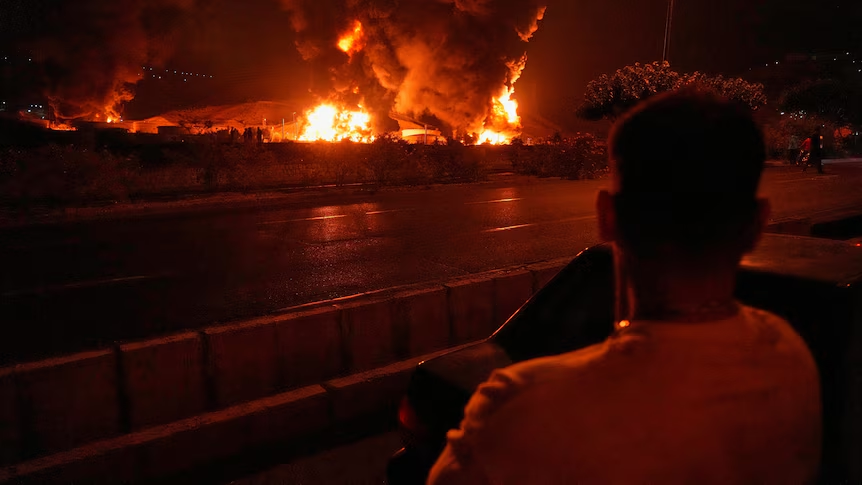
Following Israel’s recent strike on Iran, three critical questions remain.
First — and with two parts: Will Iran now ramp up its nuclear weapons program in response, and can Israel prevent it?
Second, could Iran move to block the Strait of Hormuz, a key global shipping route that handles roughly a quarter of the world’s oil and a third of its liquefied gas?
Third, might Israel target Iran’s oil infrastructure on Kharg Island?
The likely answers to the first are yes and no. If either of the latter two questions is answered yes, the consequences for the global economy would be severe.
What Triggered the Attack?
Israel’s airstrikes were widely expected once the International Atomic Energy Agency (IAEA) reported on May 31 that Iran had stockpiled over 400kg of uranium enriched to 60%. Although the report was embargoed until June 11, Israeli intelligence was likely already aware of it.
The escalation was also a consequence of Donald Trump’s 2018 decision to pull out of the Iran nuclear deal (JCPOA) signed under Obama and reimpose sanctions — a move that prompted Iran to resume its nuclear activities.
While the JCPOA was flawed and temporary, it had effectively slowed Iran’s uranium enrichment. By 2019, however, Iran’s nuclear ambitions were back in full swing. According to the IAEA, Iran’s 60% enriched uranium stockpile tripled over nine months — rising from 132.1kg in August to 432.3kg by May 2025.
There is no peaceful use for uranium enriched to 60% — it is a clear stepping stone to the 90% required for a nuclear weapon.
The Immediate Aftermath
Iran reacted to the IAEA’s findings with defiance, announcing a new enrichment facility in a “highly secure” location. The following day, Israel launched its attack, hitting military and nuclear-linked targets.
Some believe Prime Minister Benjamin Netanyahu used the strike not only to delay Iran’s nuclear efforts but also to derail upcoming talks between Iran and the U.S., and to shift global attention away from Gaza, where Israel is facing increasing allegations of war crimes and genocide.
Following the attack, oil prices spiked over 7%, and any hope of oil staying below $60 per barrel in 2025 now looks unlikely.
A High-Stakes Escalation
Unlike earlier incidents between Israel and Iran, this attack marks a major shift. It was not a tit-for-tat strike but a bold, unilateral move, conducted without U.S. support. As Secretary of State Marco Rubio emphasized, the U.S. was not involved.
Iran now finds itself isolated. With many of its top commanders and scientists dead, and key air defences previously degraded, the regime’s vulnerabilities are growing. However, any misstep — like attacking global oil routes — could backfire badly.
A conventional war between Israel and Iran is improbable. Neither side is capable of launching a full-scale invasion. Instead, the conflict is likely to remain confined to missile attacks, drone strikes, and assassinations — all aimed at slowing Iran’s nuclear ambitions.
But if Iran retaliates by closing the Strait of Hormuz or targeting Saudi oil facilities, U.S. bases, or desalination plants, the global economic fallout would be devastating.
A Precarious Global Moment
The attack resembles Israel’s 1981 airstrike on Iraq’s Osirak reactor in terms of ambition, but Iran’s nuclear sites are far more fortified, often buried deep underground.
While Israel may have temporarily set back Iran’s nuclear development, true success — stopping Iran entirely — seems unlikely without regime change.
Trump, meanwhile, has downplayed the risks, calling the strike a potential turning point. “Iran won’t have a nuclear weapon — that’s a win for humanity,” he told The Wall Street Journal.
That may prove true in time. But in the short term, Iran’s limited options and the threat of escalation put the global economy in an extremely fragile position.
