


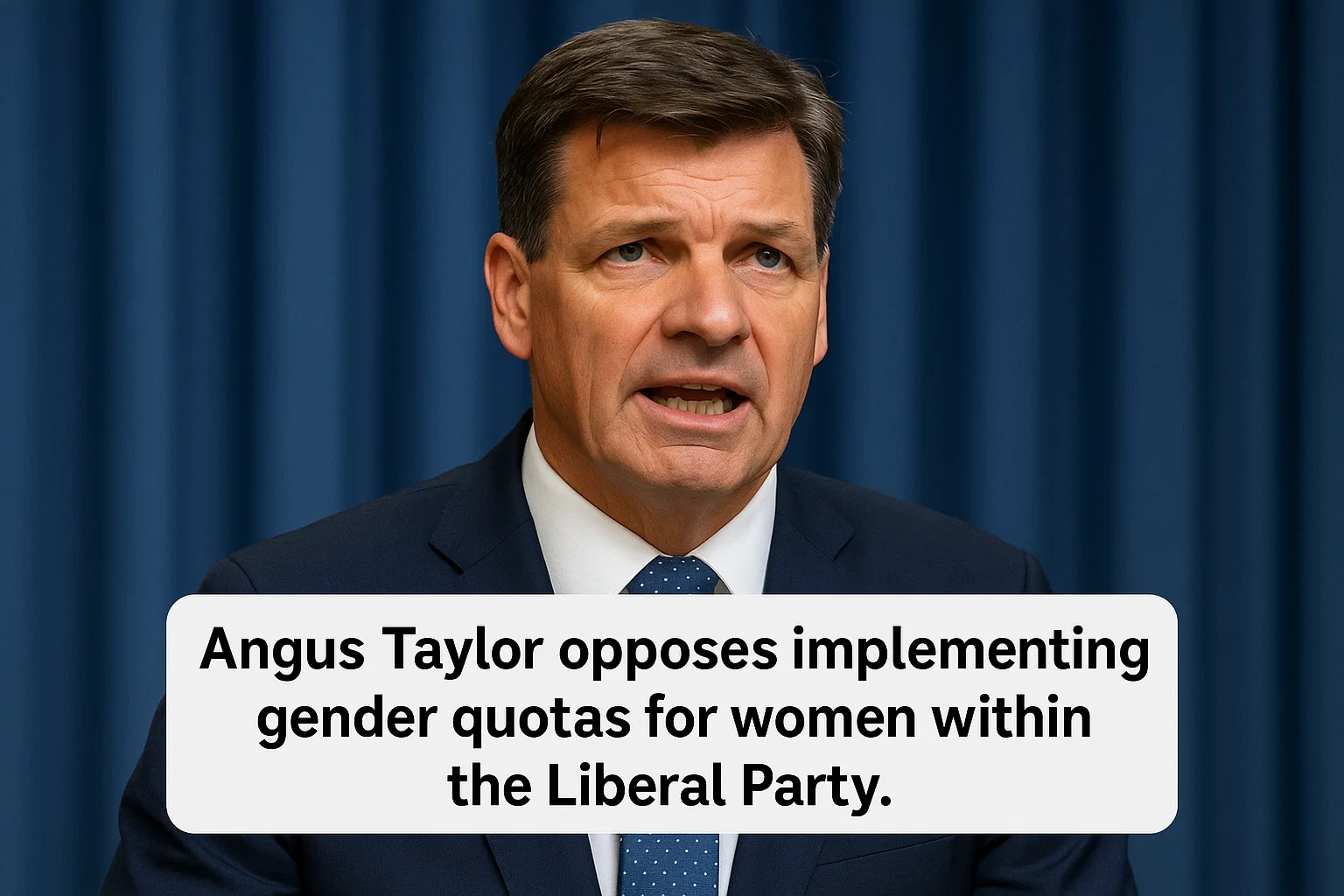
Angus Taylor, the leadership rival to Sussan Ley, says the Liberal Party must take strong action to involve more women but remains firmly against introducing gender quotas.
Debate continues within the party, as moderates and conservatives remain divided over whether mandatory quotas are necessary to increase female representation, especially following a poor election performance that left only six women among the 28 Liberal MPs in the House of Representatives. Ms Ley has pledged to push for greater female participation but remains undecided on enforcing quotas.
Taylor, a leading figure in the conservative wing of the NSW Liberal branch, argued that quotas undermine internal party democracy. “I believe there are more effective ways to achieve this. Mentoring, recruitment, and support are key to ensuring talented people rise,” he told ABC Radio National.
He stressed the importance of increasing women’s involvement across all levels of the party — from local branches to executive positions and parliament — but reaffirmed, “I have never been a supporter of quotas.”
Conservatives vs. Moderates
Taylor’s stance reflects a broader conservative concern that quotas could be used by moderates to gain an advantage in preselection battles, where they often face numerical disadvantages.
Former Prime Minister Tony Abbott echoed this sentiment, calling quotas “fundamentally illiberal” and incompatible with the party’s merit-based principles.
While some moderate women successfully secured preselection ahead of the last election — such as Gisele Kapterian, who defeated conservative Warren Mundine — moderates argue that structural issues still disadvantage female candidates. Former moderate leader Simon Birmingham has openly called for “hard, fast and ambitious” quotas, citing a shrinking and ideologically narrow membership base as a key barrier to women’s representation.
Though Birmingham acknowledged quotas may conflict with liberal principles, he questioned what other options would effectively deliver real change.
Conservatives, however, criticized Ley’s frontbench reshuffle for excluding women from the party’s right, noting that Sarah Henderson and Claire Chandler were dropped, and Jacinta Nampijinpa Price was demoted. Jane Hume — a moderate but an ally of Taylor — was also left out. All four are senators, where the party has nearly achieved gender balance.
State-by-State Gender Imbalance
Sussan Ley reiterated that under the party’s federated structure, decisions on quotas rest with state divisions.
“There’s no top-down directive… If a state chooses to adopt quotas, that’s acceptable. If not, that’s also acceptable. But what isn’t acceptable is having too few women,” she told the ABC.
The issue will be reviewed by Senator James McGrath, who is leading an internal review into the party’s future. McGrath, who is not aligned with either faction, represents Queensland — the state with the poorest gender balance in the federal Liberal team, with just one woman among 12 MPs.
Western Australia also trails, with two women and six men. In contrast, states like New South Wales, Victoria, South Australia, and Tasmania each have at least 40% female representation, a figure that would have been higher had the party not lost several competitive races at the last election. Female MPs such as Jenny Ware and Bridget Archer lost their seats, along with candidates Gisele Kapterian, Amelia Hamer, and Katie Allen.
