


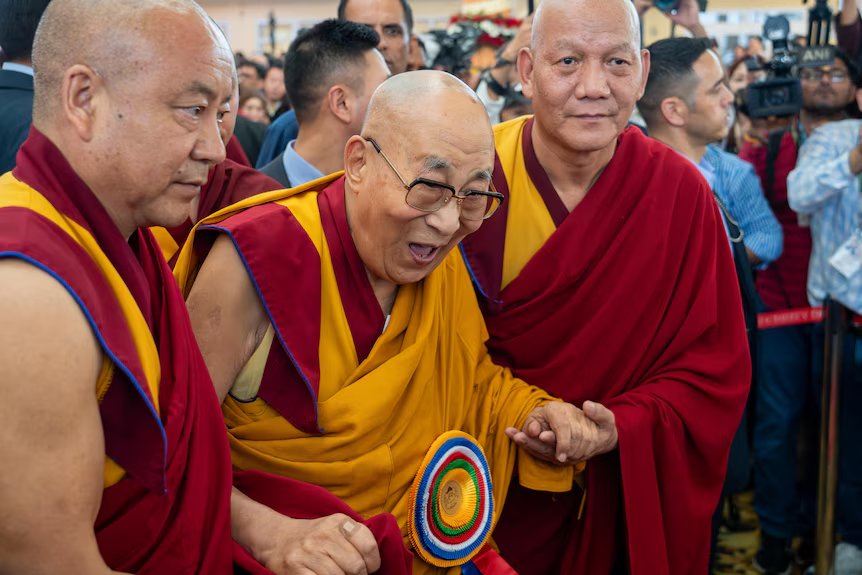
To many observers, the Dalai Lama’s confirmation that he will have a successor might have seemed like a routine declaration — as the 14th Dalai Lama, naturally a 15th would follow.
However, this perception overlooks the deeper meaning and importance of his announcement.
The Dalai Lama’s message offered reassurance to millions of his followers and simultaneously sent a clear signal to Beijing, which is widely expected to attempt to influence the succession process.
He also made it clear to the international community that Tibet’s fight for cultural and spiritual identity is far from over.
A spiritual leader and a political symbol
Tenzin Gyatso, the current Dalai Lama, is a symbol deeply intertwined with Tibet’s cultural identity and its decades-long pursuit of autonomy under Chinese control.
After fleeing Tibet in 1959, he established a government-in-exile in Dharamshala, northern India, where he has led both spiritually and politically, uniting the Tibetan diaspora and drawing global attention to their cause.
Beijing continues to denounce him as a separatist, labeling him a “wolf in monk’s robes.”
Previously, he had suggested he would reassess whether the Dalai Lama institution should continue once he turned 90, in consultation with senior monks and the Tibetan people.
This week, during a birthday celebration based on the Tibetan calendar, he confirmed the path forward.
“I am confirming that the Dalai Lama lineage will continue,” he said.
He emphasized that the Chinese government would have no role in selecting his reincarnation.
Importantly, he declared that only his foundation — the Gaden Phodrang Trust — holds the authority to identify his successor, and that he would provide detailed guidance for the process in due course.
Followers reacted with both joy and relief.
A lingering question for Tibetan Buddhists
Tibetan Buddhists have long asked the Dalai Lama to clarify his succession plans. Their concern has been twofold: that the lineage might end with him, or that China might appoint its own successor to weaken the Tibetan movement.
Such fears are grounded in past events.
In 1995, after the death of the 10th Panchen Lama, Beijing rejected the Dalai Lama’s chosen Panchen Lama — a six-year-old boy — and installed its own. The original child selected by the Dalai Lama has never been seen publicly since.
Traditionally, the Dalai Lama and Panchen Lama each play a role in recognizing one another’s reincarnations.
This week, the Dalai Lama moved decisively to prevent China from controlling the next stage of his lineage.
Shortly after his statement, a spokesperson for China’s Foreign Ministry reiterated Beijing’s stance: any reincarnation must be approved by Chinese authorities.
This raises the possibility of two rival Dalai Lamas — one accepted by Tibetans and much of the global Buddhist community, and one backed by the Chinese state.
The Dalai Lama foresaw such a scenario years ago.
In 2011, he argued, “It is particularly inappropriate for Chinese communists, who explicitly reject even the idea of past and future lives, to interfere with the system of reincarnation. Such blatant interference exposes their ideological contradictions and double standards.”
At this week’s religious gathering in Dharamshala, senior Tibetan Buddhist figures publicly thanked the Dalai Lama and condemned China’s actions as political manipulation.
“We strongly oppose the Chinese government’s use of reincarnation for political gain and will never accept it,” they declared.
Tibet’s identity remains contested
Since annexing Tibet in 1951, China has been accused of ramping up efforts to turn Tibetan Buddhism into a state-controlled religion.
According to a U.S. State Department report, the Communist Party has enforced surveillance within monasteries, subjected monks to “patriotic” education programs, and installed state-approved religious leaders — echoing strategies also reported in Xinjiang against Uyghurs.
Despite these pressures, Tibetan Buddhists have been celebrating the Dalai Lama’s birthday this week and praying for his continued health.
His recent declaration serves as a powerful reaffirmation of Tibet’s cultural resilience and his determination to protect the spiritual leadership beyond his lifetime.
At age 90, the Dalai Lama’s global influence remains strong — and his latest message is a reminder, to both his supporters and Beijing, that Tibet’s struggle for identity continues.
