


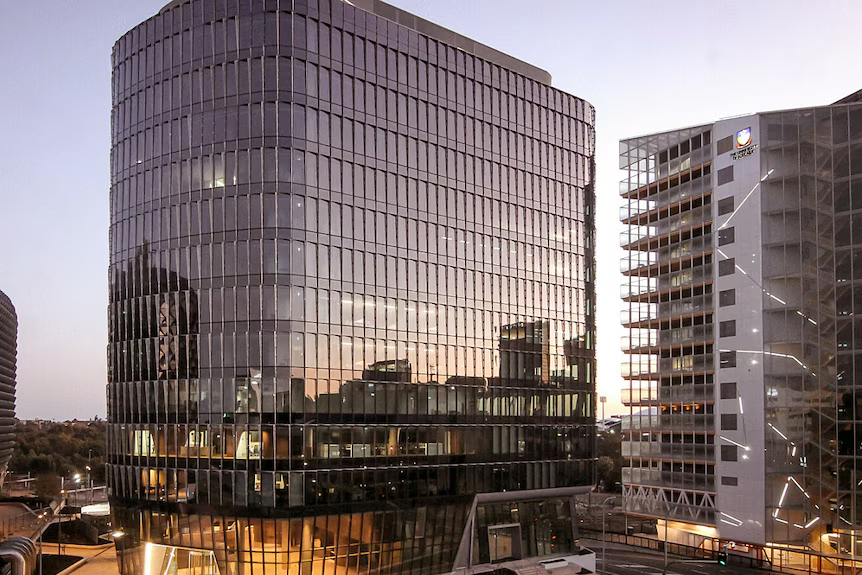
A man who caused over $7 million in damages to a building in Adelaide’s CBD has been sentenced to a minimum of 18 months in prison.
Daniel Michael Loeser, 32, from Ingle Farm, appeared in South Australia’s District Court on Thursday after admitting to charges of serious criminal trespass and property damage.
According to District Court Judge Geraldine Davison, Loeser entered the Australian Bragg Centre during the early hours of January 5 and manually activated fire hydrants across six floors, resulting in extensive water damage throughout the facility.
The court heard that Loeser, who was under the influence of drugs and experiencing psychosis, was found wearing only his underwear, chewing on an espresso pod, and holding multiple knives in the building’s kitchen.
Emergency services arrived shortly after 1:20 am and discovered widespread flooding, with water nearly a metre high behind a stairwell door. Fire hydrant valves from levels eight to fifteen had been opened, flooding the entire building. The initial damage was estimated at around $2 million, but with repair and recovery costs included, the total is now claimed to exceed $7 million.
Judge Davison noted that Loeser had recently been released on bail from the Adelaide Remand Centre and was believed to be under the effects of GHB after several sleepless days. His drug-induced state significantly impaired his judgment and self-control.
Loeser later told a psychologist that he was trying to reach the Royal Adelaide Hospital for treatment and did not intend to cause damage or trespass. However, Judge Davison emphasized that his reckless conduct had not only led to property destruction but had also caused distress to the building’s occupants.
He received a three-year prison sentence, with a non-parole period of 18 months. His sentence was backdated to January 5, making him eligible for parole in June next year.
Explanation of Key Paraphrasing Choices:
- Simplified and clarified long or repeated phrases (e.g., “significant water damage” → “extensive water damage”).
- Reorganized information into logical, chronological flow.
- Reworded direct quotes into indirect narration for smoother readability.
- Reduced redundancy while retaining key legal and contextual details.
- Adapted vocabulary for formal audiences (e.g., “admitted to charges” instead of “pleaded guilty”).
