


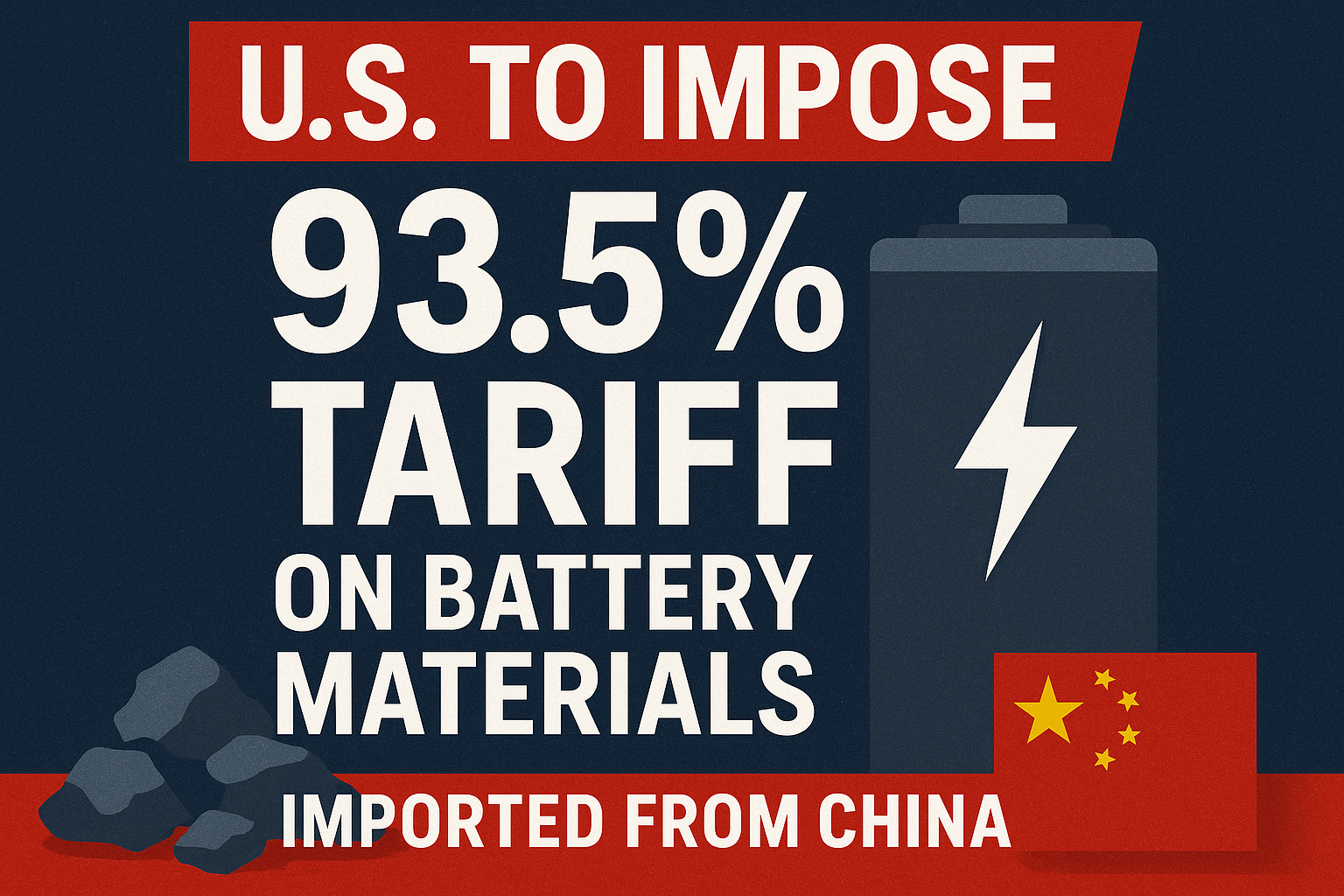
The U.S. Department of Commerce has imposed preliminary anti-dumping tariffs of 93.5% on Chinese graphite imports, a crucial material used in battery production, after determining that the imports were unfairly subsidized.
In December, a U.S. graphite industry trade group submitted petitions to two federal agencies, requesting investigations into alleged violations of anti-dumping regulations by Chinese firms. The new tariff will be added to existing import taxes, raising the total effective duty to 160%, according to the American Active Anode Material Producers—the organization behind the complaint.
This decision is likely to escalate tensions within the global electric vehicle (EV) supply chain, which is already affected by China’s export restrictions on key minerals and battery technologies. Following the announcement, battery supplier stocks fell while shares in North American graphite producers surged.
“The Commerce Department’s findings confirm that China has been selling Active Anode Material (AAM) in the U.S. at unfairly low prices,” said Erik Olson, spokesperson for the anode producers’ association.
Sam Adham, head of battery materials at consultancy CRU Group, noted that the tariffs would significantly impact battery manufacturers. He explained that a 160% duty would raise EV battery cell costs by roughly $7 per kilowatt-hour—equivalent to about 20% of the tax credits introduced under the Inflation Reduction Act, which remained intact under President Donald Trump’s budget.
“This level of added cost could eliminate profits for one or two full quarters for South Korean battery producers,” Adham added.
Tesla and its major battery partner, Japan’s Panasonic, have opposed the tariffs, citing an overreliance on Chinese graphite due to insufficient domestic supply and unmet quality and volume requirements. Tesla’s shares declined by up to 0.7% on Thursday.
Graphite, essential for battery anodes, saw U.S. imports totaling around 180,000 tonnes last year—about two-thirds of which originated from China, BloombergNEF reported.
China maintains a dominant position in graphite processing. A May report by the International Energy Agency (IEA) identified graphite as one of the most vulnerable materials to supply disruptions and stressed the urgent need for diversification.
The IEA also projected that graphite will continue to be the leading anode material in lithium-ion batteries through the medium term, with silicon only beginning to gain market share around 2030.
The Commerce Department issued its preliminary findings on Thursday, confirming the tariff decision, with a final ruling expected by December 5.
Jon Jacobs, Chief Commercial Officer at Westwater Resources—a company developing a graphite facility in Alabama—said the decision provides much-needed policy clarity to spur domestic graphite production. Westwater, which has partnerships with Stellantis NV and SK On, expects to launch with 12,500 tonnes of annual production next year, aiming to expand to 50,000 tonnes by 2028.
Following the announcement, Westwater’s stock jumped 15%. Canadian graphite companies Nouveau Monde Graphite and Northern Graphite also saw significant gains.
According to Roth Capital Partners analysts, the new duties could alter the cost dynamics for battery manufacturers like Fluence Energy and Enphase Energy. Shares in both companies dipped slightly—Fluence by 0.4% and Enphase by 0.7%.
These additional import duties will further challenge the renewable energy sector. Although energy storage retained key tax credits in President Trump’s budget, Treasury Department rules that restrict the use of Chinese components make regulatory compliance more difficult. Industry analysts at Wood Mackenzie caution that rising costs and supply chain concerns may slow down the deployment of energy storage systems on the U.S. power grid.
