


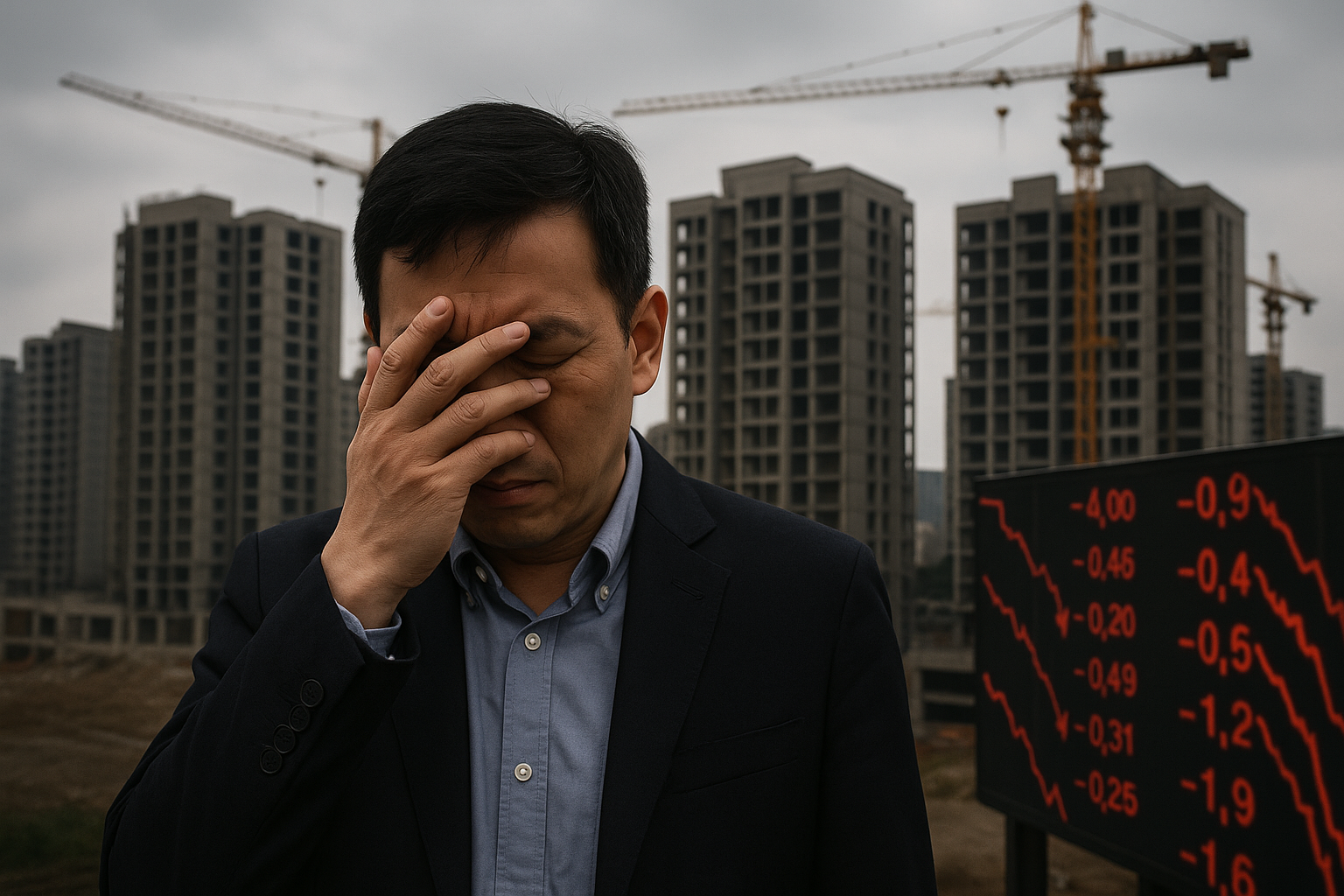
Investor confidence in a potential rebound for Chinese property stocks this year is fading, as Beijing’s cautious stance on stimulus continues to fuel concerns about the sector’s outlook.
A key index tracking property developers posted its steepest weekly decline in four months after a high-level government meeting on Tuesday failed to deliver concrete policy support for the struggling real estate market.
According to Morgan Stanley, property sales are expected to remain subdued in the third quarter. The release of stronger-than-expected economic data has further reduced the likelihood of near-term stimulus measures.
China’s real estate sector has been in a prolonged downturn for four years, with little evidence of recovery. Home prices fell at a faster pace in June, and major developers reported disappointing earnings for the first half of the year.
Hopes for a sector revival now rest largely on government intervention. Speculation about a potential aid package earlier in July briefly lifted developer shares, triggering their largest single-day gain in five months.
“I haven’t touched property stocks since 2014 because housing demand had already been met,” said Sun Jianbo, president of China Vision Capital. “Policy support may cushion the slump, but it won’t reverse it.”
The Bloomberg Intelligence real estate index is down nearly 9% this year, significantly underperforming the 23% rise in the Hang Seng China Enterprises Index.
On July 10, the property gauge surged 8.5%—its best one-day performance since February—on optimism ahead of the Central Urban Work Conference. However, President Xi Jinping stopped short of announcing major stimulus, instead promoting gradual urban development and infrastructure upgrades.
“Modest policy measures aren’t enough,” said Shujin Chen, head of China property research at Jefferies Hong Kong. “Speculation may trigger short-lived rallies, but these tend to be noise rather than trend reversals.”
With optimism waning, many market participants are reducing their exposure to the property sector. Of the 20 brokerages that once tracked China Vanke—one of the country’s largest developers—six have ceased publishing updates, Bloomberg data shows. The firm recently warned it may report a US$1.67 billion loss for the first half of 2025.
Other major developers are also facing financial strain. Poly Developments reported a 63% plunge in preliminary net profit, while Greenland Holdings announced a projected net loss of 3 to 3.5 billion yuan (S$536.8 million). Analyst coverage of these firms has dwindled, with Greenland now lacking any formal coverage.
To address liquidity pressures, developers are pursuing asset sales, debt restructuring, and loan extensions. Regulators have instructed state-owned developers to avoid defaults on public debt, yet market sentiment remains bleak.
“The sector no longer holds the same weight in China’s economy as it did a decade ago,” said Kenny Wen, head of investment strategy at KGI Asia. “Fundamentally, it’s not a space worth holding.”
Still, some strategists see selective opportunities. JPMorgan Chase has labeled the sector a tactical buy in anticipation of future policy easing. Its top picks include China Resources Land, China Resources Mixc Lifestyle Services, and China Overseas Property Holdings—all of which have gained at least 8% in 2025.
Morgan Stanley urges a defensive approach, favoring state-backed companies with strong visibility. Analysts Stephen Cheung and Cara Zhu recommend high-dividend names like C&D International Investment Group and Greentown Management Holdings. While C&D shares are up 26% this year, Greentown has declined 13%.
With little hope for a widespread property recovery, investors are reallocating capital to sectors with stronger growth prospects and more favorable policy tailwinds.
Yang Junxuan, fund manager at Shanghai Junniu Private Fund Management, explained: “The property market is heavily dependent on broader economic conditions, which remain weak. We now prefer sectors like defense and artificial intelligence over real estate.”
