
In the wake of the catastrophic air force jet crash into a school, Dhaka’s hospitals became ground zero for a tragedy that rocked the city. The National Institute of Burn and Plastic Surgery transformed into a place of despair as wave after wave of critically injured patients—most of them children—arrived in urgent need of care.
For many, the journey from the disaster site in Uttara to the premier burn facility in Chankharpool spanned 20 kilometres—a grim and painful ride. Around 70 patients were brought to the institute, many with life-threatening burns. By the afternoon, it had become the focal point of the emergency, receiving the most severe cases from smaller, overwhelmed medical centres in the city’s north.
According to the health ministry, at least 88 burn victims were receiving treatment at seven hospitals across Dhaka, with 25 listed in critical condition.
The crash struck in the heart of Uttara’s densely populated neighborhood, as the aircraft plunged into a two-storey building of Milestone School and College shortly after noon. As the chaos unfolded, parents and guardians—many already on-site to pick up their children—rushed into the wreckage. With no time to wait for rescuers, they carried the injured out with their own hands, desperate to save lives.
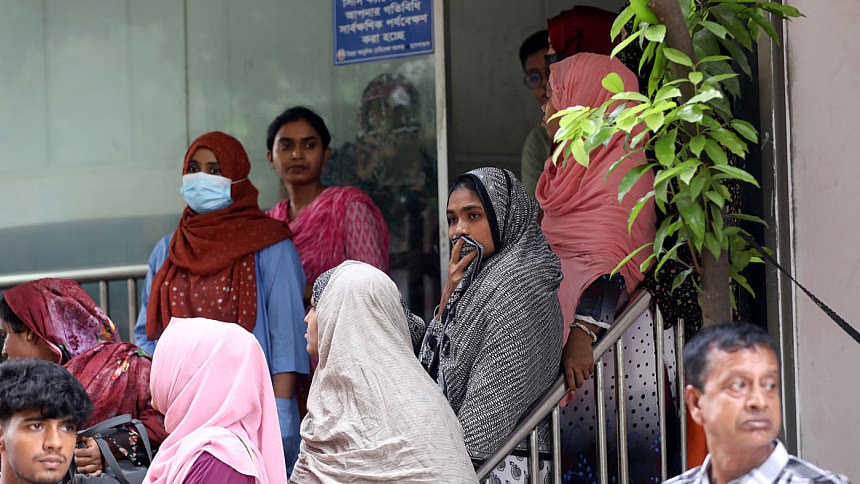
Outside the burn institute, the situation teetered on the edge of disorder. Volunteers struggled to keep paths clear for incoming ambulances and private vehicles. Many victims arrived already wrapped in bandages—evidence of rushed first aid at nearby clinics. Personnel from the Rapid Action Battalion and Ansar were deployed to control the crowd and keep access routes open.
Inside, hospital staff raced through triage. Frantic families flooded the desks with questions while medical teams scrambled to log names, stabilize patients, and coordinate emergency surgeries. The air was thick with tension and the sound of moaning and cries.
Among the injured was nine-year-old Nusrat, her arm heavily bandaged. Her uncle, who had been on his way to pick her up, witnessed the crash and pulled her from the debris with his bare hands. Her mother reported she had suffered burns to 25 percent of her body.
Soon after, a distressed man approached, frantically searching for his friend’s daughter, Nahia Ashraf. He said Nahia’s brother had already been admitted to the ICU with 95 percent burns. A sheet taped to the wall on the fourth floor displayed stark numbers beside patients’ names—40 percent, 80 percent, and in some cases, 100 percent burn coverage.
Outside that ward, more than a hundred relatives gathered. Some sat on the floor in silence, while others cried in each other’s arms. The atmosphere was thick with dread and heartbreak.
In another corridor, a young girl in her school uniform explained that both she and her twin brother had been at school. She had left early, around 12:40pm—just 30 minutes before the school was set to close. Her brother remained and was now among the injured.
Elsewhere, Akhlima Parvin stood in tears. Her son, fifth-grader Tawfiq Hossain, had just been admitted. “He had breakfast with me this morning. I made his favorite meal. He was supposed to return for lunch,” she said.
“When I heard the explosion, I ran to the school. I found him wounded. He wrapped his arms around me and begged, ‘Save me,’” she recalled.
Nearby, another mother clung to a family member as she sobbed. She had seen the plane crash into the school. Her daughter, also present during the disaster, was later rescued and hospitalized in stable condition.
On the sixth floor, crowds pressed against treatment room doors. Hospital workers tried to keep them out, warning of infection risks. “You could bring in germs,” one staff member cautioned as they attempted to manage the growing number of concerned visitors.
Outside, the chaos continued. Political figures, advisers, and delegations from professional groups arrived—often with entourages that further disrupted emergency operations.
As evening fell, people lined the streets near the hospital holding handwritten signs pleading for blood donations, especially of rare types. One sign simply read, “O Negative Needed Urgently.”
Finance Adviser Salehuddin Ahmed addressed the media at the institute: “Our top priority right now is to provide the best possible treatment to the victims. Additional support will be considered as needed.”
The National Institute of Burn and Plastic Surgery, inaugurated in October 2018, is the largest facility of its kind globally. Equipped with 500 beds, 50 ICU units, and 12 advanced operating rooms across 12 floors, it was built to handle large-scale medical emergencies.
Today, that mission is being put to the ultimate test.
