


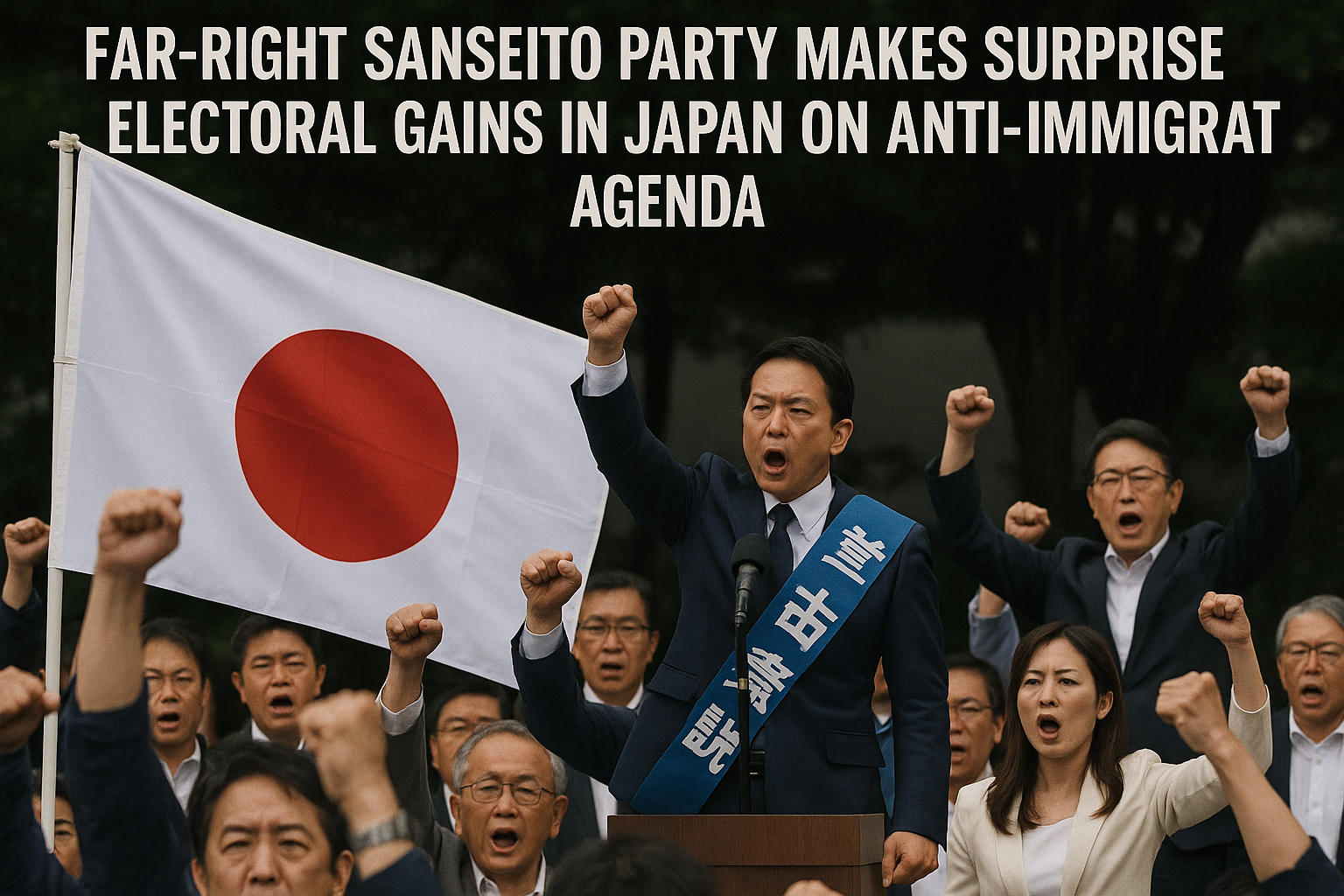
Japan Confronts Rising Anti-Foreigner Sentiment as Far-Right Sanseito Gains Ground
Japan’s Prime Minister Shigeru Ishiba has launched a new cabinet office aimed at promoting “harmonious coexistence” with foreign nationals, following a surprising surge by the far-right Sanseito party, which won 14 seats in the upper house election on July 20. This result made Sanseito the fourth-largest opposition party, catching the long-ruling Liberal Democratic Party (LDP) off guard.
🇯🇵 Sanseito’s Nationalist Surge
Sanseito ran on a fiercely anti-immigration platform, proposing measures like:
- “Loyalty checks” for foreigners
- Exclusion from social welfare
- Tightened employment restrictions
Party leader Sohei Kamiya claims foreign influence and globalism threaten Japan’s sovereignty, warning of the country becoming a “colony” if action isn’t taken. The party’s rise reflects growing economic anxiety, over-tourism, and discontent with rising living costs.
🛑 Public Concerns & Economic Tensions
Japan’s inflation, stagnant wages, and a record 36.9 million tourists in 2024 have fueled perceptions of overcrowding and price inflation. Locals have voiced frustration about crowded public services, soaring real estate prices, and competition for resources. Sanseito has capitalized on these concerns, pushing a “Japanese First” agenda.
Although foreign residents comprise just under 3% of Japan’s population (~3.8 million), fears about cultural erosion and economic displacement have gained traction. Surveys show 20–40% of new central Tokyo apartments are being purchased by foreigners, adding to resentment.
🧭 Government Response
In response to the backlash, PM Ishiba acknowledged the need for more foreign workers amid a demographic crisis but stressed that rising anxiety over foreign behavior must be addressed. Some regions have implemented differential pricing for tourists and are exploring tourist caps.
📌 Broader Implications
Experts warn that Sanseito’s success reflects a deeper shift toward economic populism and cultural nationalism, similar to movements seen in the U.S. and Europe. The LDP has quickly reacted, but whether its new office will make meaningful policy changes remains unclear.
While urban centers like Kyoto and Tokyo are under pressure, many regions still welcome foreign investment and tourism. The challenge now lies in balancing integration with economic necessity, amid a political environment rapidly shifting toward protectionism.
