


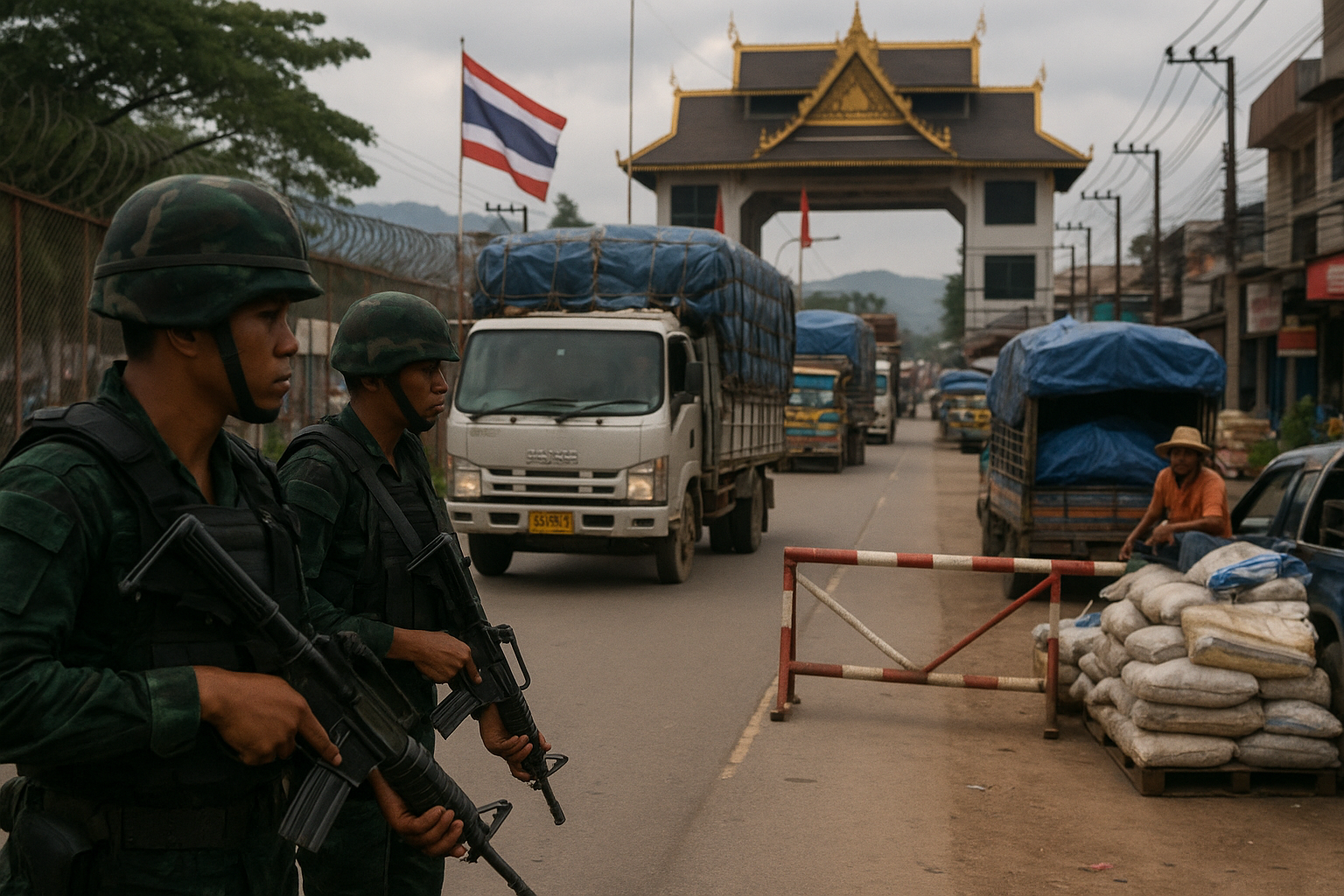
Thailand’s economic challenges have deepened, as a violent border clash with Cambodia has added geopolitical tension to ongoing trade uncertainty with the United States. The country is now racing to prevent severe new tariffs that threaten to destabilize its already fragile economy.
On July 24, fighting erupted along the Thai-Cambodian border, resulting in at least 32 deaths and displacing over 200,000 people. The unrest has come at a critical moment, as Thailand struggles to finalize a trade deal with the U.S., while regional neighbors such as Indonesia, Vietnam, and the Philippines have already secured agreements capping U.S. tariffs at 19–20%.
Without a deal, Thailand and Cambodia could face 36% tariffs on exports to the U.S. beginning August 1—an exceptionally high rate that would significantly impact Thailand’s export-driven economy.
U.S. President Donald Trump announced a ceasefire agreement after talks with Cambodian Prime Minister Hun Manet and Thailand’s acting Prime Minister Phumtham Wechayachai, stating on Truth Social that the U.S. will delay trade talks until the fighting ceases. Both sides have agreed to Malaysian mediation, with negotiations expected to begin Monday.
Economic Outlook Grows Bleaker
Thailand’s GDP growth forecast had already been trimmed to below 2% in a scenario of moderate tariffs. That figure could drop under 1% if the full 36% duties take effect. Exports, worth around US$300 billion annually, remain the economy’s backbone, with the U.S. accounting for 18%—one of the highest ratios in ASEAN.
Exports surged 15% in the first half of 2025, with June shipments to the U.S. up nearly 42%, reflecting preemptive orders amid looming tariff hikes. But the positive momentum may be short-lived.
The tourism sector, Thailand’s second economic pillar, is also faltering. Visitor numbers fell sharply in the second quarter, led by a 40% drop in arrivals from China due to safety concerns. Overall, tourist numbers are projected at 32–33 million for 2025, down from 35 million last year.
Domestic Weakness and Competitiveness
Thailand faces internal constraints as well. Consumer spending is sluggish due to high household debt—nearly 88% of GDP—limiting the potential for domestic-led recovery. Kim Eng Tan of S&P Global noted that without competitive exports and with limited domestic spending capacity, Thailand’s growth prospects remain constrained.
While the country exports a diverse range of products—from cars and electronics to food and agriculture—it lags in high-value electronics, an area where regional rivals are advancing.
“The impact of U.S. tariffs will hinge on how they compare to rates imposed on competitors,” said Louis Kuijs of S&P. With several ASEAN countries competing in the U.S. market, Thailand’s position is increasingly precarious.
China also remains a formidable rival. Researcher Kirida Bhaopichitr pointed out that in 18 of Thailand’s top 20 exports to the U.S., China is its main competitor. The U.S. is expected to finalize its new tariff rates on China by August 11, which could further reshape Thailand’s competitive standing.
Political Instability Complicates Recovery
Thailand’s internal political turmoil has made matters worse. Prime Minister Paetongtarn Shinawatra was suspended by the Constitutional Court on July 1 after a leaked conversation with former Cambodian leader Hun Sen, in which she criticized a Thai border commander and referred to Hun Sen as “uncle.”
Her family ties to former Prime Minister Thaksin Shinawatra, a polarizing figure with a history of close ties to Hun Sen, have further inflamed the domestic political landscape.
Thailand has experienced prolonged political instability, with frequent power struggles between establishment forces and populist leaders. S&P’s Tan noted that while Thailand’s macroeconomic fundamentals remain relatively stable, the political disarray adds a layer of uncertainty.
“Thailand needs a stable government with a long-term policy vision to address these mounting challenges,” he said. “But right now, that’s not what we’re seeing.”
