


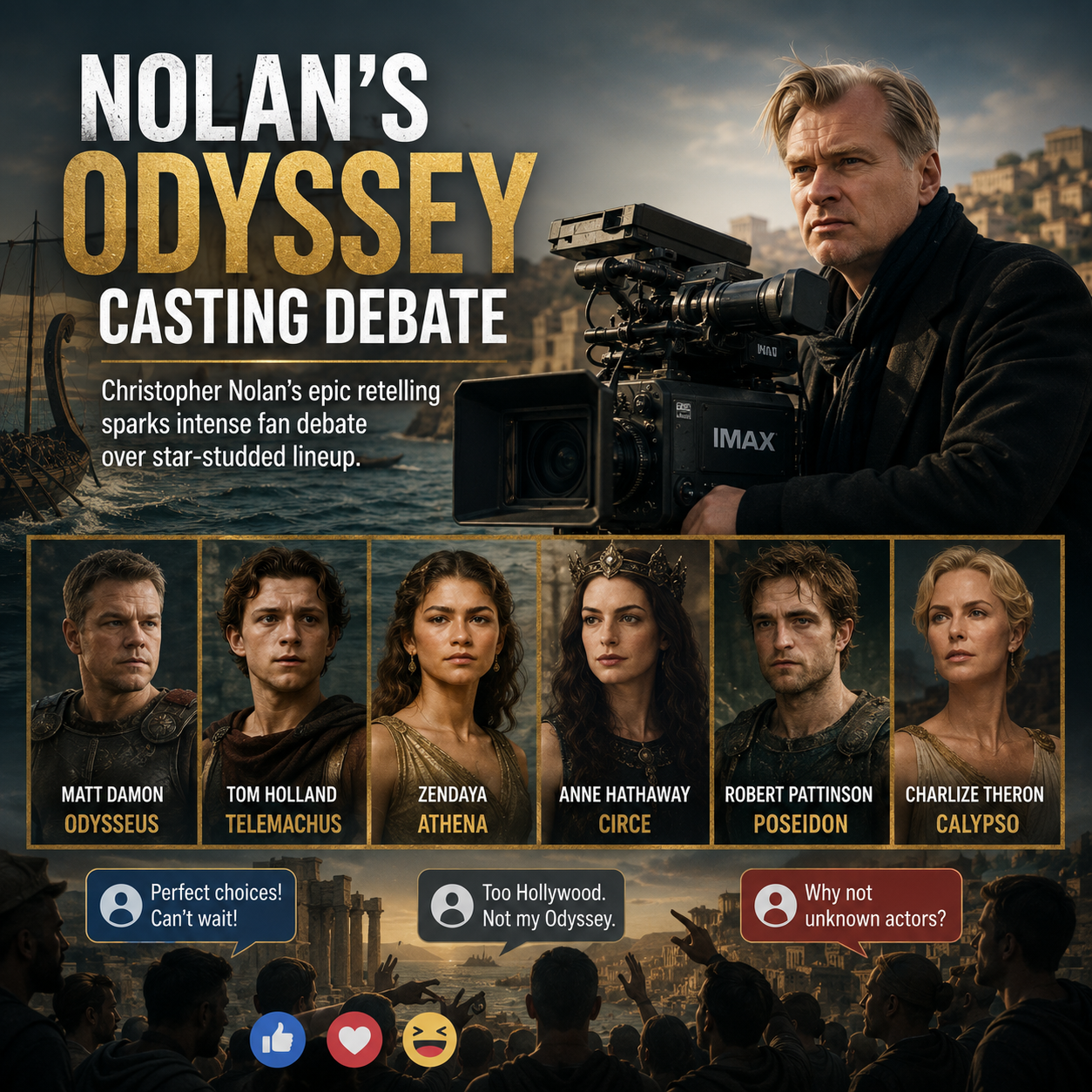
Christopher Nolan’s highly anticipated adaptation of The Odyssey has become the centre of an online dispute over casting, costumes and historical accuracy, with experts arguing that many of the criticisms misunderstand the mythical nature of Homer’s ancient epic.
Much of the controversy has focused on Oscar-winning actor Lupita Nyong’o, who plays Helen of Troy. Elon Musk repeatedly criticised Nolan’s casting decision on X, accusing the filmmaker of compromising the story and responding to pressure for greater diversity in Hollywood.
Other online commentators have attacked elements shown in the film’s promotional material, including its armour, ships, modern dialogue and American accents. Some argued that the vessels looked more like Viking longships than ships associated with the ancient Greek world.
However, classical scholars say demands for strict historical accuracy are difficult to apply to The Odyssey, which is rooted in mythology rather than documented history.
The epic is traditionally attributed to Homer and is believed to have circulated during the eighth or seventh century BC. It follows the Greek king Odysseus as he attempts to return to Ithaca after the Trojan War.
His journey involves gods, monsters and supernatural dangers, including the Cyclops, the Sirens, magical fruit and the anger of Poseidon, god of the sea. These fantastical elements make the work fundamentally different from a historical account.
Christopher Mackie, emeritus professor of classics and ancient history at La Trobe University, said Homer’s poems came from a pre-historical and pre-Socratic world.
He explained that history had not yet developed as a formal discipline when the poems were created. As a result, modern audiences should be cautious about claiming certainty over how every character, costume or ship should appear.
The original poem also provides limited evidence about the physical appearance of many characters. That leaves considerable room for interpretation by translators, artists, theatre directors and filmmakers.
The story begins after the Trojan War, with Odysseus struggling to return to his kingdom and reunite with his wife, Penelope, and their son, Telemachus.
While Odysseus faces danger at sea, Penelope must protect her household from 108 suitors who want her to declare her husband dead and choose a new partner.
She delays them by promising to make a decision after finishing a burial shroud, while secretly undoing her work each night. Her intelligence and deception parallel Odysseus’s own reputation as a cunning survivor and storyteller.
Nolan’s film features Matt Damon as Odysseus, Anne Hathaway as Penelope, Tom Holland as Telemachus and Zendaya as the goddess Athena. Nyong’o appears as Helen, while Elliot Page plays Sinon rather than Achilles, despite earlier online rumours about Page’s role.
The criticism surrounding Nyong’o’s casting has often centred on the argument that Helen, traditionally described as extraordinarily beautiful, should be portrayed by a white actor.
However, Helen is a mythological figure rather than a securely documented historical person. Nyong’o has rejected the need to defend her casting, saying the film tells a mythical story and that its cast represents the modern world.
She is also not the first Black performer to portray Helen. Eartha Kitt played the role in Orson Welles’s 1950 stage production Time Runs, while Galyn Görg appeared as Helen in an episode of Xena: Warrior Princess during the 1990s.
Homer’s work has been adapted and reinterpreted many times, including through silent cinema, television, theatre and films loosely inspired by its themes.
The Coen brothers’ O Brother, Where Art Thou?, for example, transferred elements of Odysseus’s journey to the American South during the Great Depression. The Simpsons has also produced its own comic adaptation.
Translations of the poem vary significantly as well. Nolan has said he was influenced by Emily Wilson’s acclaimed 2017 English translation, which used contemporary language and reconsidered interpretations shaped by centuries of male translators.
Professor Mackie said every generation of artists approaches the poem differently. He argued that audiences readily accept the original poet’s creative choices and should allow a modern director similar freedom.
The debate therefore raises a broader question about what viewers should expect from adaptations of ancient mythology.
While filmmakers may draw inspiration from archaeological research and ancient artwork, they must also create a story for contemporary audiences. Casting, language and visual design are artistic decisions rather than claims that the film is a historical documentary.
Early critical reactions to Nolan’s film have reportedly been largely positive. Some reviewers have praised its scale, atmosphere and cinematic ambition, while others have suggested parts of the story feel uneven or overly complicated.
The controversy is unlikely to disappear when the film reaches a wider audience. However, scholars maintain that arguments based solely on historical accuracy overlook the essential character of The Odyssey: a supernatural story passed down, translated and reinvented for thousands of years.
The Odyssey is scheduled to open in Australian cinemas on July 16, 2026.
