


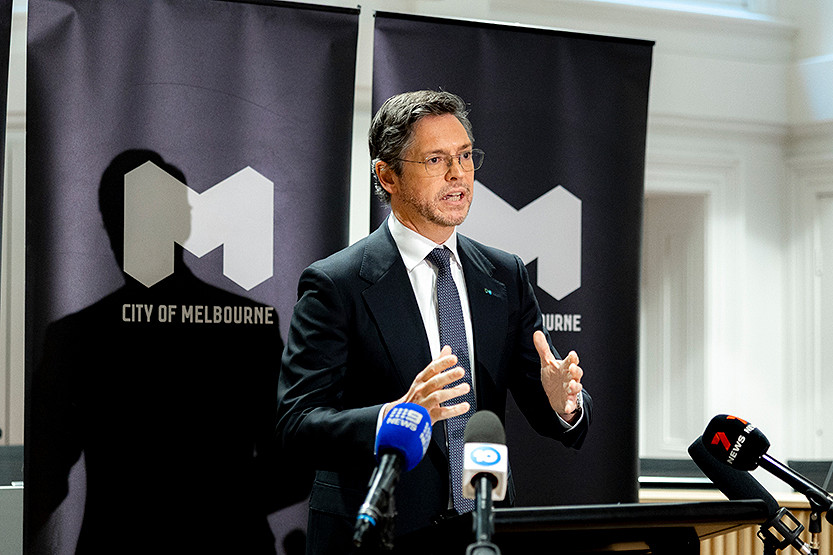
Melbourne Lord Mayor Nicholas Reece has urged the federal government to provide additional funding to help local councils strengthen security at religious and multicultural events, warning many councils do not have the financial capacity to meet growing safety demands.
Mr Reece made the call while giving evidence on Monday to the Royal Commission into Antisemitism and Social Cohesion, as its public hearings move closer to completion.
He told the inquiry that Melbourne is home to the largest Jewish community of any Australian city and said Jewish residents have played an important role in the city’s social, cultural and community life for generations.
During his evidence, Mr Reece recalled attending the scene of a synagogue firebombing last year, describing the incident as one of the most distressing situations he had witnessed.
The attack occurred during Shabbat, when families and children were gathered for dinner. Emergency services, including firefighters and Victoria Police, attended the scene while the surrounding area was treated as a crime scene.
Mr Reece said the incident was deeply confronting and represented a level of hostility that should never be considered acceptable in Melbourne or anywhere else in Australia.
He also spoke about the challenges local governments face when debates over major international conflicts spill into council chambers.
Mr Reece referred to a lengthy council debate held while he was acting mayor concerning the war in Gaza, saying councils can play a role in international engagement because of their connections with diverse communities, universities and international students.
However, he argued that highly complex geopolitical disputes are generally beyond the core responsibilities of local government.
He suggested the Department of Foreign Affairs and Trade could play a greater role in listening to community concerns about international conflicts, potentially through public consultation forums similar to community engagement initiatives previously associated with AusAID.
Mr Reece said this approach would allow councils to remain connected to their communities while ensuring foreign policy discussions are handled by agencies with greater expertise and responsibility in international affairs.
A major focus of his evidence was the rising cost of providing security at community celebrations.
Melbourne City Council hosts and supports a range of religious and cultural events, including celebrations for Hanukkah, Ramadan and Diwali.
Mr Reece said additional security measures had been introduced at some of these events because of concerns about potential antisocial behaviour or more serious incidents.
He noted that the extra security had not been required to respond to any major incident, but said the need to deploy it reflected broader concerns about deteriorating social cohesion and community tensions.
According to Mr Reece, many local councils would struggle to provide similar protection because their budgets are already under severe pressure.
He told the commission that councils are highly resource-constrained and often lack the financial capacity to fund additional security around religious and multicultural events.
He suggested the federal government consider providing dedicated funding if Australia wants communities to continue holding large public celebrations of faith, culture and multicultural identity in a safe environment.
The Lord Mayor also raised concerns about the scale of antisemitic graffiti and offensive material appearing across Melbourne.
He said synagogues had been repeatedly targeted with graffiti over the past two years, with incidents occurring at times on an almost weekly basis.
Mr Reece told the inquiry that council workers had removed more than 3,000 pieces of offensive graffiti and material, including an estimated 800 to 1,000 items considered antisemitic.
He also said close to 4,000 square metres of antisemitic graffiti, posters and stickers had been removed.
In response, the City of Melbourne has introduced a rapid-response program aimed at removing antisemitic material as quickly as possible, with a target of clearing identified material within about an hour.
The program mainly covers council-controlled public areas and does not generally extend to private property, except where standing arrangements already exist in locations such as trains and trams.
The Royal Commission, overseen by Commissioner Virginia Bell, is examining antisemitism and broader challenges to social cohesion across Australia.
Earlier in the hearings, Southbank Elsternwick Rotary president Tony Jackson spoke about growing anxiety within parts of the community.
Mr Jackson said he had heard members discussing their fears and concerns about the changing social environment and said he felt he had failed some members by not recognising sooner how deeply worried they had become.
The evidence has added to broader calls for governments at all levels to strengthen community safety measures while finding ways to protect religious freedom, multicultural events and social cohesion.
