


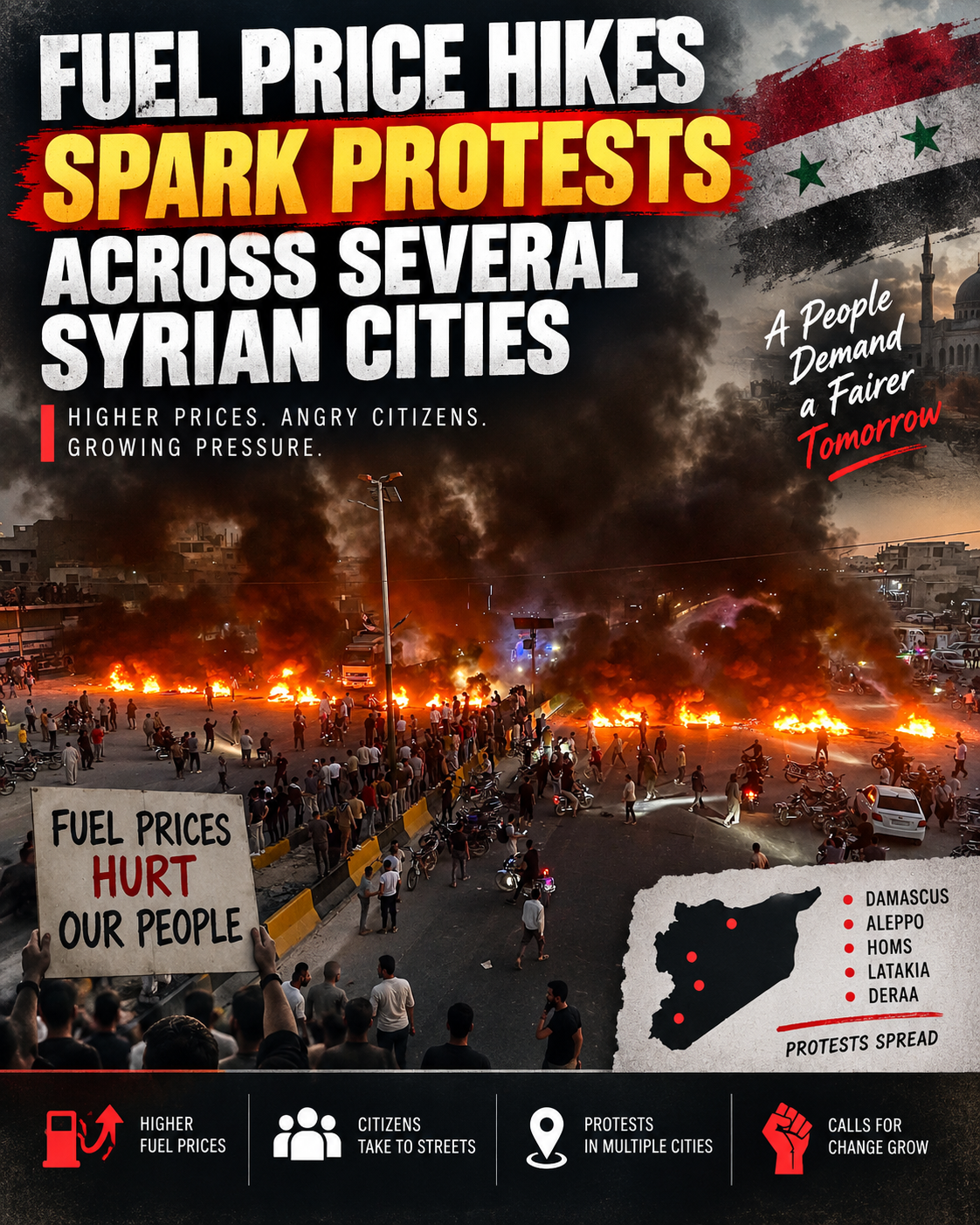
Protests have spread across several parts of Syria after the government announced sharp increases in fuel prices, prompting demonstrators to block roads and burn tyres as frustration over rising living costs intensified.
The latest increases lifted diesel prices by as much as 40 percent and petrol prices by approximately 28 percent.
Authorities described the increases as temporary, blaming a steep rise in the international cost of securing fuel as well as domestic refining challenges.
Demonstrators Block Major Highway
The fuel-price decision quickly triggered demonstrations in several Syrian cities.
Protesters blocked a major highway for several hours, disrupting traffic as people gathered to voice their opposition to the increases.
Images and video from the demonstrations showed burning tyres and groups of protesters occupying roads.
Demonstrations were reported in Hama, Khan Sheikhoun and Maarat al-Numan, while the issue also generated intense debate across social media.
Diesel Prices Rise by Up to 40 Percent
The scale of the increases has added to public concern in a country where households and businesses remain under considerable economic pressure.
Diesel prices were increased by as much as 40 percent, while petrol rose by around 28 percent.
Fuel costs affect far more than private transport. Diesel is important for commercial vehicles, generators, agriculture and other essential economic activity.
As a result, higher prices can flow through to transportation, food and other everyday expenses.
Government Blames Higher Supply Costs
Syrian authorities said the increases were necessary because of rising costs in international fuel markets and the expense of securing adequate supplies.
The government has maintained that the measures are temporary rather than a permanent pricing policy.
Officials have indicated that prices will continue to be reviewed as conditions in global energy markets change.
Baniyas Refinery Undergoing Major Upgrade
Authorities have also pointed to work at the Baniyas refinery as another factor affecting the country’s fuel situation.
The government is carrying out an overhaul intended to substantially increase the refinery’s production capacity.
Current capacity is around 80,000 barrels per day, with authorities aiming to raise that figure to approximately 130,000 barrels per day.
Increasing domestic refining capacity could eventually reduce some of the pressure created by Syria’s reliance on imported fuel.
Syria Faces Large Oil Supply Deficit
The protests come as Syria continues to face a significant gap between domestic oil production and consumption.
Energy Minister Mohammed al-Bashir said the country is currently producing about 102,000 barrels of oil per day.
However, domestic demand is approximately 325,000 barrels per day.
That leaves a shortfall of more than 200,000 barrels each day, forcing Syria to rely heavily on imports to satisfy its energy requirements.
This dependence leaves the country vulnerable to changes in international prices and supply conditions.
Energy Ministry Promises Continued Price Reviews
Syria’s Ministry of Energy has indicated that fuel prices will not remain fixed regardless of global conditions.
Officials plan to continue reviewing pricing as international markets fluctuate.
Over the longer term, the government says it intends to increase both refining and fuel-storage capacity.
Those investments could become particularly important if Syria hopes to reduce its exposure to external supply disruptions.
Fuel Remains Essential to Economic Recovery
Reliable energy supplies are considered crucial to Syria’s attempt to rebuild its economy after 14 years of war.
Fuel is needed for transportation, electricity generation, agriculture, manufacturing and reconstruction.
Any major increase in energy costs can therefore affect businesses as well as ordinary households.
For a population already dealing with significant economic pressures, another increase in essential expenses risks adding to public frustration.
Protests Highlight Economic Challenges
The demonstrations illustrate the difficult balance facing Syrian authorities.
The government needs to secure sufficient fuel supplies while dealing with higher international costs, domestic production shortages and infrastructure constraints.
At the same time, passing those costs on to consumers risks intensifying economic hardship.
The scenes of demonstrators burning tyres and blocking roads show how sensitive fuel pricing has become.
With Syria producing less than one-third of the oil it currently requires for domestic consumption, improving energy security is likely to remain a major challenge.
For now, the government is betting that refinery upgrades, expanded storage capacity and changing global market conditions can eventually ease the pressure.
But the immediate public reaction shows that significant fuel-price increases could carry substantial economic and social consequences.
