


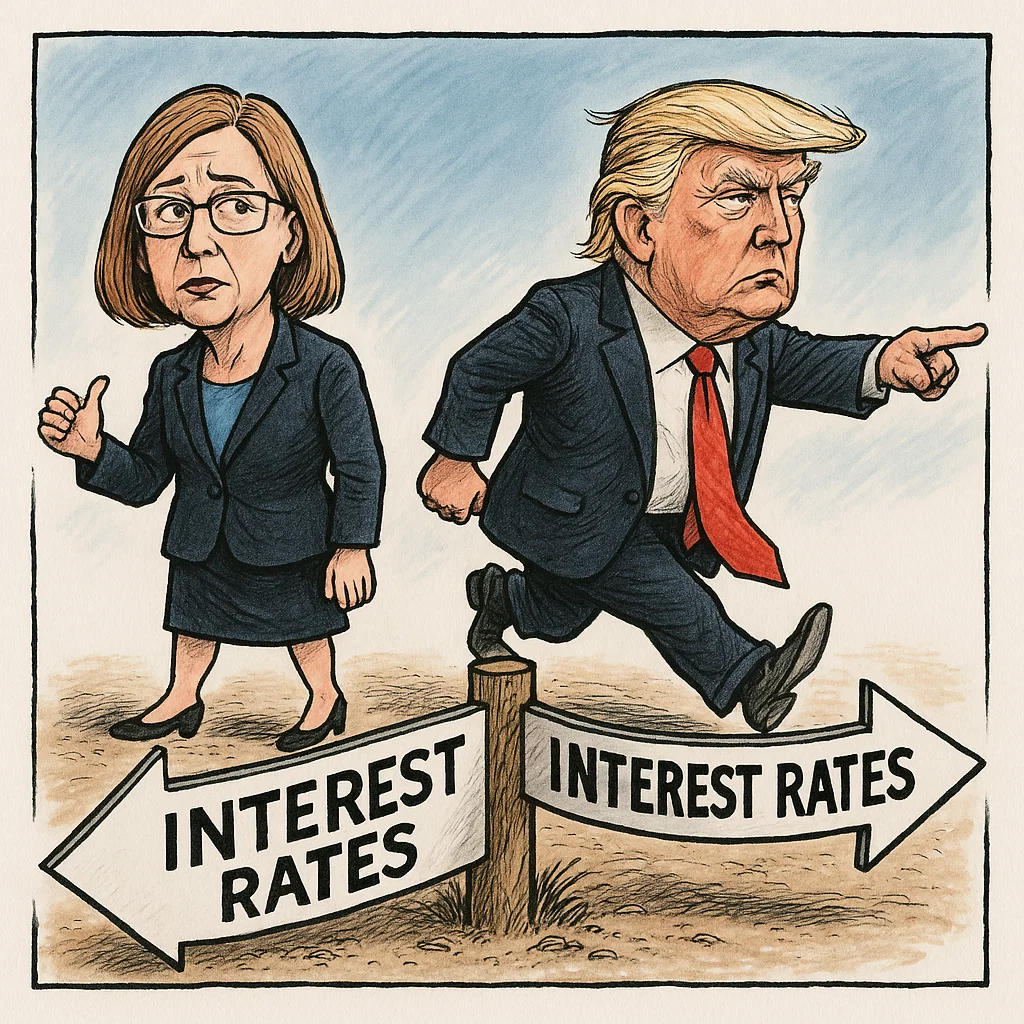
The Reserve Bank of Australia (RBA) has made a notable shift in its stance on interest rates, with Governor Michele Bullock now striking a far more optimistic tone compared to just a few months ago.
In February, when the RBA made its first rate cut after over a year of holding steady, the messaging was cautious and reluctant—suggesting the move was more about managing expectations than confidence in the economic outlook.
That hesitancy has now disappeared. Two key developments are driving this change.
First, Bullock has effectively declared that inflation is under control, and the economy has successfully achieved a “soft landing,” with low unemployment and inflation returning to target levels.
Second, however, there is a growing concern around weakening economic growth—both globally and in Australia—largely due to uncertainty surrounding potential tariffs proposed by Donald Trump.
Although these tariffs are not yet final, the possibility of steep trade barriers—ranging from 10% to 30% depending on the country—has already dampened growth forecasts. The unpredictable nature of Trump’s trade agenda is causing significant unease in global markets.
Bullock revealed that the RBA’s most recent rate cut was a unanimous decision, with some discussion around the idea of a larger, double cut.
“Of course we debated it, but in the end, it wasn’t the strongest argument,” she said.
However, while the RBA has adjusted its outlook on growth, it may be underestimating the inflation risk posed by Trump’s tariffs.
Despite some investors hoping for a de-escalation, economists widely agree that trade wars tend to raise prices for both businesses and consumers in the U.S.—and those effects could spill into the global economy.
Because the U.S. is central to the global financial system, any inflationary pressures there could drive up interest rates worldwide.
Although stock markets have remained buoyant, bond markets are showing signs of strain, with rising yields reflecting mounting inflation concerns. This trend could become more troubling if it continues.
Another issue weighing on markets is the U.S. government’s mounting debt, now exceeding $36 trillion. Interest payments are now the second-largest component of the federal budget.
President Trump’s proposed legislative package—which includes major tax cuts, increased defence spending, and a new $175 billion missile defence system—could add as much as $9 trillion to the deficit over the next decade.
That, combined with recent downgrades to U.S. debt by agencies like Moody’s, has shaken investor confidence. The U.S. dollar has dropped over 9% since Trump’s inauguration, and the cost of borrowing is expected to rise as Washington seeks more funding to cover its spending plans.
With global debt at record levels, there’s a growing risk that rising interest rates could trigger a broader financial reckoning—and Trump’s policies may be the spark that sets it off.
