


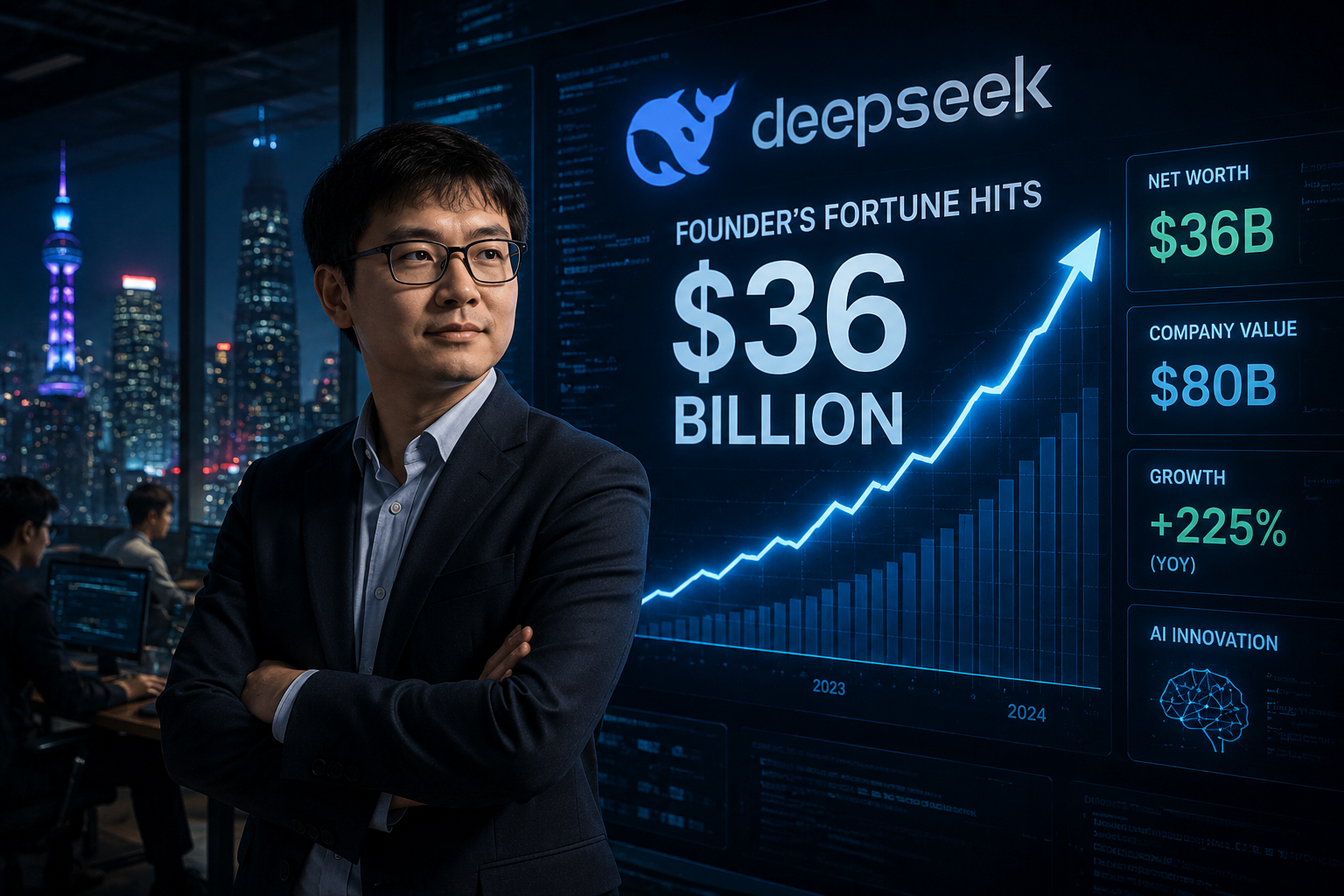
DeepSeek founder Liang Wenfeng has become the world’s wealthiest entrepreneur whose primary business is developing artificial intelligence models, after a major fundraising round more than doubled his estimated fortune.
Liang’s net worth has climbed from approximately US$16.7 billion to US$36 billion, according to the Bloomberg Billionaires Index. The increase places him ahead of prominent AI executives including Anthropic co-founder Dario Amodei and OpenAI co-founder Greg Brockman.
The comparison focuses on founders of companies that generate most of their revenue directly from producing and commercialising AI models. It does not include technology conglomerates such as Alibaba and Tencent or companies involved in supporting sectors including semiconductors and data centres.
Most of Liang’s wealth is tied to his controlling ownership of DeepSeek, whose valuation has increased fivefold from the US$10 billion figure reported in April.
The Chinese startup raised US$7.4 billion in June in a financing round that valued the business at US$50 billion. Liang reportedly contributed US$3 billion of his own money to the round, while his ownership was estimated to have declined slightly to around 78 per cent following the issuance of new shares.
His unusually large personal stake distinguishes him from many leading Silicon Valley AI founders. Frontier-model companies in the United States frequently require vast amounts of outside capital, forcing founders to surrender significant equity to venture-capital firms, technology companies and other investors.
By retaining close to four-fifths of DeepSeek, Liang has maintained both considerable control over the company and direct exposure to its rapidly rising valuation. OpenAI and Anthropic may command much higher overall valuations, but their ownership is distributed among a wider group of investors and co-founders.
The US$36 billion fortune also makes Liang China’s eighth-richest person. He sits just below Chen Tianshi, the co-founder of Chinese AI-chip company Cambricon Technologies.
Born in 1985 in Zhanjiang, Guangdong province, Liang grew up in a family where his father worked as a primary-school teacher. He later studied electronic engineering at Zhejiang University in Hangzhou and completed a master’s degree in information and communication engineering.
Liang entered the investment industry with two former university classmates. The group began experimenting with trading strategies while studying during the global financial crisis and later established Zhejiang High-Flyer Asset Management.
High-Flyer became known for using artificial intelligence and advanced computing in quantitative investment strategies. Its trading profits eventually gave Liang the resources needed to pursue large-scale AI research without initially relying on conventional technology investors.
DeepSeek was created in 2023 from High-Flyer’s internal artificial-intelligence division. Before US export controls made advanced processors more difficult for Chinese companies to obtain, High-Flyer had accumulated a substantial inventory of high-performance graphics chips.
That early supply of computing hardware gave DeepSeek the processing capacity required to train sophisticated language models. It also allowed the company to develop its technology with greater independence than many startups that rely heavily on venture-capital funding.
DeepSeek attracted global attention in early 2025 after releasing an AI model that reportedly produced results comparable to leading American systems while requiring significantly lower development and operating costs. The breakthrough challenged assumptions that only heavily funded US companies could compete at the frontier of generative AI.
The company has continued developing its technology and recently demonstrated its V4 model. It has also promoted the system’s compatibility with processors produced by Huawei Technologies, supporting China’s wider effort to reduce its dependence on foreign semiconductor suppliers.
DeepSeek’s growth reflects a broader transformation in China’s technology sector. Previous generations of Chinese technology wealth were largely created through consumer internet businesses, including e-commerce, online entertainment and digital payments.
Artificial intelligence, advanced computing and semiconductor development are now becoming increasingly important sources of influence and wealth. The growing involvement of Chinese government-linked and corporate investors has also elevated DeepSeek from an experimental private venture into a strategically important national technology company.
The latest fundraising gives DeepSeek substantial capital to recruit employees, expand computing infrastructure, improve its models and promote its AI products internationally.
However, its rapidly rising valuation and Liang’s enormous estimated fortune remain largely dependent on the company’s private-market assessment rather than publicly traded shares. The value of his stake could therefore change considerably during future funding rounds or if DeepSeek eventually pursues a public listing.
DeepSeek did not respond to requests for comment regarding the wealth estimate or Liang’s ownership position.
