


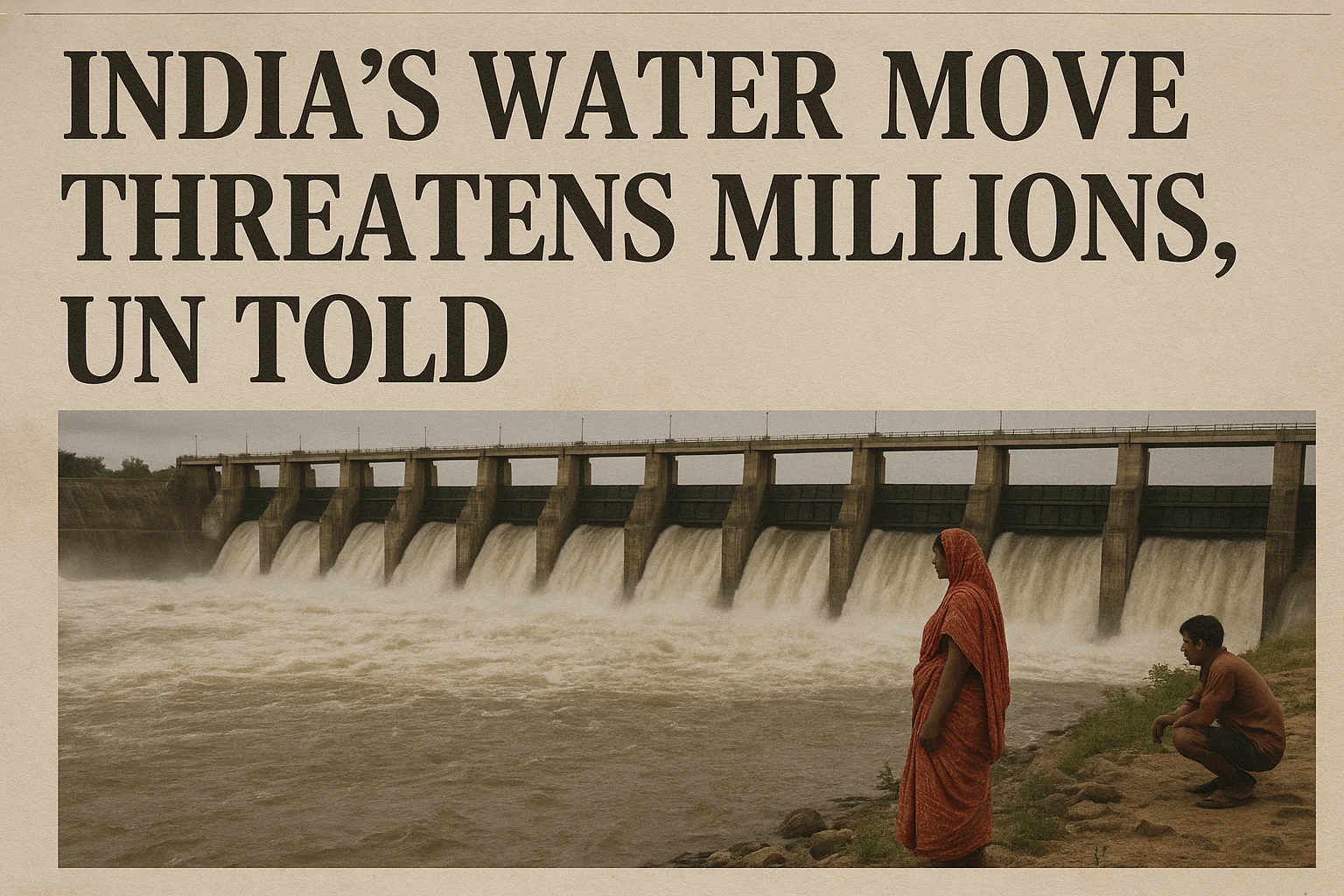
UNITED NATIONS: Pakistan has issued a strong warning at the United Nations, stating that India’s recent decision to unilaterally suspend the Indus Waters Treaty (IWT) poses a grave threat to international law and the survival of over 240 million people.
Speaking during a UN meeting on water protection in armed conflict, Pakistan’s Deputy Permanent Representative, Ambassador Usman Jadoon, criticised the move as a dangerous escalation and appealed to the global community to intervene before the situation triggers a humanitarian or regional security crisis.
“This is a serious breach of international law, including treaty law, human rights, and customary norms,” Jadoon said at the Arria Formula meeting, hosted by Slovenia.
Jadoon condemned what he described as India’s unlawful move to place the treaty in abeyance, warning it could lead to interruption or redirection of rivers vital to Pakistan’s survival.
“India must meet its legal commitments and avoid disrupting river flows that are a lifeline for Pakistan,” he asserted.
He also expressed alarm at inflammatory remarks from Indian leaders, referring to threats to “starve the people of Pakistan” as indicative of dangerous and malicious intent.
Weaponising Water and Undermining Peace
Ambassador Jadoon accused India of weaponising water, a tactic he said threatens peace and violates core international legal standards. He urged the UN Security Council to monitor such developments and respond proactively:
“The Council must step in wherever international law is being flouted in ways that could destabilise peace or create severe humanitarian outcomes.”
He outlined three critical legal principles:
- International humanitarian law prohibits attacks on water resources and infrastructure.
- Denying access to water is a breach of human rights and global norms.
- Using water as a tool of war or political pressure is unacceptable.
“It’s deeply regrettable that a country with malign intentions has turned water into both a coercive tool and a bargaining chip,” he said.
The statement comes amid concerns in Islamabad that India is bypassing treaty mechanisms and trying to diminish the role of the World Bank, which brokered the 1960 agreement. Pakistan views this as part of a broader pattern of using non-military tactics to exert pressure.
Ambassador Jadoon reaffirmed Pakistan’s commitment to supporting international norms that protect water resources, especially in conflict settings, and urged a strong and unified global stance against such politicisation.
Verbal Clash Between India and Pakistan at UN Over Civilian Protection
In a separate session at the UN Security Council, Indian and Pakistani diplomats engaged in a tense exchange over allegations of civilian harm and terrorism.
Pakistani Ambassador Asim Iftikhar Ahmad criticised the Indian military for allegedly targeting civilians in recent confrontations, sparking a sharp rebuttal from Indian Ambassador Parvathaneni Harish, who accused Pakistan of using terrorism as state policy.
Responding to Harish, Pakistani delegate Saima Saleem countered by accusing India of deflecting blame and spreading disinformation.
“India continues to kill and injure civilians in occupied Jammu and Kashmir, engages in aggression against Pakistan, and sponsors terror attacks, including assassinations across borders,” she told the 15-member Council.
She also linked India’s recent water policy decisions to broader efforts to coerce Pakistan, describing attempts to block river flows as a new low.
Humanitarian Toll and Pakistan’s Position
Ms. Saleem highlighted the Pahalgam incident, which Pakistan and other countries condemned, and challenged India to support an independent investigation—something she said India has consistently refused.
“India’s refusal to allow impartial inquiries into such incidents only further damages its credibility,” she said.
She also cited recent attacks by India, which she said killed 40 civilians, including women and children, and left more than 120 injured.
“India has no standing to lecture others about civilian protection,” she declared.
Saleem went on to defend Pakistan’s counterterrorism record, highlighting global recognition of its sacrifices, while accusing India of backing terror groups like:
- Fitna Al Khawarij (a reference to the banned Tehreek-i-Taliban Pakistan),
- The Balochistan Liberation Army, and
- Its Majeed Brigade, which Pakistan blames for attacks on civilians.
She also pointed to the recent deadly assault on a school bus in Khuzdar, which killed several children, as a grim example of the continuing threat.
Call for Dialogue and Peace
Saleem urged India to abandon “state-sponsored terrorism,” end its crackdown in Kashmir, and adhere to international law and UN resolutions. She called on Delhi to engage in meaningful dialogue to resolve the Kashmir dispute peacefully and in accordance with the will of the Kashmiri people.
