


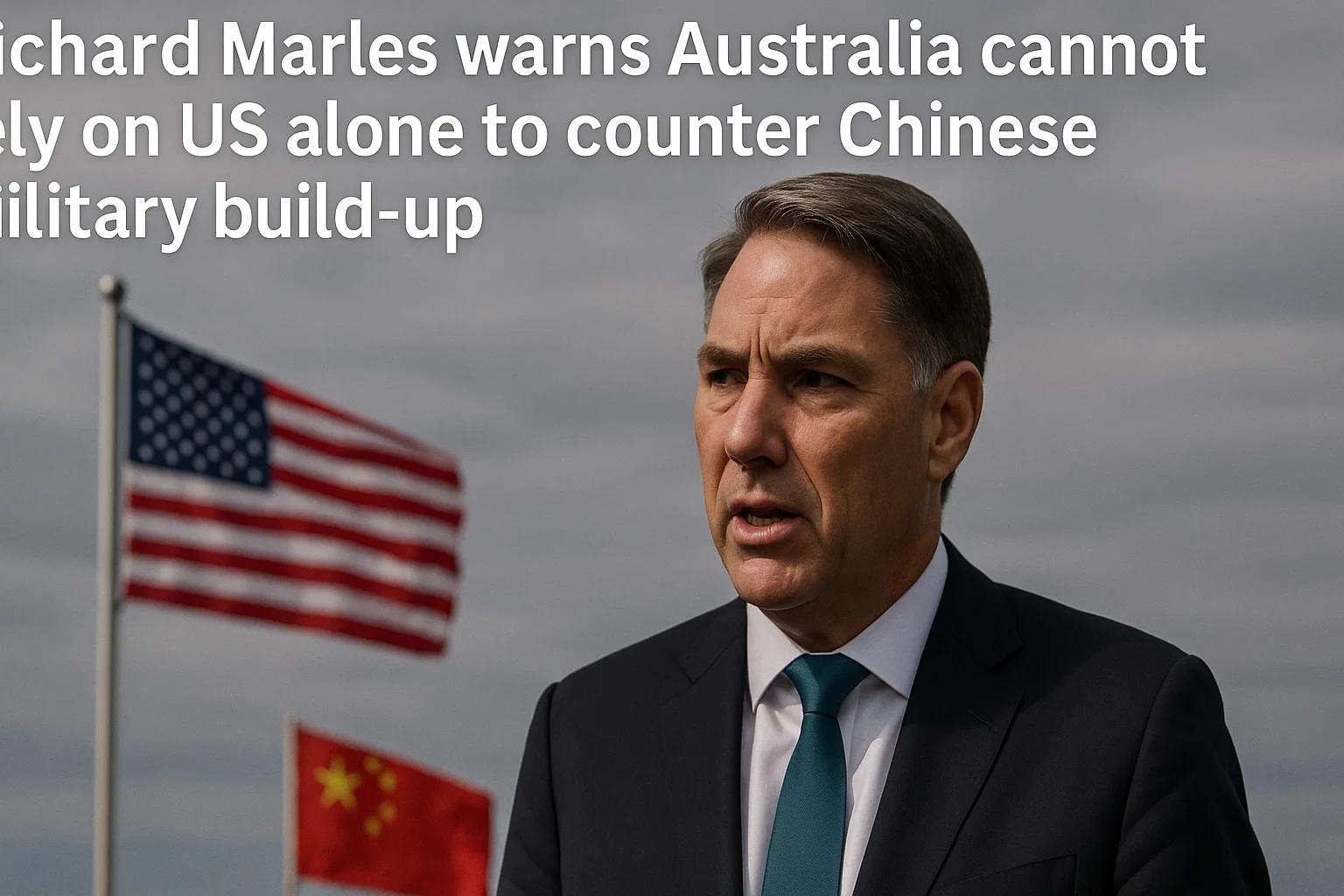
Defence Minister Richard Marles has stressed that Australia cannot rely solely on the United States to maintain balance in the Indo-Pacific, urging other regional allies to bolster their own defence efforts in response to China’s growing military power.
Speaking at the Shangri-La Dialogue in Singapore, Mr Marles said China was undertaking the largest conventional military build-up since World War II — without transparency or strategic reassurance.
“This is a defining challenge for the Indo-Pacific and the world,” he said.
His remarks followed a speech from US Defense Secretary Pete Hegseth, who assured the audience that the Trump administration would continue to support regional allies amid escalating pressure from Beijing. However, Hegseth made clear that the U.S. expects its allies to contribute more to their own defence.
“China envies what we have together,” Mr Hegseth said. “But it’s on all of us to invest and realise our shared defence potential.”
Australia Open to Defence Spending Increase
Mr Marles welcomed the US’s renewed commitment to the region but agreed that a broader collective effort is needed.
“There is no effective regional balance without the U.S. — but we cannot leave this task to America alone,” he said. “Countries like Australia must also step up.”
Australia is currently increasing its defence budget and is on track to reach 2.33% of GDP by 2033–34, up from the current 2.02%. However, the Trump administration is pressuring Canberra to raise spending to at least 3% of GDP. Mr Marles acknowledged the request and said Australia is open to further discussions.
“We understand why the US is asking more from its allies, and we’re willing to have that conversation,” he told the ABC.
Hegseth Warns China Is Preparing for Conflict Over Taiwan
Mr Hegseth, a former military officer and Fox News personality, used his address to spotlight China’s increasing military drills around Taiwan, describing them as “rehearsals for the real deal.”
“The threat is real — and it could be imminent,” he warned. “Beijing appears to be seriously preparing to use force to change the balance of power in the region.”
He added that any attempt by China to take Taiwan would bring “devastating consequences” for the Indo-Pacific and the global community. President Donald Trump, he noted, remains committed to preventing a Chinese invasion during his administration.
Not all responses were positive. US Democratic Senator Tammy Duckworth, attending the summit with a bipartisan delegation, welcomed the commitment to allies but said Mr Hegseth’s language about burden-sharing came off as “patronising.”
Marles: Arms Control Needs Urgent Revamp
In addition to regional security, Mr Marles called for a new global approach to arms control, citing growing nuclear threats from Russia, China, North Korea, Iran, and others.
He said the collapse of older arms control frameworks, including Russia’s withdrawal from the New START treaty, alongside the emergence of technologies like cyber warfare and autonomous weapons, required urgent international cooperation.
“The old models are being overtaken, but no new ones are replacing them,” Marles warned.
He also pointed to Russia’s war in Ukraine, warning that its nuclear threats undermine global disarmament efforts and could trigger a new wave of nuclear proliferation, especially in regions feeling directly threatened.
“Russia’s aggression and alignment with countries like North Korea and Iran is destabilising — and could push other nations to seek nuclear capabilities.”
Mr Marles said arms control must be integrated into a broader strategic framework — one based not just on military might, but on rules, norms, and collective accountability.
