


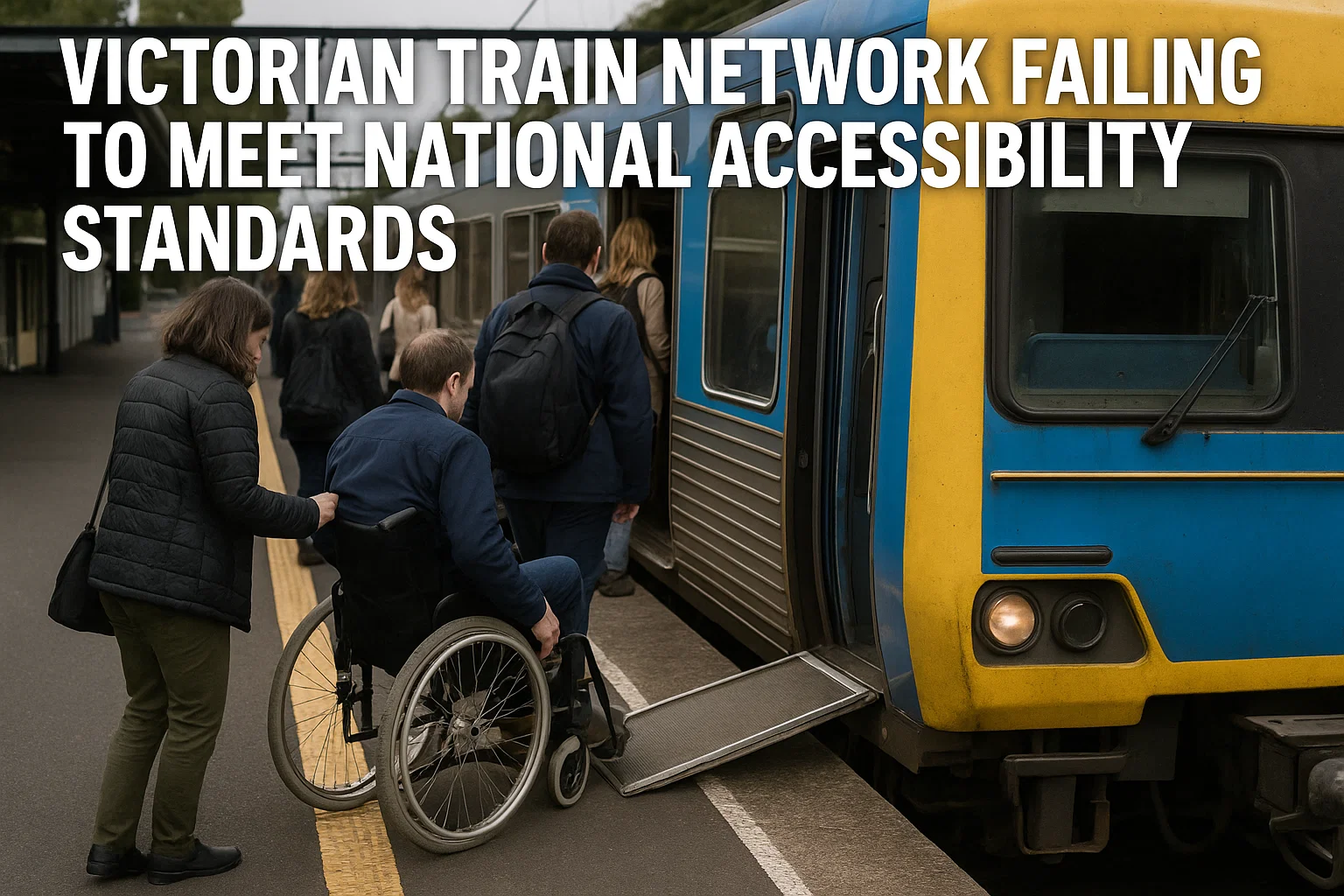
Accessing Melbourne’s train system presents major obstacles for Andrew Bretherton.
The 38-year-old, diagnosed with myalgic encephalomyelitis a decade ago, uses a wheelchair to get around. However, his nearest station — Windsor, in Melbourne’s inner south-east — remains difficult to use due to steep ramps and limited accessibility.
“You really feel isolated, like the world doesn’t want you out in it,” he said.
Windsor station lacks vital infrastructure like elevators, independent boarding access, and proper pick-up and drop-off areas for people with disabilities.
“I’ve missed events with friends because I physically couldn’t get there,” Mr Bretherton added.
Even with the aid of his powered wheelchair, he must lean forward to climb the steep ramp from the platform up to Chapel Street. Without this feature, he said it would be nearly impossible to exit the station independently.
“It’s like our needs and our lives are invisible,” said Mr Bretherton, an advocate with the Disability Resource Centre.
Windsor is located on the Sandringham line, which stretches through Melbourne’s bayside suburbs — and has no stations equipped with lifts.
An analysis of Metro Trains’ data by the ABC revealed that out of 220 stations across the network, about one in three fail to meet national ramp standards, which require a rise of one metre for every 14 metres of length.
Metro Trains flags some stations, including busy hubs like Richmond and South Yarra, as potentially requiring assistance due to poor accessibility.
Two-thirds of all stations lack lifts, and more than half are without accessible toilets.
“It’s a basic need, but I’m not shocked. Our community is an afterthought,” Mr Bretherton said, adding that successive state governments have failed to prioritise disability access while investing heavily in other transport projects.
“They’re telling us our lives aren’t worth the money,” he said.
Australians Miss Out Due to Gaps in Accessibility
Lilly Cascun, 18, has to walk an extra 30 minutes each way to Darebin station because her nearest station, Ivanhoe, doesn’t meet her needs.
Born totally blind, Ms Cascun said the longer walk is tiring and unsafe.
“I often get home late, and my parents really worry about me walking in the dark,” she said.
She depends on tactile ground surface indicators (TGSIs) — raised patterns on platforms that guide people with vision impairment.
“It’s disheartening. There are so many stations where I don’t feel safe,” she said.
Ivanhoe is one of 36 Melbourne stations lacking TGSIs along some or all of the platform edges.
After her requests for funding were denied, Ms Cascun launched an online petition that attracted thousands of supporters.
In response, Public Transport Minister Gabrielle Williams said the government had taken notice and committed to installing tactiles at Ivanhoe.
“This will help create a safer, more accessible environment for locals like Lilly,” Ms Williams said.
While grateful, Ms Cascun stressed that progress needs to accelerate.
“It took months of pushing just to get this far,” she said. “Ivanhoe is just one station — I hope this marks the beginning of broader changes.”
Liberal MP Nick McGowan, who has supported her campaign, agreed that much more needed to be done.
“Lilly’s courage is inspiring, but it shouldn’t take a young person leading a campaign for the government to recognise the urgent need for inclusive infrastructure,” he said.
Nationwide Standards Still Unmet
Federal laws passed in 2002 set targets to make public transport accessible and eliminate disability discrimination. Trains must be fully compliant by 2032, while other infrastructure, such as stations, was required to meet standards by the end of 2022.
A Department of Infrastructure and Transport spokesperson acknowledged that many operators have still not fulfilled their obligations.
In Melbourne, nearly half of train stations still lack 1.2-metre-wide paths needed for wheelchair access.
Minister Williams admitted progress has been slow, citing the complexity of upgrading ageing infrastructure.
“These are difficult but crucial standards to meet,” she said. “Much of our network was built decades ago, so significant investment is required to modernise it.”
The opposition argued that the pace of change has excluded over one million Victorians with disabilities.
“Public transport should be for everyone, not just the able-bodied,” Mr McGowan said.
Metro Trains declined to comment.
At Ivanhoe station, Ms Cascun said she was encouraged by the changes ahead.
“I’m incredibly thankful that our voices were heard. It’s empowering to know that persistence can lead to real change,” she said.
