


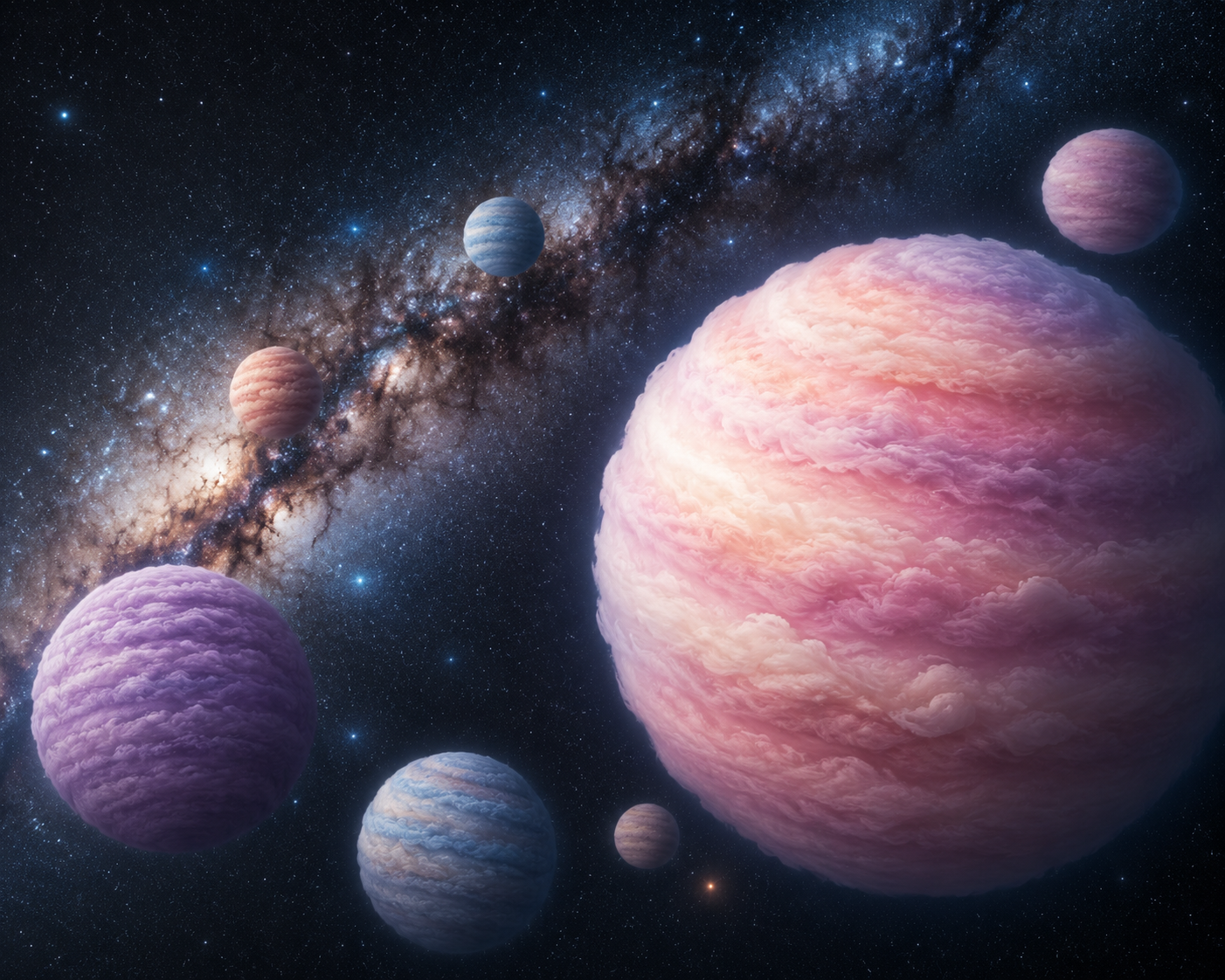
Astronomers have discovered two extraordinary “super-puff” planets that are among the least dense worlds ever found, with sizes comparable to Jupiter but densities similar to cotton candy. The planets orbit a Sun-like star located more than 1,000 light-years from Earth in the Milky Way galaxy.
The newly identified planets, known as TOI-791 b and TOI-791 c, are remarkable because they are enormous in size while containing surprisingly little material. Researchers estimate they are dominated by lightweight gases such as hydrogen and helium, giving them an extremely inflated appearance compared with planets in our own solar system.
Detected initially through NASA’s Transiting Exoplanet Survey Satellite (TESS), the planets were studied further using ground-based telescopes to measure their masses and confirm their unusual characteristics. Scientists found that these worlds are among the largest and lowest-density “super-puffs” discovered so far.
Despite being roughly Jupiter-sized, the planets are estimated to be far lighter than Jupiter. Their extremely low density challenges existing ideas about how giant planets form and maintain their atmospheres over millions of years. Researchers believe their huge gas envelopes may provide clues about the early stages of planetary evolution.
Super-puff planets are extremely rare. Scientists have identified only a small number among thousands of confirmed exoplanets, making the discovery of two such unusual planets in the same system particularly valuable for studying how planetary systems develop.
Astronomers say further observations, including possible studies with the James Webb Space Telescope, could reveal more about the planets’ atmospheric composition and explain why they remain so inflated. The findings may help scientists understand why some planets shrink over time while others retain massive gas envelopes.
The discovery highlights the extraordinary diversity of planets across the Milky Way, showing that worlds can exist in forms far different from anything found in our own solar system.
