


An alleged terrorist accused over the deadly Bondi Beach attack may eventually be offered an agreement to resolve some of the charges without a lengthy trial, as prosecutors confront one of Australia’s largest and most complicated terrorism cases.
At the same time, investors are being warned that dozens of ASX-listed companies are under increasing pressure to reduce employee numbers as wage costs rise faster than revenue.
The developments come as attention also turns to the factional officials, union leaders and party organisers who exercise significant influence inside the Australian Labor Party, often without the public recognition given to elected politicians.
The legal proceedings connected to the Bondi attack remain highly sensitive.
Naveed Akram is accused of participating in the December 2025 mass shooting at a Jewish Hanukkah celebration at Bondi Beach. The attack killed 15 people and left many others injured.
Akram was wounded during an exchange with police, while his father and alleged co-attacker, Sajid Akram, was killed.
Authorities subsequently charged the surviving accused with numerous offences, including murder, attempted murder and committing a terrorist act. Additional weapons-related counts later increased the total number of allegations against him.
Police have alleged the attack was inspired by Islamic State ideology. Investigators also recovered improvised explosive devices that failed to detonate and allegedly found further extremist material connected to the accused.
None of the charges has yet been proven in court, and Akram is entitled to the presumption of innocence.
Given the scale of the case, prosecutors and defence lawyers may eventually discuss whether some form of plea agreement could narrow the issues requiring a trial.
Under such an arrangement, an accused person may agree to plead guilty to particular charges in exchange for other counts being withdrawn, reduced or not pursued.
A negotiated outcome would not necessarily mean the most serious allegations disappear. Prosecutors would need to consider the strength of the available evidence, the interests of victims, the likely sentence and whether an agreement would still reflect the gravity of the alleged attack.
Complex terrorism prosecutions can involve hundreds of witnesses, extensive digital evidence, forensic material and national-security information. A full trial could take months and impose further emotional strain on survivors and bereaved families.
Any proposed agreement in the Bondi case would therefore attract intense scrutiny.
Victims’ families would expect to be consulted, while prosecutors would need to demonstrate that public confidence in the justice system had not been sacrificed merely to secure a faster outcome.
Separately, a Goldman Sachs analysis has highlighted mounting labour-cost pressure across the Australian sharemarket.
The investment bank reportedly examined dozens of ASX-listed businesses whose employee expenses have been growing more quickly than sales.
Its analysis found that wage costs across the identified companies had risen by about 8 per cent, compared with revenue growth of approximately 5 per cent.
That gap is significant because labour is one of the largest expenses for many companies. When salaries and related costs rise faster than income, profit margins can deteriorate even when overall sales continue increasing.
The pressure is particularly acute for businesses exposed to weaker consumer demand, slowing construction, rising operating expenses or limited pricing power.
Companies identified as vulnerable reportedly include Generation Development Group, insurance broker AUB Group, telecommunications provider Aussie Broadband and explosives manufacturer Dyno Nobel.
The degree of pressure differs across the group.
Dyno Nobel, for example, was reported to have recorded a sharp increase in labour expenditure even as revenue declined, creating an especially difficult margin equation.
Goldman Sachs analysts Matthew Ross and Tony Wu reportedly identified 35 listed companies facing some level of labour-cost pressure, with about 16 viewed as particularly likely to consider restructuring or job reductions.
The report does not mean every company on the list will necessarily dismiss workers.
Management teams have several possible responses. They can freeze recruitment, leave vacant positions unfilled, reduce contractor expenditure, reorganise operations, sell underperforming divisions or attempt to increase prices.
However, where those measures are insufficient, direct job cuts may become one of the fastest ways to protect earnings.
The warning comes before the August corporate reporting season, when investors will examine how effectively management teams are controlling costs.
Companies that acknowledge the problem and present credible efficiency plans may receive a more favourable market response than those that allow wage expenses to continue outpacing revenue.
Recent increases in award wages have added to the challenge.
Although higher pay supports workers facing elevated living costs, it can place additional strain on companies already experiencing weak demand or declining profitability.
Businesses with large workforces and relatively low profit margins are particularly exposed because even a modest wage rise can translate into a substantial increase in total expenses.
Artificial intelligence is increasingly being presented as part of the solution.
Companies such as WiseTech Global and online retailer Temple & Webster have spoken about using AI and automation to improve productivity, reduce repetitive work and support growth without matching increases in employee numbers.
Investors are nevertheless becoming more sceptical of companies that use AI terminology without showing measurable financial benefits.
Simply claiming to adopt artificial intelligence is unlikely to satisfy the market. Companies will be expected to demonstrate actual reductions in processing time, improved customer service, greater sales productivity or lower operating costs.
There is also a risk that management teams may attribute conventional cost-cutting programs to AI even where technology played only a limited role.
In many cases, job reductions remain the result of slower growth, duplicated positions or traditional restructuring rather than the direct replacement of employees by automated systems.
The Goldman analysis therefore points to a broader issue for corporate Australia.
Businesses expanded their workforces and operating structures during stronger economic conditions. As growth slows and wages remain elevated, some of those companies may discover that their cost bases are no longer sustainable.
The adjustment could extend beyond technology companies to financial services, telecommunications, industrial businesses and consumer-facing groups.
Meanwhile, Labor’s internal power structure is receiving renewed attention following the party’s 50th national conference.
Although Prime Minister Anthony Albanese and cabinet ministers are the most visible representatives of the federal government, important decisions within Labor are heavily influenced by factions, affiliated unions, state secretaries and conference delegates.
These figures are sometimes described as Labor’s “faceless men”, although women now occupy many of the influential organisational roles as well.
Their power comes from the party’s formal structure.
Labor is not controlled solely by its parliamentary representatives. It is also governed through state branches, national conferences, factional agreements and affiliated trade unions.
Those organisations influence candidate selection, policy positions, internal appointments and the composition of party conferences.
Labor’s two major factional groupings are generally described as the Left and the Right.
The divisions once reflected clearer ideological differences over economic policy, foreign affairs, privatisation, social reform and the relationship between unions and government.
Today, the factions continue to exercise considerable organisational power, but the policy differences between them are sometimes less obvious.
They often function as networks that coordinate votes, distribute internal positions and negotiate compromises before debates reach the public stage.
This means many important outcomes are settled behind closed doors.
By the time a motion reaches the conference floor, factional leaders may already have negotiated wording designed to avoid a damaging confrontation with the parliamentary leadership.
Supporters argue that this system helps Labor maintain unity and prevents the destructive internal conflict that has damaged the party in the past.
It allows competing groups to resolve differences privately while presenting voters with a disciplined and coherent government.
Critics say the same process can reduce genuine debate and give unelected officials excessive influence over public policy.
Ordinary party members may attend conferences and participate in local branches, yet major decisions can still be shaped by a relatively small number of factional negotiators.
The contemporary Labor Party has become particularly disciplined under Albanese.
Although the Left faction has significant representation among conference delegates, the prime minister has at times taken more cautious positions than many activists would prefer.
Some members want faster action on climate change, stronger workplace rights, a different approach to the Middle East and greater resistance to the AUKUS defence partnership.
Nevertheless, public confrontations are usually contained.
Factional leaders understand that open rebellion against a Labor government can create damaging headlines and provide opportunities for the opposition.
The result is a national conference that often appears united, even where substantial disagreements remain beneath the surface.
Labor’s organisational figures also play an important role in determining who enters parliament.
Preselection contests can be influenced by factional support, union endorsements and agreements between senior party officials.
A candidate backed by the dominant faction may gain access to organisational resources and delegate votes that are unavailable to an independent challenger.
Once elected, politicians may retain strong connections to the networks that assisted their rise.
This does not mean every parliamentary decision is dictated by factional officials. Ministers remain accountable to parliament, voters and the law.
However, understanding Labor’s internal machinery helps explain why some individuals hold influence far beyond their public profile.
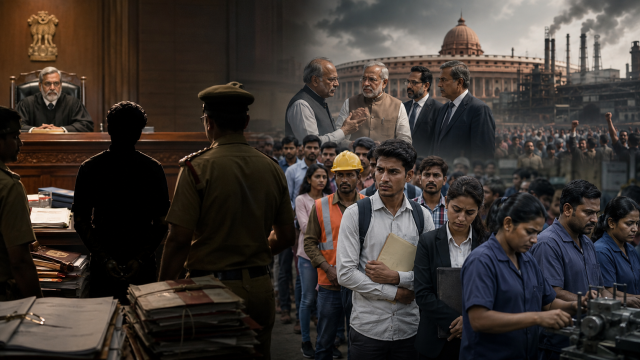
The three stories together reveal different forms of power operating across Australian society.
The courts must decide how to handle an extraordinarily serious terrorism prosecution while respecting legal fairness and the interests of victims.
Corporate executives must determine whether to preserve jobs or protect profits as labour expenses rise faster than revenue.
Labor’s internal organisers must balance party unity with demands for genuine debate and democratic participation.
In each case, the most consequential decisions may be made away from public view.
A potential plea agreement could determine whether the Bondi allegations proceed through a full trial.
Private corporate restructuring discussions could decide the future of thousands of workers.
Factional negotiations could shape policies later presented to the public as settled government positions.
The immediate outcomes remain uncertain.
What is clear is that legal bargaining, corporate cost pressure and internal political organisation will continue to influence some of Australia’s most important institutions.
