
India and the United Kingdom have signed a landmark free trade agreement that removes tariffs on a wide range of goods, including automobiles and alcoholic beverages. This deal, concluded amid ongoing global trade tensions spurred by U.S. President Donald Trump’s tariff policies, represents a significant accord between two of the world’s major economies.
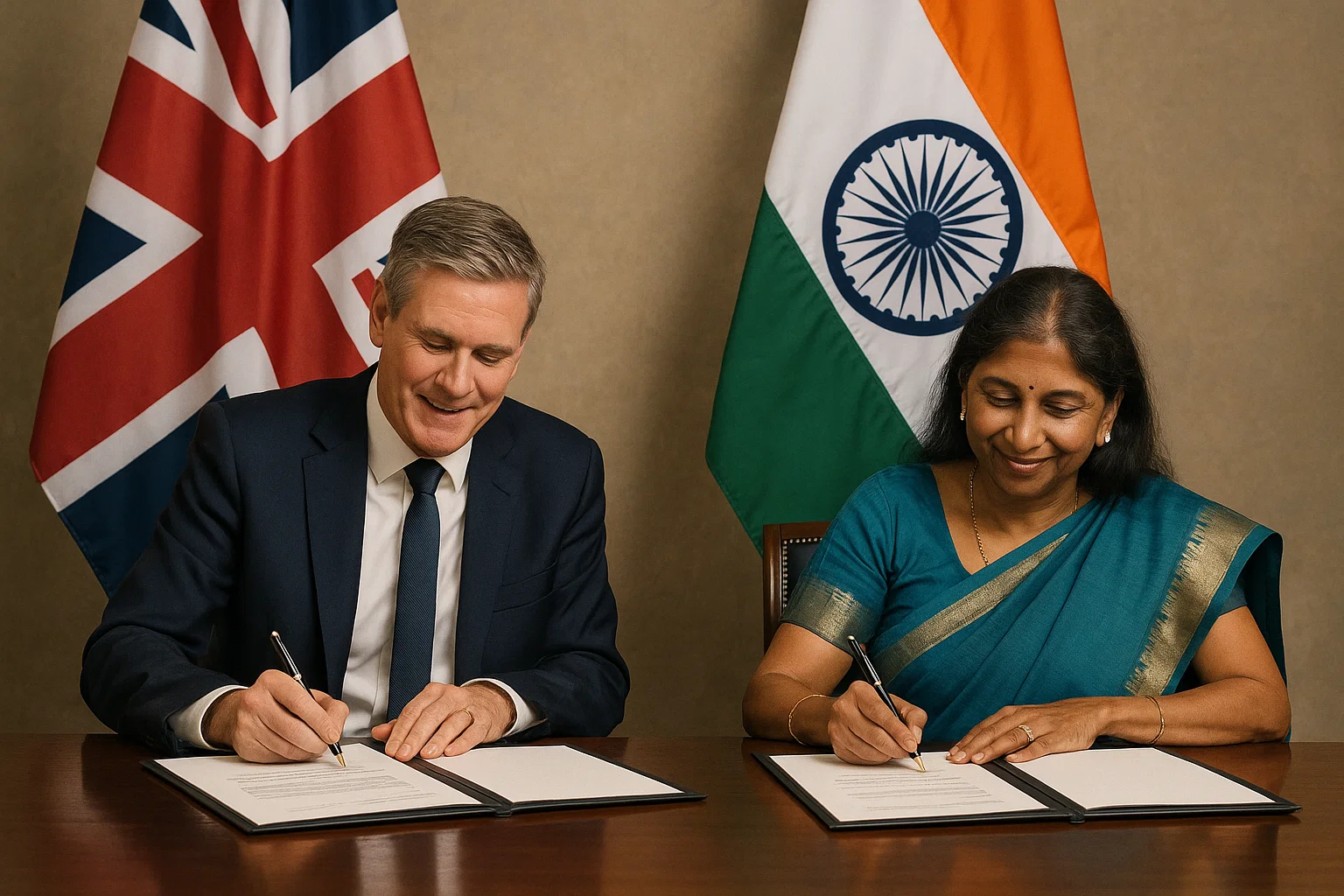
Television broadcasts on Thursday (July 24) captured the signing ceremony held near London, where UK Business and Trade Secretary Jonathan Reynolds and India’s Commerce Minister Piyush Goyal formalized the agreement. Also present were UK Chancellor Rachel Reeves and Indian External Affairs Minister Subrahmanyam Jaishankar. The event was further highlighted by the attendance of Indian Prime Minister Narendra Modi and UK Prime Minister Keir Starmer.
The agreement follows three years of rigorous negotiations, tackling complex issues such as visa access, tariff cuts, and fiscal incentives. Talks concluded in May, culminating in the UK’s most substantial trade pact since Brexit and India’s most impactful trade agreement in a decade.
The timing coincides with Trump’s expected arrival in Scotland on Friday, where he is scheduled to meet Starmer, underscoring Britain’s broader trade ambitions, including finalizing terms with the United States. Simultaneously, India is aiming to complete a deal with Washington before August 1 to avoid looming tariff hikes.
For Prime Minister Modi, this agreement enhances India’s strategy of becoming a key player in global supply chains, reflecting its openness to reducing trade barriers to attract foreign investment. It also sets the stage for further negotiations with the European Union.
For Prime Minister Starmer, the deal supports his agenda to revitalize the UK economy. While projected to add £4.8 billion (S$8.3 billion) annually to the UK’s GDP—a modest increase—it represents an important step in fostering investor confidence and stimulating business growth under his Labour government.
Under the terms of the agreement, around 90% of tariff lines for UK exports to India will be reduced, with 85% becoming fully tariff-free within a decade. India, in turn, will enjoy reduced duties on approximately 99% of its goods exported to the UK.
Tariffs on whisky and gin will be halved to 75%, eventually dropping to 40% over ten years, while automotive tariffs will be cut from 110% to 10%, subject to quotas.
Bilateral trade between the two countries reached US$21.9 billion in 2024, with the new agreement expected to boost trade volumes by £25.5 billion annually in the long term.
