
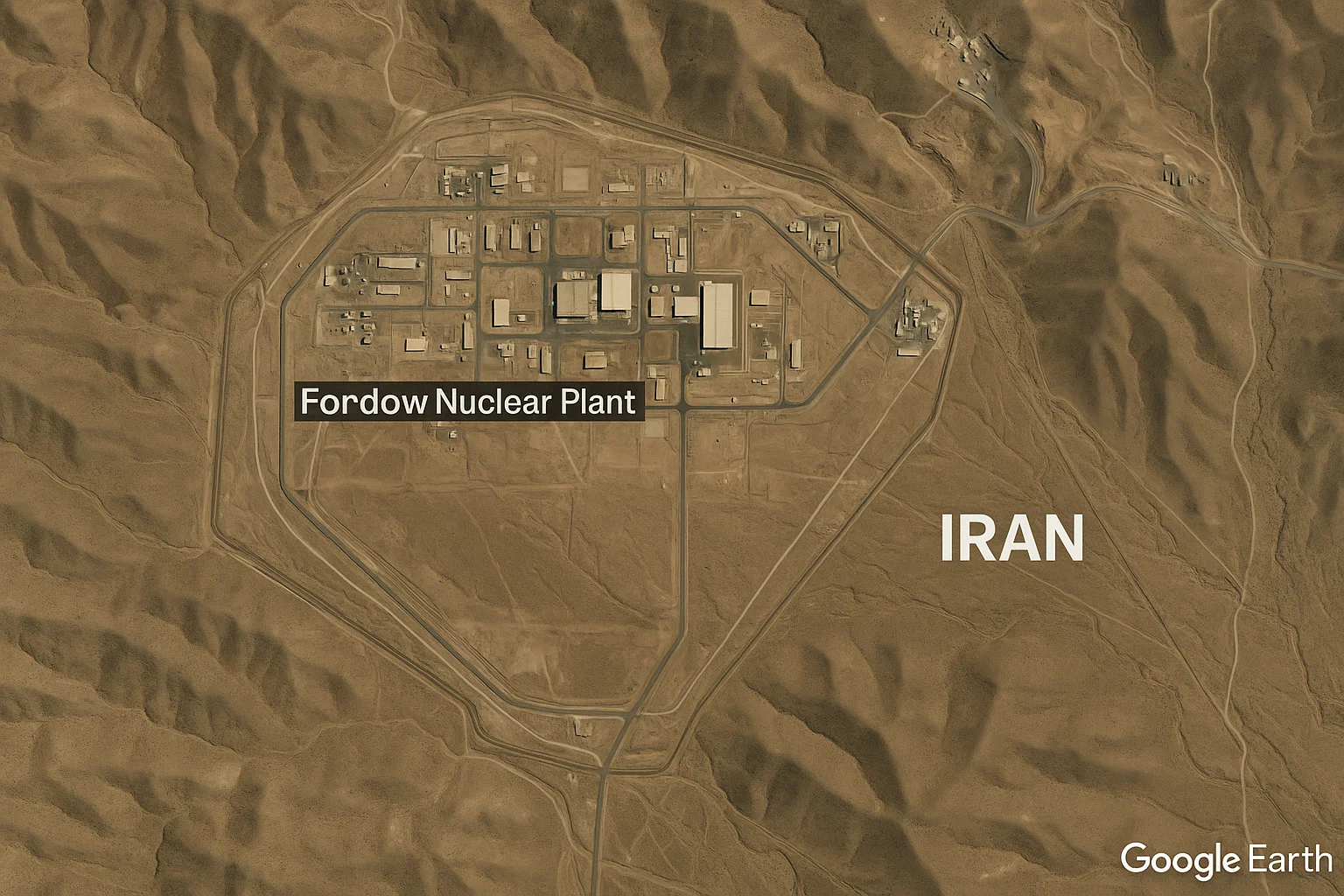
If the US opts to more directly support Israel in its attacks on Iran, one option under consideration is supplying Israel with advanced “bunker-buster” bombs capable of damaging deeply buried nuclear sites, such as the Fordow enrichment plant, which is built deep within a mountain.
Delivering such a weapon would require deployment from a US aircraft, a move that could carry serious consequences, including undermining any potential nuclear negotiations between the US and Iran.
What Is a Bunker-Buster Bomb?
Bunker-buster bombs are designed to penetrate deep underground before detonating. In this context, it refers to the American GBU-57A/B Massive Ordnance Penetrator — a 13,600-kilogram precision-guided bomb capable of reaching depths of around 60 meters beneath the surface. Multiple bombs can be used sequentially to penetrate deeper layers.
US Air Force officials confirm that, at present, only the B-2 Spirit stealth bomber is configured to deploy the GBU-57A/B, though theoretically any heavy bomber capable of carrying the load could be modified for the task.
Aside from direct ground assaults or a nuclear strike, the bunker-buster remains the most viable conventional option to significantly damage a fortified site like Fordow.
Michael Shoebridge, director of Strategic Analysis Australia, told the ABC that Israel lacks weapons powerful enough to target deeply buried facilities like Fordow and Natanz, possessing only smaller 2,270-kilogram munitions.
Risks of Striking Fordow
Fordow, Iran’s second major enrichment site after Natanz, is built into a mountain near Qom, roughly 95 kilometres southwest of Tehran. It became operational in 2009, after being secretly constructed beginning in 2006. The facility sits beneath approximately 80 meters of rock and is protected by both Iranian and Russian air defence systems, which may have already been compromised by Israeli strikes.
Although the GBU-57A/B carries only a conventional warhead, the International Atomic Energy Agency (IAEA) has warned that any strike could risk dispersing enriched nuclear material into the environment. However, past Israeli attacks on Iran’s Natanz facility have only resulted in localized contamination.
The Broader Conflict
The Fordow site has become a focal point in the ongoing conflict, with Israeli Prime Minister Benjamin Netanyahu calling Iran’s missile and nuclear programs an “existential threat.” Israel’s ambassador to the US, Yechiel Leiter, recently stated that fully neutralizing Fordow is a central objective of the operation.
While Iran insists its nuclear activities are solely for peaceful purposes, concerns persist due to Iran’s enrichment of uranium far beyond civilian energy needs. Marion Messmer of Chatham House noted, however, that no strong evidence exists indicating Iran was actively building nuclear weapons prior to Israel’s recent attacks.
US Involvement and Political Tensions
Middle East analyst Rodger Shanahan said the US has deployed military assets to the region, both to apply pressure on Iran and provide options to President Donald Trump. When asked at a G7 summit about possible US military involvement, Trump declined to specify conditions, though he recently declared on social media that the US holds “complete and total control of the skies over Iran” and warned Iran against further missile attacks.
Despite speculation, Israeli officials maintain they have not requested US offensive assistance, only defensive support. Ambassador Leiter stated that Israel has multiple strategies for dealing with Fordow, not all of which involve air strikes.
Iran’s Response
Iran’s Deputy Foreign Minister Kazem Gharibabadi announced that Iran would no longer fully cooperate with the IAEA and may withhold information on its nuclear materials and equipment. Meanwhile, Iranian lawmakers are preparing legislation that could lead to withdrawal from the Nuclear Non-Proliferation Treaty, following a path similar to North Korea’s withdrawal in 2003, which was followed by nuclear weapons testing.
Dr. Shanahan explained that negotiations between the US and Iran remain deadlocked over whether Iran should be allowed to conduct any uranium enrichment within its borders, with Washington demanding a complete halt.
The IAEA has also expressed concern about Iran’s undisclosed centrifuge stockpiles, raising fears that Iran might be running secret enrichment sites if cooperation with inspectors further diminishes.
