


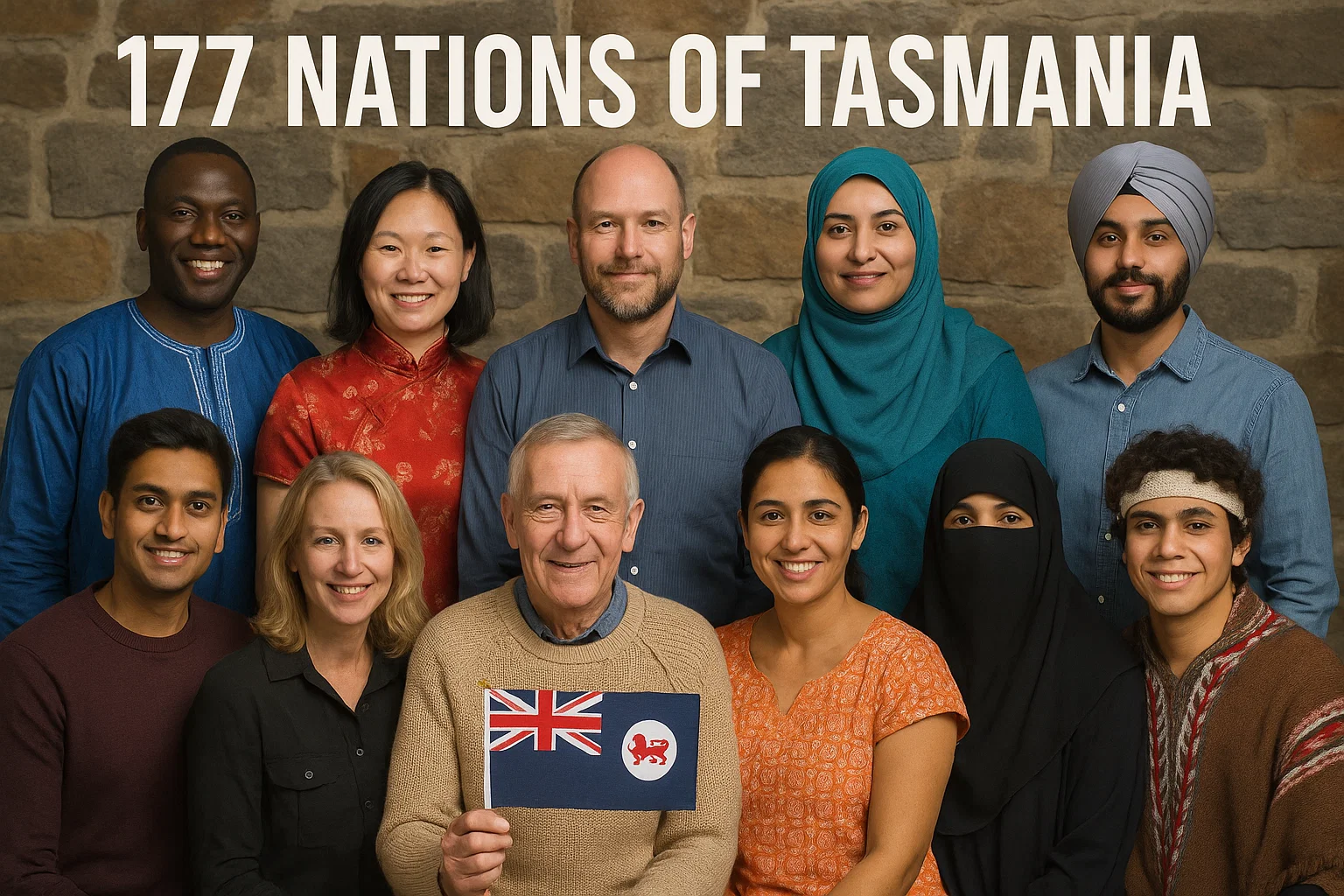
It might seem like an unusual request, but along with photographer Andrew Wilson, Thomson is working toward a remarkable goal: to interview and photograph at least one person from each of the 177 nationalities currently represented in Tasmania.
“I’ve heard there are around 20 Jamaicans living in Tasmania, but I haven’t been able to find them yet — I’d really love to hear from one,” Thomson said.
Photo: Mark Thomson stands in a flannelette shirt, highlighting how these stories help connect people to history and community (ABC News: Luke Bowden).
After losing his job during the COVID-19 pandemic in 2020, Thomson decided to focus on a long-term, meaningful project.
“One piece of advice I heard about podcasting was to find something repeatable. I was already interested in migration and diversity,” he said.
“It made me wonder — has anyone tried interviewing someone from each nationality represented in Tasmania? That seemed like a unique way to explore cultural stories.”
Inspired by a list from Tasmania’s Multicultural Access Point (MAP), which documents 177 nationalities on the island, the project took off.
What began as the 177 Nations of Tasmania podcast has evolved into an exhibition, currently on display at the State Library of Tasmania in Hobart, enriched by Wilson’s striking portrait photography.
Among the powerful stories captured so far is that of Nick Anagnostis, whose parents sent him alone from Lesbos, Greece, to Australia at age 15 to escape civil unrest. He made his way from Melbourne to Sydney without knowing any English.
Stories that resonate deeply
Thomson says some interviews have left a lasting emotional impression.
“I spoke with a Hungarian woman, now 99, who was a teenager during the Nazi occupation of Austria,” he said.
“She recalled how the language at her school changed overnight from Hungarian to German.”
Photo: A black-and-white portrait of Anna Kecksemeti from Hungary, captured for the project (Andrew Wilson).
But the memory that struck Thomson the most was when she described seeing German soldiers take away her Jewish friend’s father.
“It really stuck with me. Personal stories like that are more powerful than textbooks — they help us understand the real people behind historical events,” he said.
With 115 of 177 nationalities already represented, Thomson says what once seemed like a far-off goal now feels achievable.
“Honestly, I didn’t think I’d get this far,” he said.
“Now that we’ve reached 115, I’m thinking, ‘why not keep going?’ Hopefully, the exhibition will inspire more people to reach out. But I know some of the remaining nationalities may only be represented by one or two people, so it’ll take luck and patience.”
Capturing culture through portraits
Photographer Andrew Wilson joined the project in 2024 after the pair discussed expanding the podcast’s scope. With funding from Hobart City Council, they brought the visual side of the project to life.
“As a portrait photographer, I thought it would be amazing to capture the faces of the people Mark was speaking to,” Wilson said.
His motivation was clear — to highlight Tasmania’s cultural diversity.
“Tasmania might be remote, but it’s home to people from all around the globe,” he said.
“Rather than fear that, we should celebrate it. These people bring their cultures with them, and that enriches us all.”
For each shoot, Wilson starts by asking who the person is, where they’re from, and what emotional circumstances brought them to Tasmania.
“Many have fled persecution, left family behind, or moved here for love or opportunity,” he said.
“Sometimes, it’s emotional — people are torn between their new life and their aging parents overseas.”
Photo: Iranian participant Marzi Riazi in ornate silk traditional dress with detailed jewelry — one of many cultural items showcased through portraits.
Wilson encourages participants to wear or bring items that reflect their culture.
“Marzi from Iran wore this incredible silk face scarf and a crown with intricate beading — I had to use eight different shots because each one told a unique story,” he said.
Singapore-born Joanna Sun, who posed for her portrait while the ABC was present, brought a teapot with her. It was a gift from her parents during a trip to Malacca, Malaysia — where her grandmother was born — and holds deep cultural significance.
Photo: Joanna Sun, from Singapore, holds her family teapot. The colors and motifs are unique to Peranakan culture (Andrew Wilson).
“The phoenix and floral design are rooted in Chinese culture, but the specific use of pink, teal, and peonies is distinctively Peranakan,” she explained.
Sun moved to Tasmania in 2007, where she pursued a nursing course that led to a career in aged care — and eventually, a PhD.
“Living in Tasmania has opened up opportunities I wouldn’t have had in Singapore,” she said.
“It’s not just a project for me — it’s part of my children’s history now too.”
Photo: Joanna Sun and Mark Thomson viewing the exhibition at the State Library of Tasmania.
When complete, the 177 Nations of Tasmania collection will be archived by Libraries Tasmania, preserving it as a record of the island’s rich multicultural fabric.
Hard-to-find nationalities still sought for the project
Thomson is looking for people who moved to Tasmania — ideally as adults or older teens — and who now live there permanently. These are the remaining countries yet to be represented:
Europe:
- Albania, Belarus, Jersey, Iceland, Kosovo, Moldova, Montenegro, Wales
Asia:
- Brunei, Georgia, Kuwait, Laos, Mongolia, Tajikistan, Yemen
Africa:
- Algeria, Botswana, Burkina Faso, Burundi, Cameroon, Gambia, Guinea, Liberia, Namibia, Somalia, Zambia
Americas:
- Costa Rica, El Salvador, Jamaica, Trinidad and Tobago, Uruguay
(Plus possible additions from the Bahamas and St Lucia)
Oceania:
- Kiribati, Solomon Islands, Tuvalu, Vanuatu, New Zealand (someone with a unique or unusual story)
The 177 Nations of Tasmania exhibition is currently on display on Level 2 of the State Library of Tasmania. Those interested in participating can contact the team via the 177 Nations of Tasmania Facebook page.
