


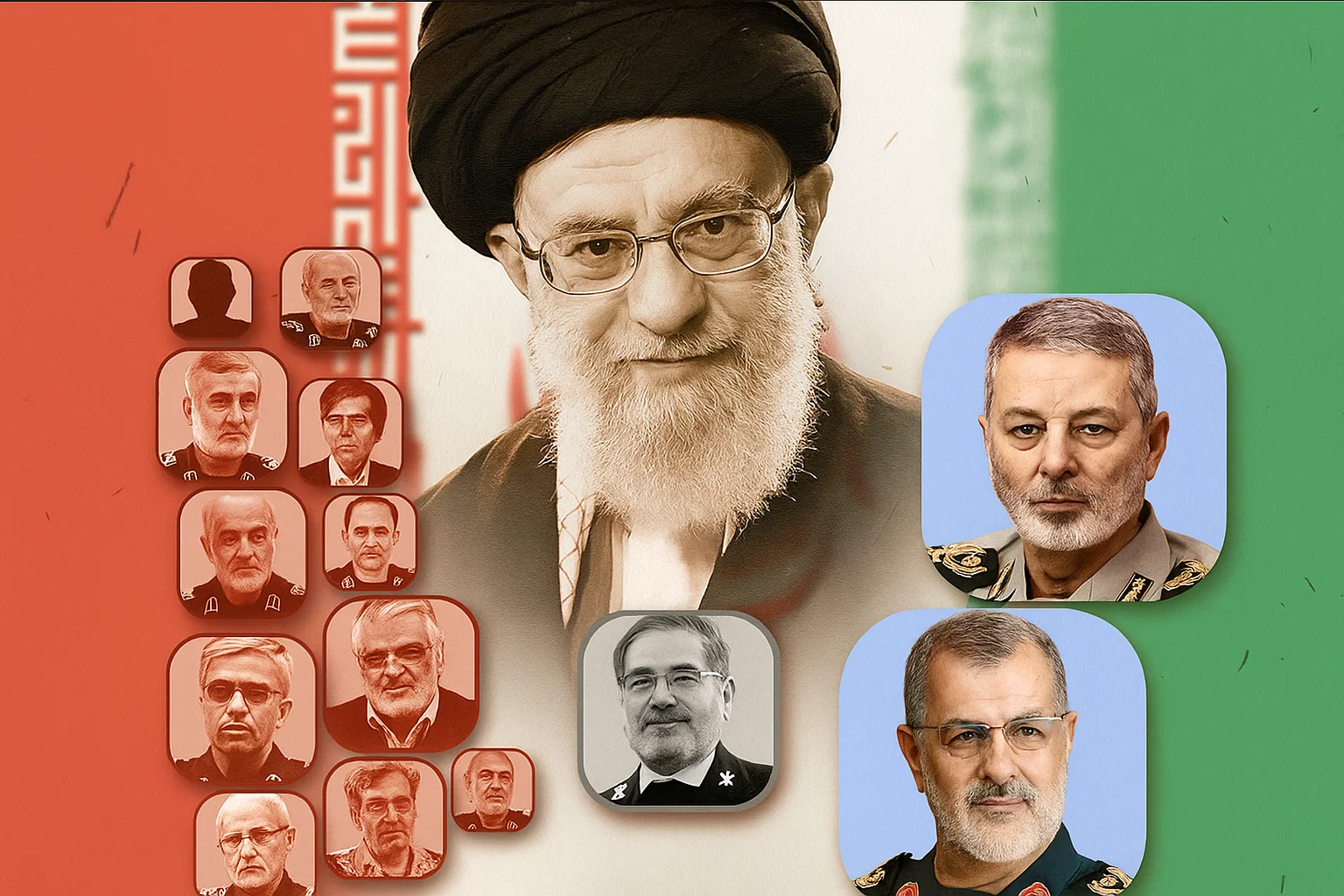
Israel’s recent air campaign on Iran is being described as unprecedented, pushing the Middle East closer to direct war between two nation-states—a scenario many world leaders have feared since Hamas’s October 7, 2023 attack on Israel.
The escalation is deeply concerning for Iran, which now faces the loss of numerous senior military and intelligence figures, showing Israel’s willingness and capability to target the regime’s top leadership.
Key Iranian Figures Reportedly Killed
Among those killed in Israeli strikes were some of Iran’s most powerful figures:
- Mohammad Bagheri, former commander-in-chief of Iran’s armed forces, held the second-highest rank under Supreme Leader Ayatollah Ali Khamenei. He was appointed in 2016 and had a background in military intelligence. The IDF confirmed his death on June 12. He has reportedly been replaced by Abdolrahim Mousavi.
- Hossein Salami, who led the Islamic Revolutionary Guard Corps (IRGC) since 2019, was also killed on June 12. Mohammad Pakpour is said to be his successor.
- Gholam Ali Rashid, who led the IRGC’s headquarters and oversaw joint military operations, was also among those killed. Ali Shadmani has reportedly replaced him.
- Amir Ali Hajizadeh, head of Iran’s aerospace division and missile program—accused by the IDF of orchestrating past missile attacks on Israel—was confirmed dead on June 13.
Other high-ranking officials and operatives, including deputy intelligence chiefs, air defense commanders, and nuclear scientists, were also killed in the strikes, according to both Israeli and Iranian sources.
Notably, Ali Shamkhani, a senior adviser to Khamenei and key figure in past nuclear negotiations, was critically injured. His condition remains uncertain, with conflicting reports about whether he survived.
Senior Nuclear Scientists Among the Dead
Two prominent nuclear experts, Fereydoon Abbasi and Mohammad Mehdi Tehranchi, were killed in the operation, according to the IDF. Abbasi had survived an assassination attempt in 2010 and was once sanctioned by the UN. Tehranchi had been linked to Iran’s alleged nuclear weapons development efforts.
Israel also reportedly eliminated five senior nuclear researchers from Shahid Beheshti University during the coordinated attacks.
Details of Operation Rising Lion
Launched just after midnight on June 12, Operation Rising Lion aimed to significantly degrade Iran’s nuclear weapons program and eliminate top figures in the regime. The campaign followed a damning UN report that found Iran had failed to meet its nuclear obligations and raised concerns over lack of cooperation since 2019.
The initial phase of the operation involved swarms of small, explosive-laden drones that Israeli operatives had hidden inside Iran, targeting radar systems and disabling key air defenses. Soon after, over 200 Israeli military aircraft—including F-35 stealth fighters—conducted coordinated strikes on more than 100 nuclear and military sites.
According to U.S. officials, Israel had even drafted a plan to assassinate Supreme Leader Ayatollah Ali Khamenei, but the operation was reportedly blocked by then-President Donald Trump.
Iran’s Retaliation and Global Concerns
Iran responded with a large-scale aerial assault on Israel. While most incoming missiles were intercepted by Israel’s advanced air defense systems, some still penetrated Israeli airspace.
As the region teeters on the edge of further escalation, world leaders are calling for restraint. The key concern now is how far each side is willing to go, and whether full-scale war can still be avoided after such high-level blows have already been exchanged.
