


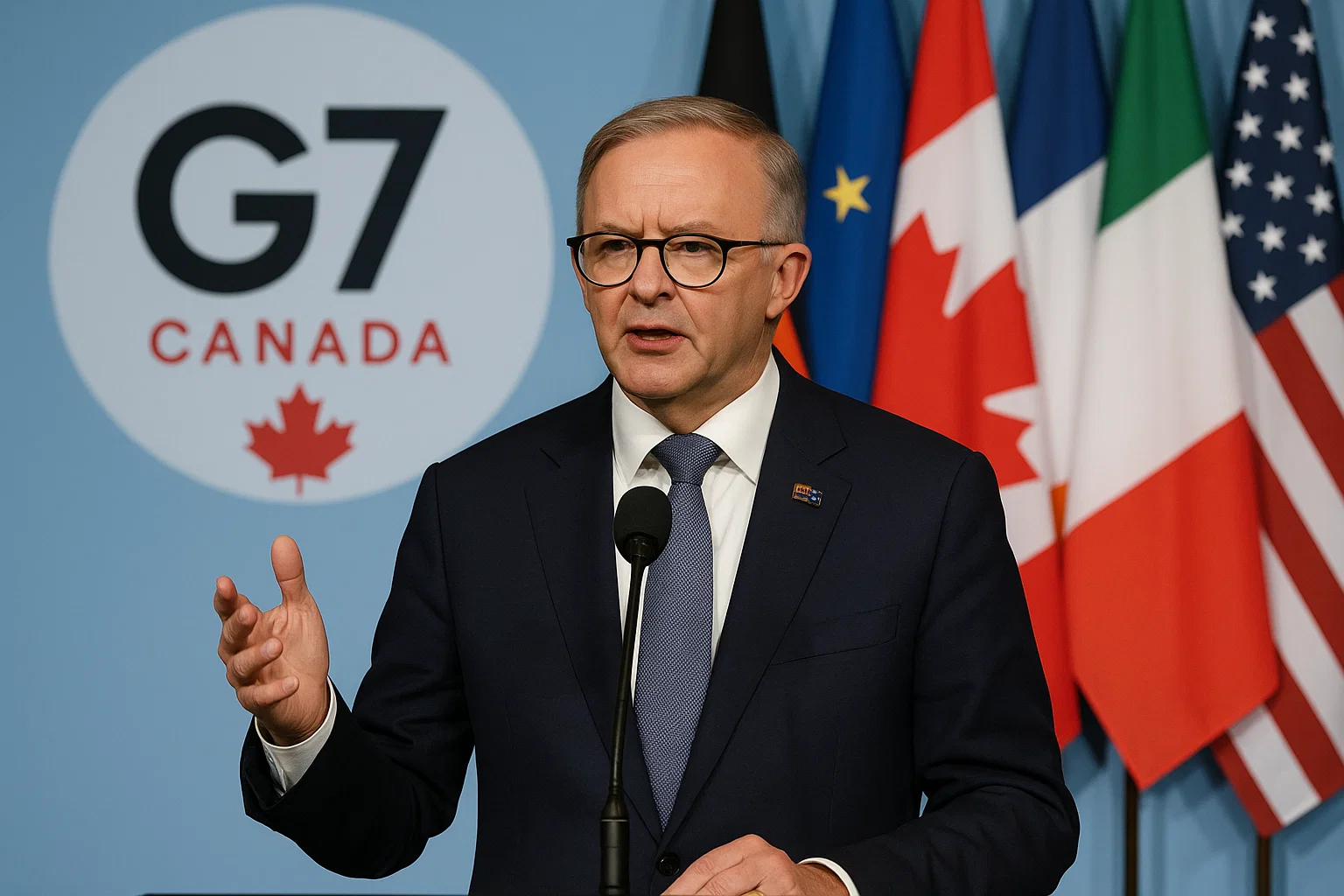
The prime minister appeared confident and well-prepared ahead of what was meant to be his first formal meeting with Donald Trump, following his final press conference in Calgary. His upbeat performance came after months of preparation, including seeking advice from golfing legend and Trump confidant Greg Norman.
However, as Anthony Albanese left the Sheraton Suites Calgary hotel en route to a G7 event, news broke unexpectedly: Trump was cutting his trip short. The announcement, posted on social media by White House press secretary Karoline Leavitt, cited escalating tensions in the Middle East as the reason for the president’s early departure.
Just moments earlier, Albanese had expressed anticipation for the meeting. Despite months of planning and travel, he learned from social media that the face-to-face with Trump was cancelled.
Although some saw this as a potential snub, the Australian government noted that Trump had also been scheduled to meet with leaders from countries including Ukraine, Mexico, India, and South Korea—plans that were also scrapped due to the evolving Middle East crisis. Trump had warned Iranians to evacuate Tehran as U.S. military forces were being deployed to the region.
Opposition Leader Sussan Ley called the cancellation disappointing for Australia, arguing that the Albanese government shouldn’t have relied solely on a sideline meeting during an international summit to engage with the U.S. president. Her office shared a list of several world leaders who had visited Washington since Trump’s election.
This cancellation marks a missed opportunity for the prime minister. Though the situation was outside his control, seven months have now passed since Trump’s election without a direct meeting between the two leaders.
Albanese had hoped to address several key issues with Trump, including controversial tariffs and the $368 billion AUKUS submarine agreement. While no major breakthroughs were expected, the cancelled meeting delays progress on these fronts.
Of particular concern is the AUKUS pact, which the Pentagon recently announced is under review as part of Trump’s “America First” strategy. This, combined with U.S. calls for Australia to boost defence spending, has raised alarms in Canberra.
Still, there was a glimmer of optimism. During the G7 summit, UK Prime Minister Keir Starmer, standing beside Trump, affirmed that the AUKUS deal would continue, describing it as critical for both nations. Trump offered a more reserved response but didn’t contradict Starmer’s remarks. Albanese welcomed this as a positive sign, emphasizing the strategic value of the trilateral partnership between Australia, the U.S., and the UK.
As world leaders arrived in Calgary, they anticipated unpredictability from Trump, who has a history of upending global summits. At a previous G7 meeting in Canada, he abruptly left amid disputes over tariffs and Russia, refused to endorse a joint statement, and publicly criticized then-Prime Minister Justin Trudeau.
At this summit, Trump echoed that unpredictability—lamenting Russia’s exclusion, initially refusing to sign a joint statement on the Middle East, and ultimately departing early. While the circumstances differed, the outcome felt familiar: another disrupted summit with Trump at the center.
