


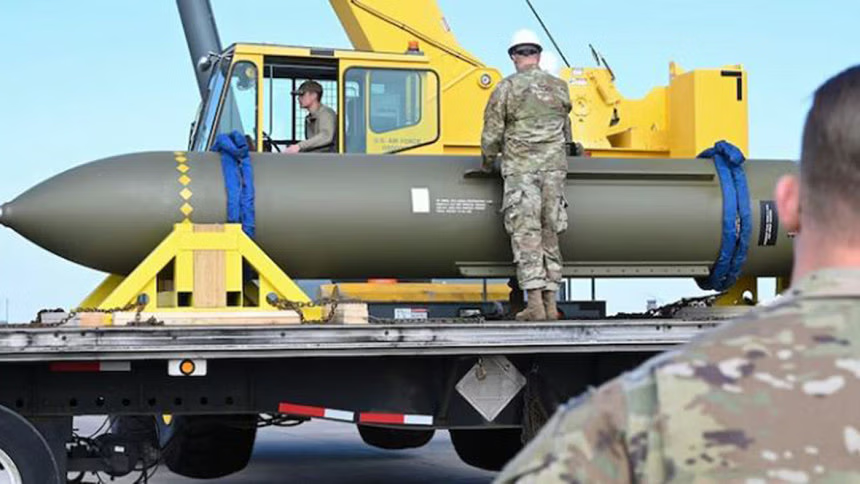
A powerful American bunker-buster bomb stands as the only conventional weapon capable of destroying Iran’s heavily fortified underground nuclear sites, making it President Donald Trump’s potential go-to option if he chooses to support Israel militarily.
The GBU-57, a 30,000-pound (13,607 kg) warhead, can penetrate up to 200 feet (61 meters) underground before detonating. Israel, despite its commitment to preventing Iran from acquiring nuclear weapons, does not possess this weapon.
Why this bomb matters
In under a week, Israel has struck numerous Iranian military targets, including commanders, surface facilities, missile stockpiles, and command centers, according to Behnam Ben Taleblu, director of the Iran program at the conservative-leaning Foundation for Defense of Democracies (FDD).
However, key questions remain about how effective these strikes have been against Iran’s core nuclear infrastructure. The International Atomic Energy Agency (IAEA) has reported no damage to Fordo, Iran’s deeply buried uranium enrichment site south of Tehran. Unlike Natanz and Isfahan, Fordo lies deep beneath the earth, beyond the reach of Israel’s conventional arsenal.
“All eyes are on Fordo, buried under roughly 300 feet of rock,” Taleblu said.
According to former US Army lieutenant general and RAND Corporation defense analyst Mark Schwartz, only the United States possesses the conventional capability to destroy such deeply buried sites — specifically, through use of the GBU-57.
What the GBU-57 can do
The GBU-57 — also known as the Massive Ordnance Penetrator — is designed to drill through up to 200 feet of rock and concrete before exploding, unlike most bombs that detonate upon or shortly after impact.
“To destroy deeply buried facilities, these weapons require thick steel casings to punch through layers of rock,” explained Masao Dahlgren, a missile defense expert at the Center for Strategic and International Studies (CSIS).
The bomb’s special fuse ensures that it survives the extreme shock and pressure of impact before detonating deep inside the target. Development of the bomb began in the early 2000s, and Boeing was contracted to produce 20 units in 2009.
How it’s delivered
Only the American B-2 stealth bomber can deploy the GBU-57. In early May, some B-2s were stationed at Diego Garcia, a UK-US military base in the Indian Ocean, though satellite imagery indicated they had departed by mid-June.
B-2 bombers can fly from the US to the Middle East to conduct long-range bombing missions, as they have in the past, Dahlgren said. Each bomber can carry two GBU-57 bombs. Schwartz noted that multiple bombs might be required to successfully destroy a deeply buried target. “It’s not a one-and-done operation,” he said.
Schwartz also pointed out that Israel’s recent establishment of air superiority over Iran could lower the risks for any B-2 bombers entering Iranian airspace.
Potential consequences
Using the GBU-57 would carry significant political ramifications for the United States, Taleblu emphasized, warning that military strikes aren’t the only way to counter Iran’s nuclear ambitions.
In the absence of the bunker-buster bomb or a diplomatic resolution, Israel could try to disrupt access to Fordo by attacking entrances, collapsing tunnels, cutting power, and using similar tactics already employed at Natanz.
