


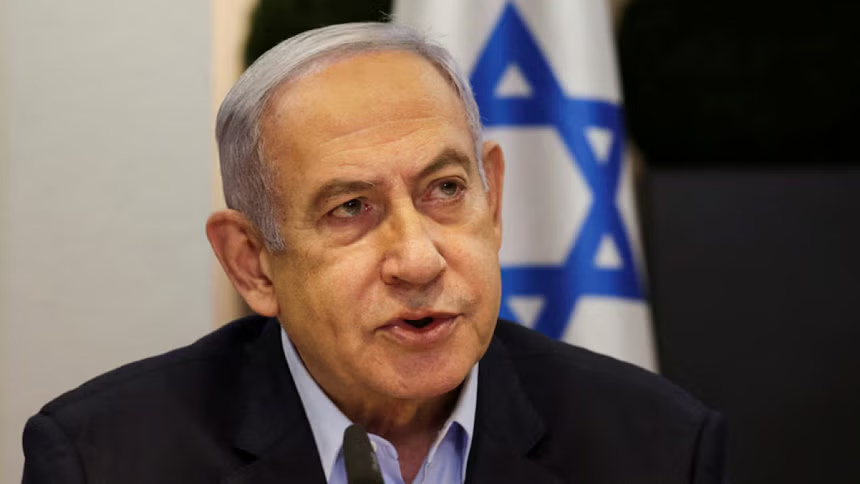
Israel has launched a large-scale military campaign targeting Iran’s nuclear program, including its facilities, scientists, and military leadership.
The United Nations Security Council quickly convened an emergency meeting in response. At the session, Israeli ambassador Danny Danon defended Israel’s actions as a “preventative strike” carried out with “precision, purpose, and the most advanced intelligence.” He argued that the operation aimed to:
dismantle Iran’s nuclear program, eliminate the architects of its terror and aggression, and neutralize its repeated threats to destroy Israel.
What does international law say about self-defence?
Under Article 2.4 of the UN Charter:
All members shall refrain from the threat or use of force against the territorial integrity or political independence of any state.
There are only two exceptions to this rule:
- when the UN Security Council authorizes the use of force, or
- when a state acts in self-defence.
Article 51 of the UN Charter preserves the “inherent right of individual or collective self-defence” until the Security Council intervenes to restore peace.
Defining self-defence
The International Court of Justice (ICJ) has historically interpreted self-defence narrowly, often rejecting broader claims made by countries such as the United States, Uganda, and Israel.
However, after the 9/11 attacks, the UN Security Council recognized that self-defence could apply to threats from non-state actors like terrorist groups. This allowed the US to justify its military intervention in Afghanistan.
The traditional definition of self-defence — responding to an actual armed attack — came to be viewed as too restrictive in an age of missile strikes, cyber warfare, and terrorism. This led to the concept of anticipatory self-defence, where a state may act before an imminent attack occurs.
For anticipatory self-defence to be lawful, there must be clear imminence — the last possible moment to prevent an unavoidable attack. As then-UN Secretary-General Kofi Annan put it in 2005, self-defence can be justified if:
- an attack is imminent,
- no alternative measures can prevent it, and
- the response is proportionate.
International law expert Donald Rothwell emphasizes that anticipatory self-defence requires careful factual analysis and strict legal standards.
The blurred lines of pre-emptive strikes
In 2002, the US introduced the pre-emptive doctrine in its national security strategy, arguing that new threats like terrorism and weapons of mass destruction justified using force before attacks occurred. Critics, including Annan, warned that broad acceptance of preventive self-defence could erode the prohibition on the use of force and encourage states to act unilaterally based on speculative intelligence.
Annan suggested that if strong evidence supports preventive military action, it should be brought to the Security Council for authorization. If the Council declines, other options such as diplomacy, sanctions, deterrence, or monitoring should be pursued.
Israel did not follow this process before attacking Iran.
Lessons from history
Israel’s stated objective was to disrupt Iran’s nuclear program and prevent it from developing nuclear weapons. But this is based on preventing a potential future attack. Publicly available information indicates that Iran does not currently possess nuclear weapons.
This is not the first time Israel has stretched the definition of self-defence. In 1981, Israel bombed Iraq’s Osirak nuclear reactor under construction near Baghdad, claiming a nuclear Iraq would be too dangerous. The UN Security Council condemned that attack.
As international law stands, unless an attack is imminent and unavoidable, such pre-emptive strikes are generally considered illegal. When other non-military options exist — such as diplomatic efforts, sanctions, and international monitoring (like the work of the International Atomic Energy Agency) — military action is not yet legally necessary.
Preserving the rule of law
The right to self-defence has clear limits. Anticipatory self-defence remains legally unsettled and controversial.
Were Israel’s strikes against Iran lawful under international law? Based on the facts available, the answer appears to be no. International law expert Marko Milanovic also rejects Israel’s claim of acting in preventive self-defence.
In a volatile global landscape, it is critical to uphold these legal standards to prevent unchecked aggression and protect the rule of law.
