
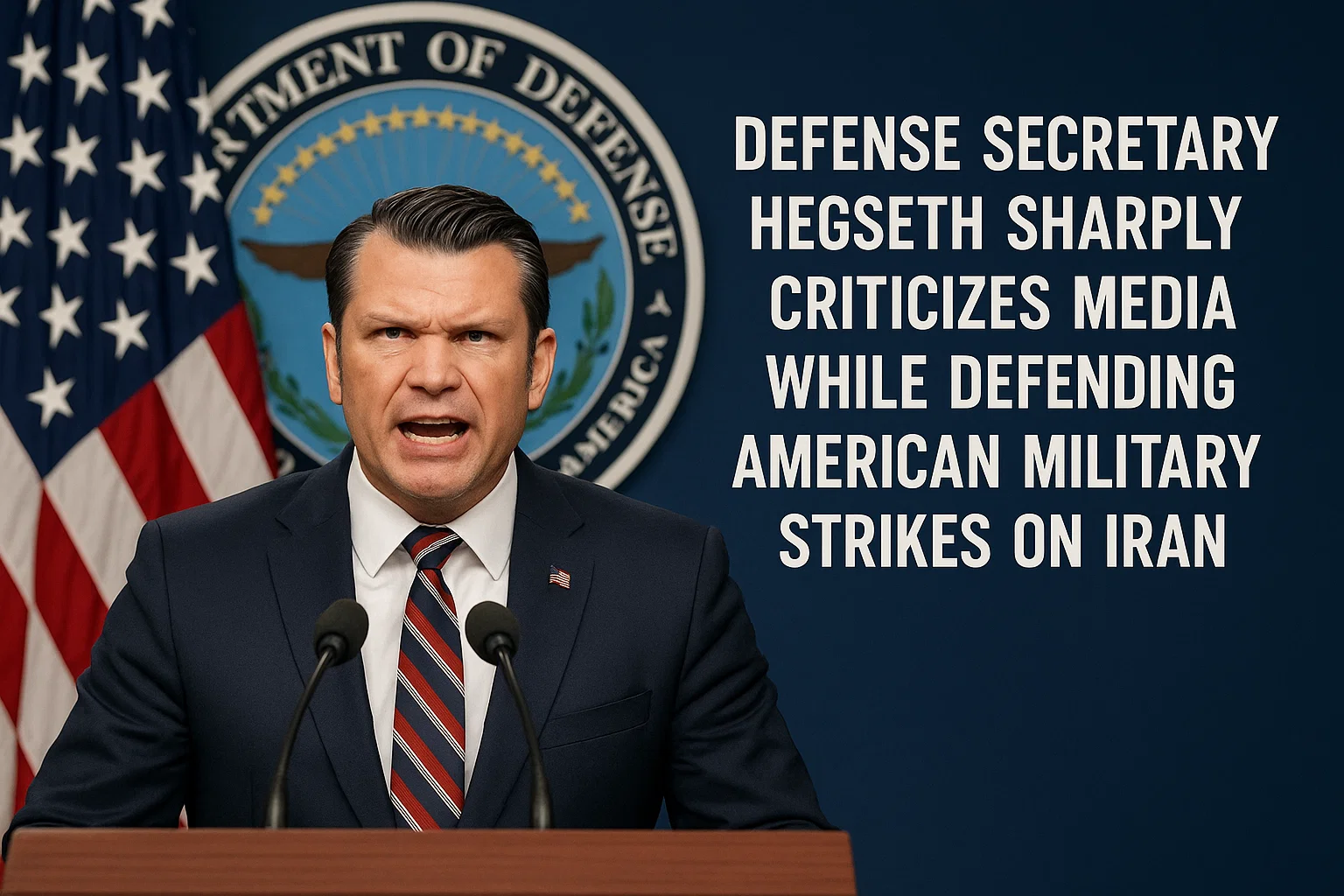
U.S. Defense Secretary Pete Hegseth lashed out at the media during a Pentagon briefing, accusing reporters of being driven by anti-Trump bias in their scrutiny of a recent U.S. airstrike on Iran’s Fordow nuclear facility.
Visibly emotional, Hegseth condemned news outlets like CNN and The New York Times for citing leaked intelligence that suggested the attack did not achieve the level of destruction claimed by former President Donald Trump. Instead of presenting new evidence during the briefing, Hegseth focused on criticising journalists — including Fox News’ Jennifer Griffin — for allegedly trying to discredit the operation.
“You cheer against Trump so hard, it’s in your blood,” Hegseth said. “You want to believe these strikes weren’t effective.”
The Pentagon’s claim that Iran’s nuclear program had been “obliterated” has faced skepticism, with analysts and media outlets using satellite imagery and other tools to verify the extent of the damage. A leaked intelligence report reportedly assessed that the strikes only delayed Iran’s nuclear activities by several months. However, Hegseth insisted more recent intelligence shows the damage was far greater and would take Iran years to recover.
“You can call it destroyed or obliterated — this was a historic success,” Hegseth said.
CIA and Intelligence Assessments
CIA Director John Ratcliffe backed Hegseth’s assertion, stating that credible intelligence from reliable sources confirmed severe damage to Iran’s nuclear infrastructure, which would take years to rebuild.
However, some nuclear experts remain cautious, noting that Iran may have preemptively relocated some of its enriched uranium, shielding it from the attack. Satellite imagery from Maxar Technologies captured increased activity at the Fordow site before the strike.
Hegseth said he had seen no evidence suggesting that Iran moved nuclear material ahead of time. Meanwhile, a senior Iranian source told Reuters that much of the material had indeed been relocated.
The head of the UN nuclear watchdog, Rafael Grossi, said inspectors are eager to return to Iranian sites to assess the full impact of the airstrikes.
White House and Diplomatic Fallout
At a separate White House briefing, Press Secretary Karoline Leavitt reiterated that the Fordow facility had been “obliterated” and accused the media of leaking intelligence to undercut a U.S. military achievement. While she said the U.S. remains in communication with Iran via intermediaries, there are currently no talks scheduled.
Iranian Supreme Leader Ayatollah Ali Khamenei accused the U.S. of exaggerating the damage. Iran’s foreign minister confirmed there are no plans to engage directly with the U.S. at this time.
Behind the Operation: A 15-Year Mission
General Dan Caine, Chairman of the Joint Chiefs of Staff, detailed the long preparation behind “Operation Midnight Hammer.” He described a top-secret mission that began over 15 years ago, focused solely on understanding and preparing to strike Fordow — a deeply buried nuclear site in Iran’s mountains.
From geological analysis to the development of the GBU-57 “bunker-busting” bomb, General Caine praised the precision and dedication of the small intelligence team that tracked Fordow’s evolution over the years. He explained how the operation struck two critical ventilation shafts, overcoming Iran’s last-minute attempt to reinforce them with concrete.
Though Caine refrained from endorsing Trump’s use of the word “obliterated,” he underscored the mission’s complexity and success.
Trump Responds
Following the briefing, Trump praised Hegseth’s performance on Truth Social, calling it “one of the greatest, most professional” press conferences he had seen. He slammed CNN for “fake news” and claimed the media’s skepticism was part of a broader effort to discredit U.S. military achievements.
Trump maintained that Iran did not have time or ability to remove nuclear materials before the strikes, calling such claims unrealistic.
