


Next week marks 40 years since the Hawke government’s landmark tax summit, an event largely shaped by then-Treasurer Paul Keating’s failed attempt to gain backing for a consumption tax. The summit stood as the public centerpiece of a broader political and policy narrative—one about the scope and limitations of ambitious reform, the power a determined treasurer can wield with a strong Treasury team, and how ministerial aspirations may collide with a prime minister’s pragmatism.
At the time, Ken Henry—later to become Treasury secretary—was part of the so-called “treasury tax reform bunker”. He reportedly averaged 100 hours a week for three months, even bringing in sleeping bags and his young children, aged three and five, as the office became a second home.
Ahead of the summit, the government released a detailed draft white paper. Keating tried to balance competing interests in support of his reform vision, but the four-day event—attended by representatives from business, unions, state leaders, and community groups—fractured under the weight of conflicting agendas. The unions, in particular, opposed Keating’s proposed consumption tax, and Prime Minister Bob Hawke decisively shut it down. Though Keating managed to implement other substantial reforms, his frustration with Hawke left a lasting rift in their relationship.
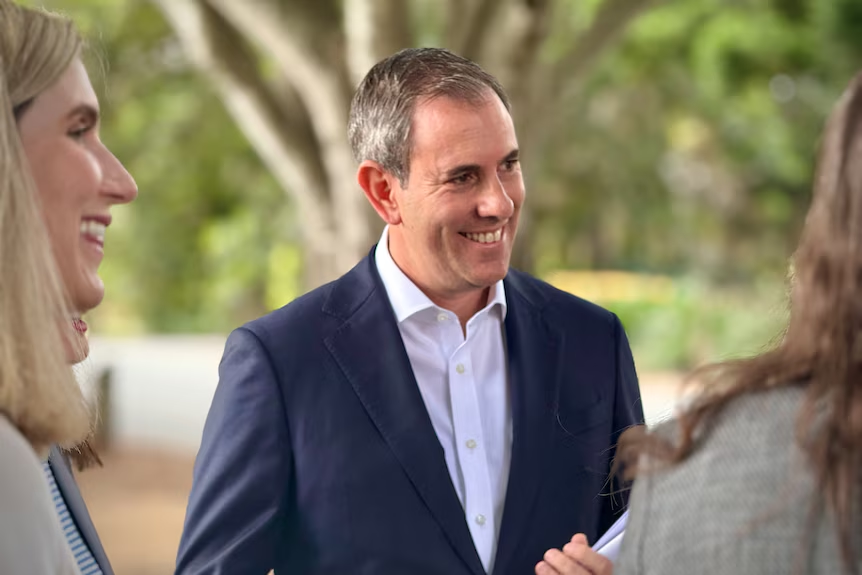
Jim Chalmers, who was seven years old in 1985, has studied Keating closely—writing his PhD on Keating’s leadership—and is clearly drawing on that history as he prepares for the government’s August 19–21 “roundtable” on economic reform, including tax.
Originally billed as a meeting on productivity, Chalmers has broadened its scope to cover economic reform, budget resilience, and sustainability. Tax reform, though not explicitly the focus, is poised to feature prominently—if not from Chalmers himself, then certainly from others in attendance. A robust and efficient tax system is seen as fundamental to boosting productivity.
Invitations for the roundtable are currently being distributed, including to business and union leaders, although the scale is far smaller than the 1985 summit—about 25 participants compared to 160. Moreover, while the Hawke-era summit concluded a policy process, Chalmers’ roundtable is set to initiate one.
Chalmers is tempering expectations, especially around concrete tax outcomes. He may aim to secure general agreement on the direction of reform rather than on specific policies. For instance, could the system shift towards lower personal and corporate taxes, offset by increased taxes on certain savings and investments?
Tax experts frequently argue that Australia’s tax model is too heavily reliant on income, not spending. This has prompted repeated calls to expand or raise the GST to fund income tax reductions. Although Chalmers has long opposed changes to the GST, he’s leaving the door open for it to be discussed—unlike during Kevin Rudd’s government, when the GST was excluded from a major review led by Henry.
However, consensus on GST reform—particularly from both unions and business—is unlikely. Not least because compensating those adversely affected would be costly, and the current budget doesn’t have room for such outlays. That significantly narrows the scope of feasible reform.
On The Conversation podcast, Ken Henry said that if he were crafting a reform package today, he’d consider expanding and possibly increasing the GST. But he also believes that major reform is possible without changing the GST’s scope or rate.
Henry’s preferred changes include scrapping outdated state taxes like stamp duty and raising more revenue from taxing land, natural resources, and pollution. He argues that this would help reduce the tax burden on younger workers by enabling lower income taxes and reintroducing income tax indexation.
He’s particularly concerned about how the current system disproportionately burdens younger taxpayers. Addressing this might also prompt scrutiny of the generous tax settings for wealthier retirees. Chalmers is already navigating this contentious space with proposed changes for those with superannuation balances over $3 million.
The roundtable may also reopen debates around negative gearing and the capital gains tax discount. While Labor pledged no changes to negative gearing this term, Chalmers had policy work done on it in the last term and may still favour reform—though it remains uncertain whether Prime Minister Albanese would go that far.
Albanese’s stance on reform remains a key question. Will he only endorse widely supported proposals? And how far is he willing to push beyond what the government has an explicit mandate for?
For Chalmers, real tax reform will demand sustained effort over many months. It can’t be rushed, but delaying too long could see the government’s political capital diminish—especially if public goodwill is more due to opposition weaknesses than strong policy wins.
Unlike in 2022, when the Liberals snubbed Labor’s jobs summit, this time shadow treasurer Ted O’Brien has accepted the invitation and will attend the roundtable. It’s a delicate task for him—he’ll need to strike a balance between being constructive and avoiding support for policies the Coalition might later oppose. Without a formal tax policy in place, O’Brien’s presence offers him a chance to build relationships and gain insight into key economic positions.
How O’Brien performs will be watched closely, especially by business leaders keen to assess whether opposition figures like Sussan Ley are genuinely committed to constructive dialogue.
Michelle Grattan is a Professorial Fellow at the University of Canberra and Chief Political Correspondent at The Conversation, where this article originally appeared.
