


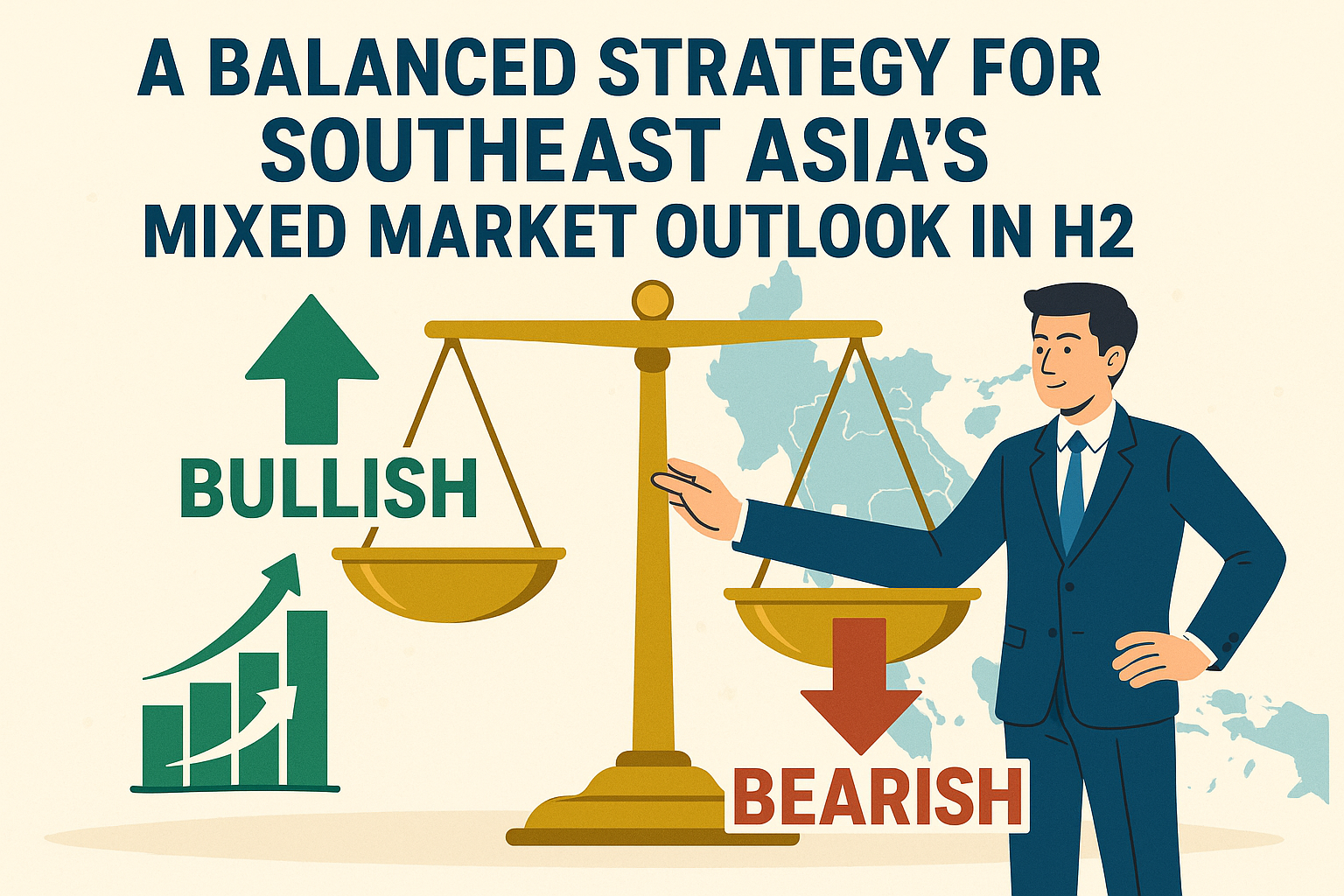
As we enter the second half of the year, ASEAN’s market outlook remains mixed, offering both opportunities and headwinds. While monetary easing and more clarity on U.S. trade policy provide a more positive backdrop for equities, persistent global uncertainties could continue to weigh on corporate earnings. With the risk of a U.S. and global recession still high at around 40%, ASEAN economies face notable challenges.
Much attention has been paid to reciprocal tariffs, but what could truly shift the needle for ASEAN is the fate of tariff exemptions on semiconductors, pharmaceuticals, and select commodities. For nations like Malaysia and Singapore—where about 60% of exports benefit from such exemptions—outcomes from ongoing Section 232 trade investigations in the U.S. will be pivotal in determining tariff baselines.
Monetary Policy as a Supportive Force
Expected rate cuts across the region are likely to ease pressure on sectors such as real estate and consumer staples by improving liquidity and encouraging investment. Singapore’s recent adjustments to the S$NEER slope have already lowered borrowing costs, supporting real estate investment trusts (REITs) and potentially increasing local equity fund flows.
The Philippines is also positioned for additional rate cuts—possibly two more of 25 basis points each—supporting equity revaluation and spurring growth in consumer credit and real estate.
Trade Policy Clarity Boosts Market Confidence
Greater transparency in U.S. trade policies could lift investor sentiment further. The recent U.S.-Vietnam agreement, which cut tariffs on domestically produced goods to 20%, could serve as a model for other ASEAN members. This two-tier system—with higher tariffs on re-exported goods and lower rates for direct domestic exports—sets a clearer path for future trade negotiations.
Similar agreements have been reached with Indonesia and the Philippines, both securing 19% tariffs. Hopes are rising for similar deals with Thailand and Malaysia. Vietnam’s equity market, buoyed by strong fiscal support and a potential upgrade to FTSE Emerging Market status, has gained more than 9% month-to-date. We’ve upgraded Vietnam to an “overweight” allocation, expecting over US$500 million in capital inflows as a result.
Sectoral Bright Spots
Within this shifting landscape, several sectors show strong potential. In Vietnam, the industrial, logistics, and technology sectors stand to benefit from government-backed science and infrastructure investments.
In the Philippines, real estate is on the mend, driven by falling mortgage rates, infrastructure progress, reduced inventory, and lower vacancy rates in key central business districts—factors that could lift rental income by 2026.
Singapore also presents opportunities in REITs and small- to mid-cap stocks, supported by interest rate cuts, strong dividend yields, and the Equity Market Development Programme.
Risks and Uncertainties
Nonetheless, several risks persist. U.S. inflation continues to pose a threat to ASEAN equities. A sharp rise in the U.S. 10-year yield could spark reassessments of valuations and volatility across asset classes—particularly in manufacturing- and export-heavy ASEAN economies.
Geopolitical tensions and growing protectionism also cloud the outlook. Ongoing scrutiny of transshipment activities and sector-specific exemptions, especially in semiconductors and pharmaceuticals, complicates regional trade dynamics.
The introduction of “Liberation Day” tariffs on August 1 for ASEAN nations that received Trump’s trade notices adds further uncertainty. Even with negotiated settlements, effective tariffs are expected to be higher than the current 10% baseline, with sector-specific levies compounding the risk.
Striking a Balanced Path Forward
In conclusion, ASEAN faces a delicate balancing act amid ongoing global headwinds. Yet, monetary stimulus and improved trade clarity offer meaningful upside potential. Investors are advised to take a measured approach, emphasizing quality, defensive assets with strong domestic fundamentals.
