


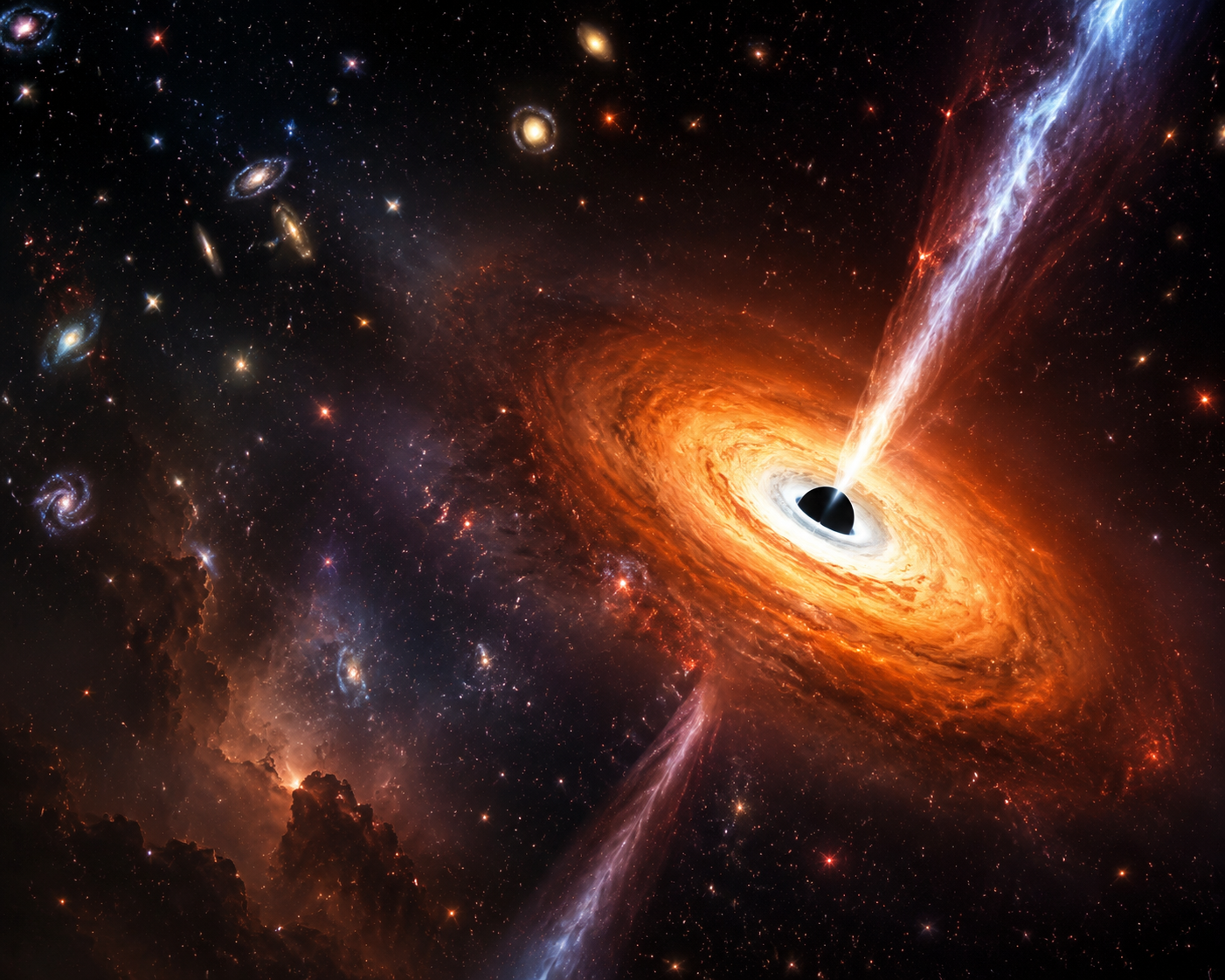
Astronomers have discovered EUCL J172902.75+641018.1, the most distant quasar ever observed, revealing a powerful black hole that existed when the universe was only about 670 million years old. The discovery provides new clues about how giant black holes formed and grew so rapidly in the early universe.
The record-breaking object was identified by the European Space Agency’s Euclid space telescope as part of a survey that uncovered 31 ancient quasars from the universe’s earliest period. EUCL J172902.75+641018.1 has a redshift of about 7.77, making it the most distant quasar known so far.
A quasar forms when enormous amounts of gas and dust spiral into a supermassive black hole. The intense friction and gravitational forces heat the material to extreme temperatures, producing radiation so powerful that the quasar can shine brighter than its entire host galaxy.
Scientists estimate that the newly discovered quasars were already powered by massive black holes when the universe was just 5 per cent of its current age. Some of these black holes appear to have masses reaching hundreds of millions or billions of times that of the Sun, creating a major challenge for existing theories of black hole formation.
The discovery raises a major scientific question: how did such enormous black holes become so massive so quickly after the Big Bang? Researchers suggest they may have formed from unusually large “seed” black holes or grown at rates much faster than previously believed possible.
Before Euclid’s observations, only a small number of extremely distant quasars had been detected. The telescope’s wide-field survey capability has allowed scientists to identify a much larger population of early quasars, opening a new era for studying the first galaxies, black hole growth and the evolution of the young universe.
Researchers say future observations from Euclid, the James Webb Space Telescope and other advanced observatories could help explain how these cosmic giants appeared so early in history and reshape our understanding of the universe’s first billion years.
