


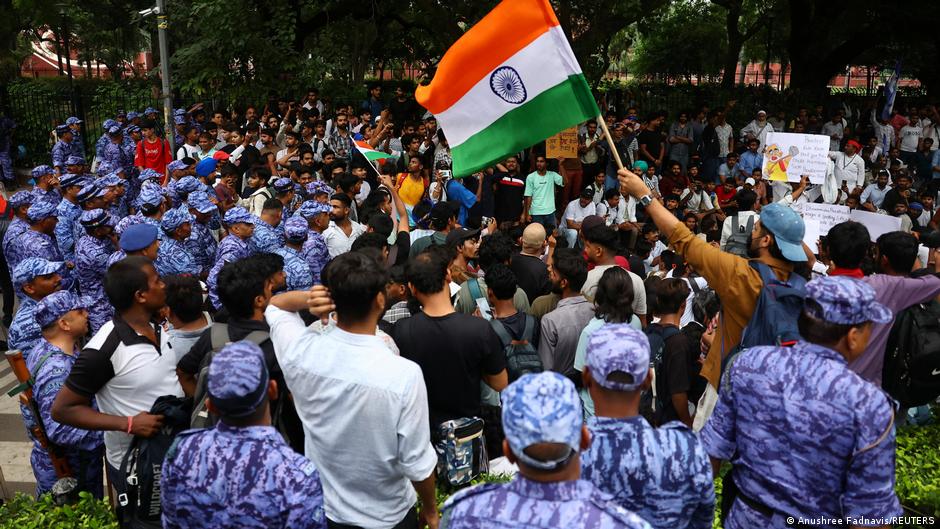
India’s political tensions have intensified as three separate protest campaigns unfold at the same time, with the Cockroach Janta Party leading a student movement over the alleged NEET paper leak, while the Bharatiya Janata Party and Congress stage nationwide demonstrations against each other.
At the centre of the confrontation is the youth-led CJP movement, which has been demanding the resignation of Union Education Minister Dharmendra Pradhan and major reforms to India’s competitive examination system.
Educational Resources
The protests began over allegations that the NEET-UG question paper had been leaked, affecting millions of medical aspirants and raising wider concerns about examination security, fairness and accountability.
The CJP has said it remains open to negotiations but insists that the central government must take the initiative. The group has proposed that talks be held either at a neutral location or at the Jantar Mantar protest site in New Delhi.
The movement has refused to abandon its sit-in despite clashes with police earlier in the week.
Thousands of mostly young demonstrators gathered at Jantar Mantar on Monday before attempting to march towards Parliament. Police used tear gas and batons to prevent the procession from moving forward.
Witnesses said dozens of protesters and security personnel were injured during the confrontation.
Videos showing students being struck, detained and dragged away circulated widely on social media, triggering criticism from opposition leaders, activists, celebrities and sections of the public.
The protests gained further momentum after climate activist Sonam Wangchuk, whose hunger strike had become a powerful symbol of the movement, was removed from the protest site and transferred to hospital.
As the student agitation continued, Congress launched its own nationwide protest against the central government.
The party condemned the police action at Jantar Mantar and protested the temporary detention of Rahul Gandhi, Priyanka Gandhi Vadra and other senior leaders during a demonstration near Prime Minister Narendra Modi’s residence.
Congress workers organised protests in cities including Thiruvananthapuram, Guwahati, Jabalpur and Bhubaneswar.
In Kerala, Congress and Kerala Students Union members demonstrated against the detention of the Gandhi siblings and other party leaders.
In Guwahati, protesters accused the government of using excessive force against students and attempting to suppress opposition voices.
Similar demonstrations were held in Madhya Pradesh, where Congress members demanded accountability for the treatment of party leaders and student protesters.
Senior Congress figures, including party president Mallikarjun Kharge, Rahul Gandhi, Priyanka Gandhi Vadra, K.C. Venugopal and Pawan Khera, joined the protest near Lok Kalyan Marg.
Other opposition leaders also participated, further increasing the political pressure on the government.
The Congress campaign prompted a counter-protest from the ruling BJP.
The BJP organised demonstrations outside Congress offices across the country, accusing the opposition party of irresponsible and disorderly conduct near the prime minister’s residence.
Party leaders argued that the Congress protest created an unacceptable security risk around one of the country’s most highly protected locations.
BJP president Nitin Nabin criticised Rahul Gandhi’s behaviour, saying it was inappropriate for someone holding the constitutional position of Leader of the Opposition.
He accused Gandhi of failing to respect the responsibilities and dignity associated with his office.
BJP spokesperson and parliamentarian Sambit Patra also condemned the Congress demonstration.
Patra said the prime minister’s residence was governed by strict security arrangements and protocols. He warned that large political crowds near the premises could be exploited by undesirable or anti-social elements.
He questioned whether it was responsible to expose the prime minister’s residence to such risks in the name of democratic protest.
The BJP described Congress’s actions as politically motivated and accused the opposition of exploiting student concerns to target the government.
Congress, in turn, said the ruling party was attempting to divert attention from the examination controversy and the police response to the student march.
The result has been a three-sided political confrontation.
The CJP continues to focus on examination reforms, accountability and Pradhan’s resignation.
Congress has aligned itself with the students while also protesting the detention of its senior leaders.
The BJP is defending the government and attacking Congress over its demonstration near Modi’s residence.
The CJP movement initially emerged as an online satirical campaign but quickly developed into a nationwide youth protest.
Its growth reflects broader dissatisfaction among young Indians over paper leaks, unemployment, the rising cost of education and the pressure associated with competitive examinations.
The NEET controversy has become one of the sharpest political challenges facing Modi’s government in its current term.
Young voters have traditionally been an important electoral base for the BJP, making the scale of the protests particularly significant.
The government has said it is willing to discuss student concerns and introduce reforms aimed at preventing future examination failures.
Prime Minister Modi has promised action against those responsible for paper leaks, while Education Minister Pradhan has said the issue can be debated in Parliament.
Educational Resources
However, the CJP insists that meaningful negotiations require direct engagement and concrete commitments.
The group says it will continue its protest until the government formally responds to its demands.
With three rival protest campaigns now taking place across India, the examination controversy has moved far beyond the original allegations of a leaked question paper.
It has become a broader struggle involving student anger, opposition politics, police conduct, national security and the government’s handling of dissent.
