


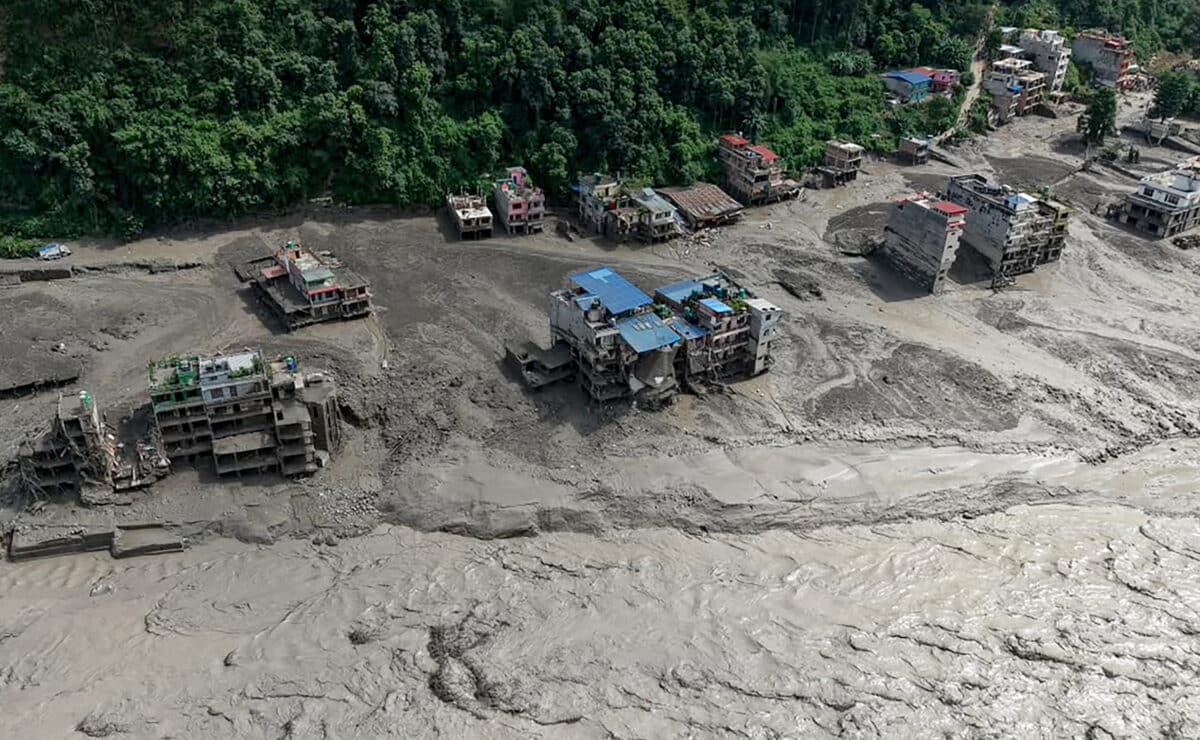
Nepal is continuing investigations into the cause of the devastating Bhotekoshi flash flood that killed dozens of people and caused widespread destruction near the Nepal-China border, with officials suspecting that an earthquake or glacier-related event may have triggered the disaster.
The sudden flood, one of Nepal’s most serious natural disasters in recent years, destroyed villages, damaged infrastructure and swept away communities along the Bhotekoshi River in Rasuwa district.
Authorities have not yet confirmed the exact cause of the disaster, but preliminary assessments suggest that a glacial event, possibly triggered by an earthquake in Tibet, may have caused a massive release of water and debris into the river system.
Earthquake connection under investigation
Nepal’s Foreign Minister Shisir Khanal told Parliament that a magnitude 4.4 earthquake struck Tibetan territory at around 8:37am, followed shortly by reports of the flash flood at approximately 8:40am.
According to the United States Geological Survey, the earthquake occurred about 47 kilometres north of Gosainkunda.
Officials said further scientific investigation is needed to confirm whether the earthquake directly triggered the flood.
The National Disaster Risk Reduction and Management Authority (NDRRMA) said satellite analysis from Planet Labs showed that a debris-filled flood entered the Lhende River after a possible glacier-rock collapse near the Nepal-China border.
The flood reportedly originated around 20 kilometres northeast of the Rasuwagadhi border crossing before flowing through Timure and eventually reaching the Trishuli River.
Cause remains unclear on both sides of the border
Despite ongoing investigations, authorities in both Nepal and China have not yet determined the exact cause of the massive flood.
Nepal officials said they are seeking real-time information from Chinese authorities and scientific institutions to understand how the disaster developed.
“We need to verify the information through scientific evidence,” Foreign Minister Khanal said, adding that communication difficulties in the remote Himalayan region have made investigations more challenging.
Nepal’s consul general in Lhasa, Laxmi Prasad Niraula, said Chinese authorities were also struggling to identify the source of the flood.
He said communication networks, roads and internet services in the affected region were severely disrupted, preventing officials from obtaining reliable information.
“Neither side has confirmed the exact reason behind the flood,” Niraula said. “A glacial outburst is suspected, but it has not yet been verified.”
Officials are examining whether heavy rainfall in Tibet’s Manasarovar and Ali regions may also have contributed to the disaster.
Concerns over cross-border warning systems
The disaster has renewed concerns about Nepal’s vulnerability to glacier-related floods and the absence of a fully operational cross-border early-warning system.
Experts said timely information sharing between Nepal and China could help communities downstream prepare for sudden flood events.
A similar disaster occurred in July 2025 when a glacial lake burst in China’s high mountain region, sending floodwaters through the Lhende Khola and Bhotekoshi River system.
That flood killed at least 11 people, destroyed the Miteri Bridge connecting Nepal and China, and damaged roads, hydropower facilities and border infrastructure.
Although Nepal and China agreed to improve cooperation on flood and landslide information sharing, officials said a formal real-time warning mechanism has not yet been established.
International assistance offered
As Nepal continues rescue and recovery operations, several countries and international organisations have offered support.
India, China, the United States and the World Bank have expressed readiness to provide emergency assistance, including relief supplies, financial support and reconstruction aid.
Indian Prime Minister Narendra Modi expressed condolences over the loss of lives and property and assured Nepal of India’s support.
Nepal officials said India has prepared to send emergency materials, medicines, equipment and disaster response teams if requested.
Indian Air Force transport aircraft and rescue teams were reportedly placed on standby.
China has also informed Nepal that it is ready to provide assistance based on Nepal’s requirements.
The United States has communicated its willingness to support Nepal’s recovery efforts, while the World Bank has offered financial assistance for emergency response and reconstruction.
According to officials, the World Bank could mobilise up to 25 billion Nepali rupees from various sources for disaster recovery, although details regarding the form of assistance are still being discussed.
Government declares affected areas crisis zones
Nepal’s Cabinet has declared flood-affected municipalities in Rasuwa, Nuwakot and Dhading as crisis-hit areas to accelerate rescue, relief and recovery operations.
The government has also issued warnings to communities living along the Bhotekoshi, Trishuli and Narayani rivers, urging residents to move to safer locations if water levels rise.
Chinese President Xi Jinping ordered authorities to strengthen search and rescue operations, relocate affected residents and improve disaster monitoring systems.
Chinese Premier Li Qiang also directed officials to verify casualties, mobilise rescue resources and coordinate international communication efforts.
Authorities in Tibet have launched emergency search and rescue operations while continuing efforts to determine the full impact of the disaster.
As rescue operations continue, officials say establishing a reliable Himalayan early-warning network will be essential to prevent similar tragedies in the future.
