


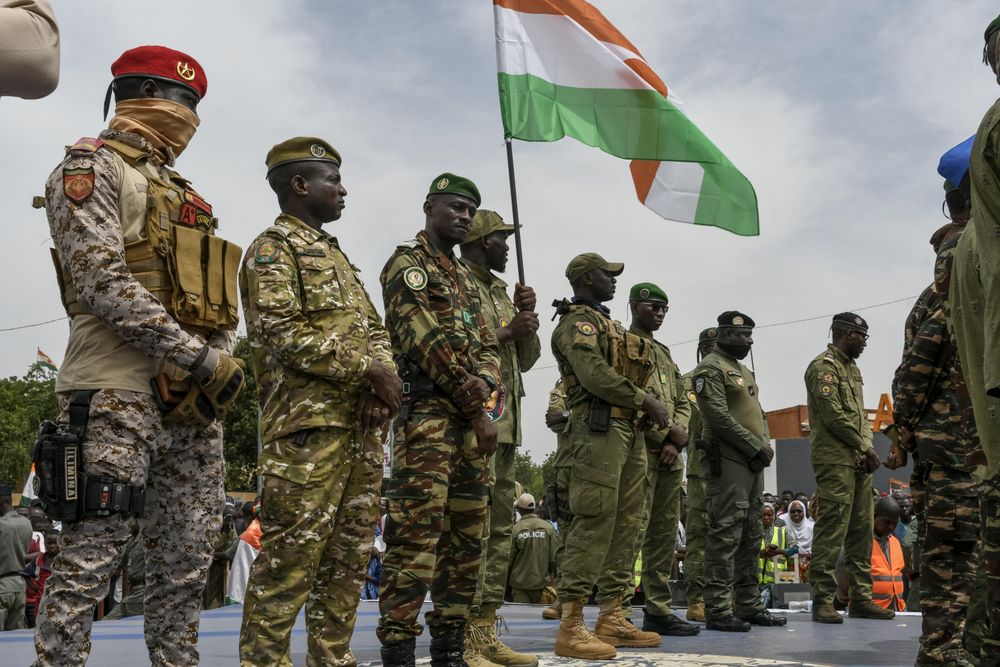
A failed military uprising in Niger has exposed deep tensions inside the country’s armed forces and highlighted President Abdourahamane Tchiani’s growing reliance on Russian support to defend his government.
The attempted power grab began on August 29, when soldiers identifying themselves as the Armed Forces for the Restoration of the Homeland launched coordinated attacks on Air Base 101 at Niamey’s international airport, the presidential palace and the national broadcaster.
During the fighting, a statement falsely claimed that Tchiani had been removed from power.
Loyalist forces eventually defeated the mutiny, but the episode revealed both internal divisions within Niger’s military and the increasing importance of Russia’s Africa Corps in the country’s security structure.
Russian Forces Help Retake Strategic Airbase
Presidential guard units loyal to Tchiani managed to hold the presidential palace through the night.
At the same time, roughly 200 personnel from Russia’s Africa Corps reportedly helped government forces regain control of Air Base 101.
Russian units were supported by drones and were reportedly reinforced by personnel arriving from Mali and Libya.
By the end of the fighting, loyalist forces had regained control of the key military installation.
At least 27 people were killed during the unrest, while around 100 suspected mutineers were arrested.
The operation demonstrated that Russian personnel are now playing a role that extends beyond counterinsurgency support.
Mutiny Exposes Divisions Inside the Army
Security analysts say the attempted uprising reflects grievances that have been developing inside Niger’s armed forces for some time.
Ryan Cummings, head analyst at Signal Risk, said one of the biggest sources of frustration is the heavy toll suffered by junior and mid-ranking troops fighting armed groups in remote areas.
Those soldiers are often deployed to some of the country’s most dangerous front lines, where they face increasingly capable militant organisations.
At the same time, better-paid senior units, particularly the presidential guard, are generally stationed in heavily protected cities such as Niamey and Agadez.
That difference in risk, deployment and compensation appears to have deepened resentment within parts of the military.
Frontline Soldiers Face Greater Pressure
Niger’s security forces continue to battle armed groups operating across the wider Sahel.
Many junior and middle-ranking troops are stationed in areas where militant groups have become better armed, more organised and increasingly capable of overrunning military positions.
By contrast, elite and senior units often remain closer to major urban centres, where the risk of sustained combat is lower.
Analysts believe that imbalance has contributed to dissatisfaction and may have played an important role in the failed mutiny.
Russia’s Role Expands Beyond Counterterrorism
Niger’s relationship with Moscow has grown considerably since Tchiani’s government forced French and US troops to leave the country in 2023 and 2024.
Russian Africa Corps personnel entered Niger as the military leadership sought alternatives to Western security partnerships.
Initially, the relationship was presented largely as a way to strengthen Niger’s ability to fight armed groups.
The mutiny, however, demonstrated that Russian assistance now also helps protect the government from threats originating within Niger’s own military.
That represents a significant expansion in Moscow’s role.
Tchiani Increasingly Dependent on Moscow
For Tchiani, Russian support has become increasingly important as he faces challenges on multiple fronts.
His government is dealing with persistent insurgent attacks, dissatisfaction among soldiers and uncertainty over how much military assistance neighbouring allies can provide during a crisis.
The successful defence of the government during the mutiny showed that loyal Nigerien units remain capable of holding strategic positions.
However, Russia’s role in retaking the airbase also demonstrated how heavily Niamey may now depend on Moscow during a major internal security emergency.
Sahel Alliance Faces Questions
The uprising also tested the strength of the Alliance of Sahel States, which brings together the military-led governments of Niger, Mali and Burkina Faso.
The alliance was created partly around promises of mutual security assistance.
However, analysts noted that Niger’s two partners did not play a major visible role while the mutiny was unfolding.
Romane Dideberg, a research analyst with Chatham House’s Africa Programme, said the muted response raises questions about the operational strength of the alliance.
According to her assessment, Mali and Burkina Faso only reacted significantly once the uprising had already been contained.
Relations Between Sahel Leaders May Be Complicated
The lack of immediate assistance may reflect more than operational weakness.
Analysts believe political and personal relationships among the three military governments could also affect cooperation.
Tchiani is older and comes from a different generation of military leadership than his counterparts in Mali and Burkina Faso.
His government is also seen by some observers as maintaining greater continuity with elements of Niger’s previous political establishment.
Those differences may complicate the close cooperation envisioned under the Sahel alliance.
Mutual Defence Pact Under Scrutiny
The crisis has therefore raised questions about how effective the alliance would be if one member faced a more prolonged threat.
The three governments have repeatedly emphasised regional solidarity and collective defence.
But the Niger mutiny suggests that the alliance may still lack the operational mechanisms needed to quickly respond to an internal security emergency.
That could increase the importance of outside partners, particularly Russia.
Foreign Involvement Allegations Surface
The aftermath of the mutiny has also produced allegations that foreign interests were connected to the uprising.
Nigerien officials have made claims involving France, the United Arab Emirates and individuals linked to former President Mohamed Bazoum.
Those allegations have not been independently verified.
Roger Gabriel, a Nigerien army captain who commands an elite parachute battalion, appeared on state television on September 4 and accused several individuals of involvement in the attack.
He alleged that people connected to Bazoum, along with officers from Chad, Benin and Ivory Coast, had participated in the conspiracy.
Gabriel also claimed that individuals from the UAE contacted him and encouraged him to join the mutiny.
Claims Remain Unverified
There is currently no independently established evidence proving Emirati involvement.
Analysts have nevertheless noted that the UAE has expanded its political and economic influence across parts of Africa and the Sahel.
Hossamaldeen Ibrahim of the Bloomsbury Intelligence and Security Institute said the UAE has developed relationships with military governments, resource interests and other regional actors.
He argued that allegations of involvement should therefore be examined carefully, while stressing that they should not be treated as established fact without evidence.
Gas Pipeline Adds Another Strategic Dimension
The allegations have emerged alongside broader geopolitical competition surrounding Niger and the proposed Trans-Saharan Gas Pipeline.
The project has strategic importance because it could eventually provide another route for African gas toward Europe.
That has increased international interest in Niger’s political stability and regional relationships.
However, no verified link has been established between the pipeline dispute and the August mutiny.
Mutiny Leaves Tchiani in Power but Exposes Weaknesses
Tchiani ultimately survived the attempted uprising, but the crisis exposed vulnerabilities that may continue to shape his government.
Discontent inside the army remains a major risk.
The effectiveness of Niger’s regional alliances is also under greater scrutiny.
At the same time, Russia’s growing role means Moscow is becoming increasingly central not only to Niger’s fight against armed groups but also to the survival of the current political leadership.
The failed mutiny therefore represents more than an unsuccessful attempt to seize power.
It highlights an increasingly fragile security environment in which domestic military grievances, regional alliances and competition among foreign powers are becoming deeply intertwined.
