


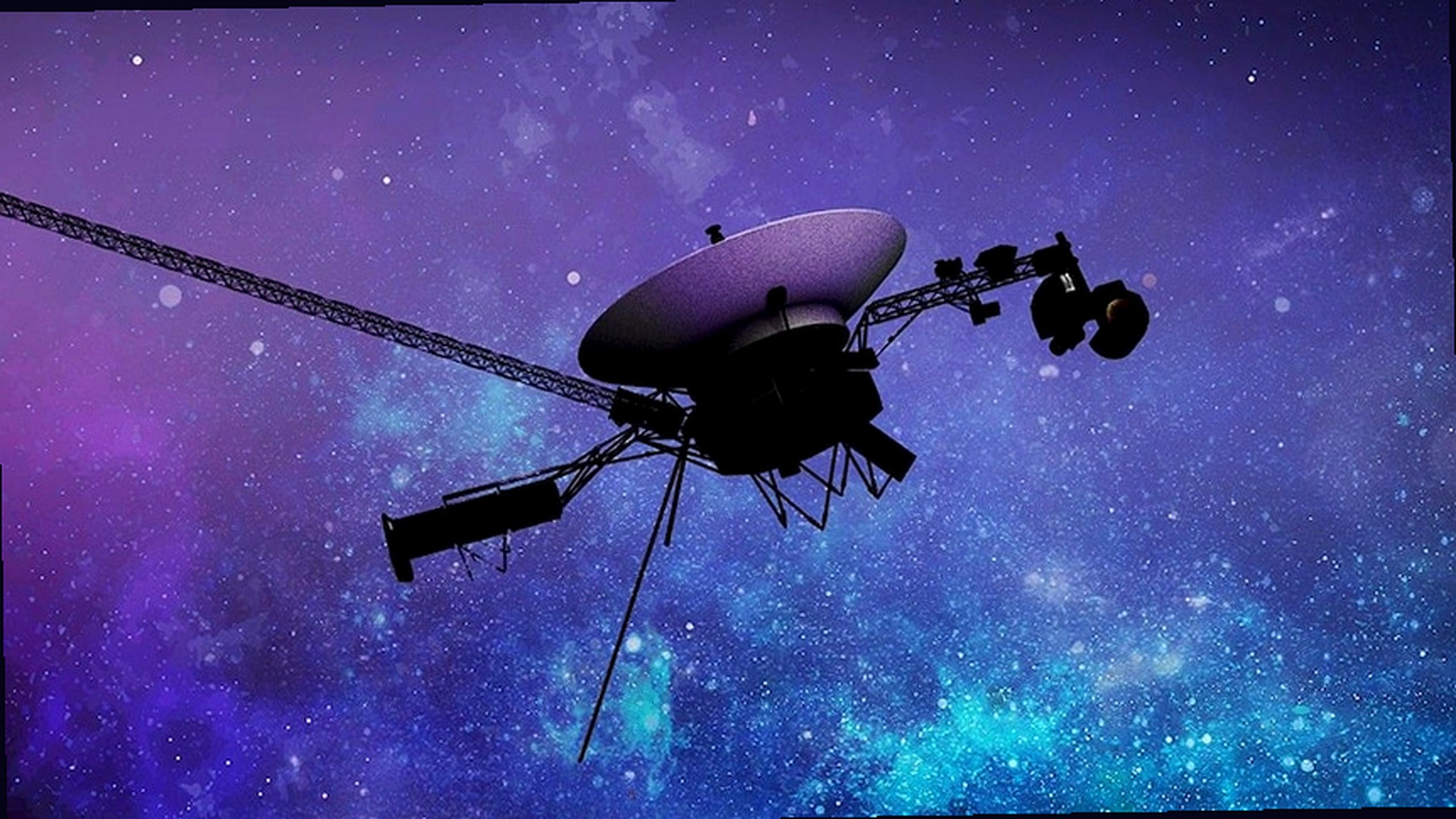
NASA’s Voyager 1 spacecraft has reached one light-day from Earth — 25.9 billion kilometres away — becoming the first human-made object ever to travel that far from our planet.
The historic milestone was reached at 9:16 pm AEDT on Wednesday, 18 November 2026. At that distance, Voyager 1 is exactly 24 hours away from Earth at the speed of light, meaning a radio signal sent from Earth would take a full day to reach the spacecraft.
NASA Voyager project scientist Linda Spilker described the moment as an incredible milestone to celebrate, noting that one light-day is a measure of distance rather than time.
Voyager 1 was launched in 1977, along with its twin Voyager 2, on a mission to explore Jupiter and Saturn. Voyager 2 went on to fly past Uranus and Neptune as well. The mission was originally expected to last only a decade, yet both spacecraft are now 49 years into their journey and will celebrate 50 years in space late next year.
Despite being built with 1970s technology — each probe stores data on an eight-track tape player and carries a computer with less memory than a modern key fob — the Voyagers transformed humanity’s view of the Solar System. They returned the first close-up images of Jupiter and Saturn, images that inspired a generation of scientists.
Planetary Society chief scientist Bruce Betts said the probes were not the first to reach Jupiter, but they returned by far the best images of Jupiter and Saturn ever seen at the time, and made those distant worlds feel real to people.
Voyager 1 crossed into interstellar space in 2012, with Voyager 2 following in 2018. That puts both craft beyond the reach of the Sun’s magnetic field, although they are still a long way from the Oort Cloud, the ring of icy objects surrounding the Solar System. Voyager 1 has now travelled about 173 astronomical units from Earth.
The spacecraft is tracked by NASA’s Deep Space Network of telescopes in Canberra, California and Madrid. Travelling at 61,000 kilometres per hour, Voyager 1 reached the light-day mark as predicted. Voyager 2, which can now only communicate with the Canberra station, is not expected to reach the same milestone until late 2027.
The mission is now running on borrowed time. In recent decades NASA has switched off almost all of the equipment aboard the spacecraft, and the team has had to manage faults caused by failing hardware and clogged thrusters. Dr Spilker said the spacecraft should have enough power and thermal energy to keep going until about the early 2030s, but the hardware itself is the greater concern, and the spacecraft is growing colder as its power fades.
Only two instruments aboard Voyager 1 still work, measuring the Sun’s magnetic field and plasma, and Dr Spilker expects one of those to go quiet within about a year. Voyager 2 still has enough power to run three science instruments.
Dr Spilker, who worked on the Voyager program for 12 years from its 1977 launch and rejoined the team in 2020 expecting it to last only a few more years, said the spacecraft have outlasted every expectation. She described each extra day as a gift, and the extra years and decades as a bonus.
Last month NASA lost communication with Voyager 1 for about 48 hours before the ground team managed to reboot it and bring it back online. Dr Spilker acknowledged that one day the team will not be so lucky, and they will be left waiting for a signal that never comes.
Even when all contact is eventually lost, the two spacecraft will keep travelling away from Earth, carrying their golden records — gold-plated discs with instructions on how to find Earth, greetings in more than 100 languages and a playlist of classical and popular music. NASA has described the record as a message in a bottle, and Dr Spilker said it was made from an inert material so it would survive the harsh environment of space largely unchanged, carrying a piece of humanity in the hope that someone, someday, finds it.
