


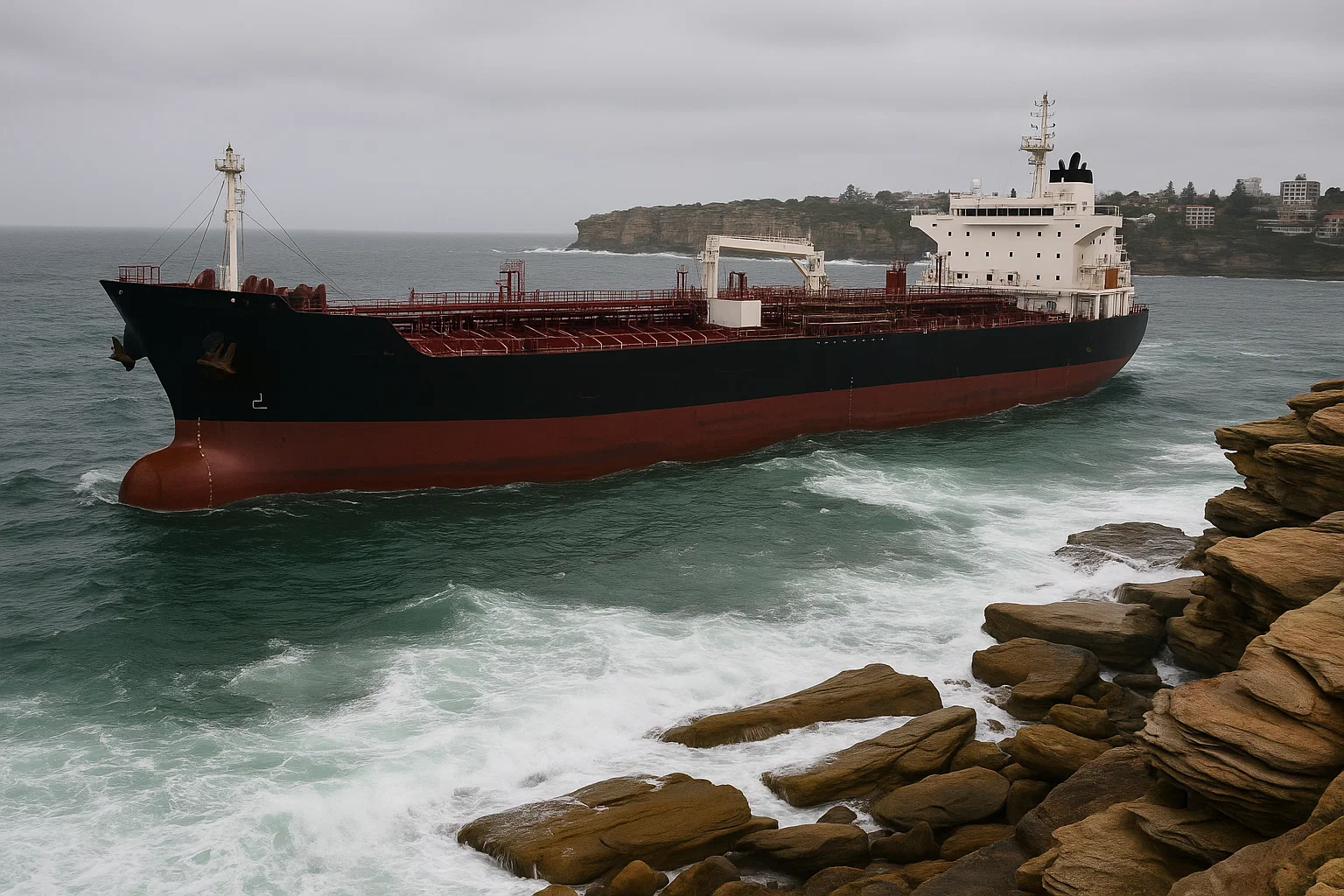
Nearly three years after a bulk carrier loaded with hundreds of tonnes of fuel oil narrowly avoided crashing into cliffs off Sydney’s Royal National Park, the national transport safety watchdog has issued an “unprecedented” number of safety recommendations.
In its final report on the July 2022 incident involving the MV Portland Bay, the Australian Transport Safety Bureau (ATSB) identified serious failures by multiple government agencies and made eight formal recommendations. The ATSB noted that the Australian Maritime Safety Authority (AMSA), Maritime NSW, and Port Authority NSW had not adequately addressed concerns raised during the initial investigation.
ATSB Chief Commissioner Angus Mitchell warned of the potentially catastrophic consequences had the 170-metre vessel, carrying 950 tonnes of heavy fuel oil, run aground. “The stranding on pristine national park coastline… would have had internationally significant environmental and economic consequences,” he said, adding that this was one of the ATSB’s most extensive marine investigations in almost 20 years.
Key Failures and Delays
The ship’s 21-member crew had departed Port Kembla on July 3, 2022, to escape storm damage when its main engine failed 12 nautical miles off the coast. This left the vessel drifting toward the cliffs in rough seas, having breached a self-imposed safety perimeter of 50 nautical miles from shore.
The report detailed a series of delays and miscommunications that hindered the emergency response:
- The ship’s master delayed reporting the engine failure.
- NSW authorities failed to promptly inform AMSA, the national response authority.
- Harbour tugs were dispatched only after multiple emergency broadcasts and radio calls for help—nearly five hours after the engine failure.
- The three responding tugs were unequipped for the severe conditions.
The only suitable emergency tow vessel, Svitzer Glenrock, arrived about 30 hours later—an “extended and unnecessary” delay, according to the ATSB.
Despite their anchors not being fit for extreme weather, the ship’s master deployed both in a last-ditch effort to prevent grounding. Even with one tug attached, the ship continued to drift toward shore overnight. Eventually, more than two days after the emergency began, the Portland Bay was safely towed into Port Botany for repairs.
Confusion Over Responsibility
Mr Mitchell criticised the lack of clear accountability among the agencies involved. “Each agency did not believe the response necessarily fell within their responsibility,” he said, pointing to differing interpretations of emergency plans.
Port Authority NSW responded by stating it played a key role in averting disaster and committed to working with AMSA and NSW Maritime to clarify roles and improve emergency protocols.
AMSA acknowledged the incident had exposed “areas for improvement” and said it had since reviewed its procedures and successfully managed similar cases.
The ATSB will continue to monitor the agencies’ responses to ensure recommended actions are implemented, aiming to prevent similar high-risk situations in the future.
