


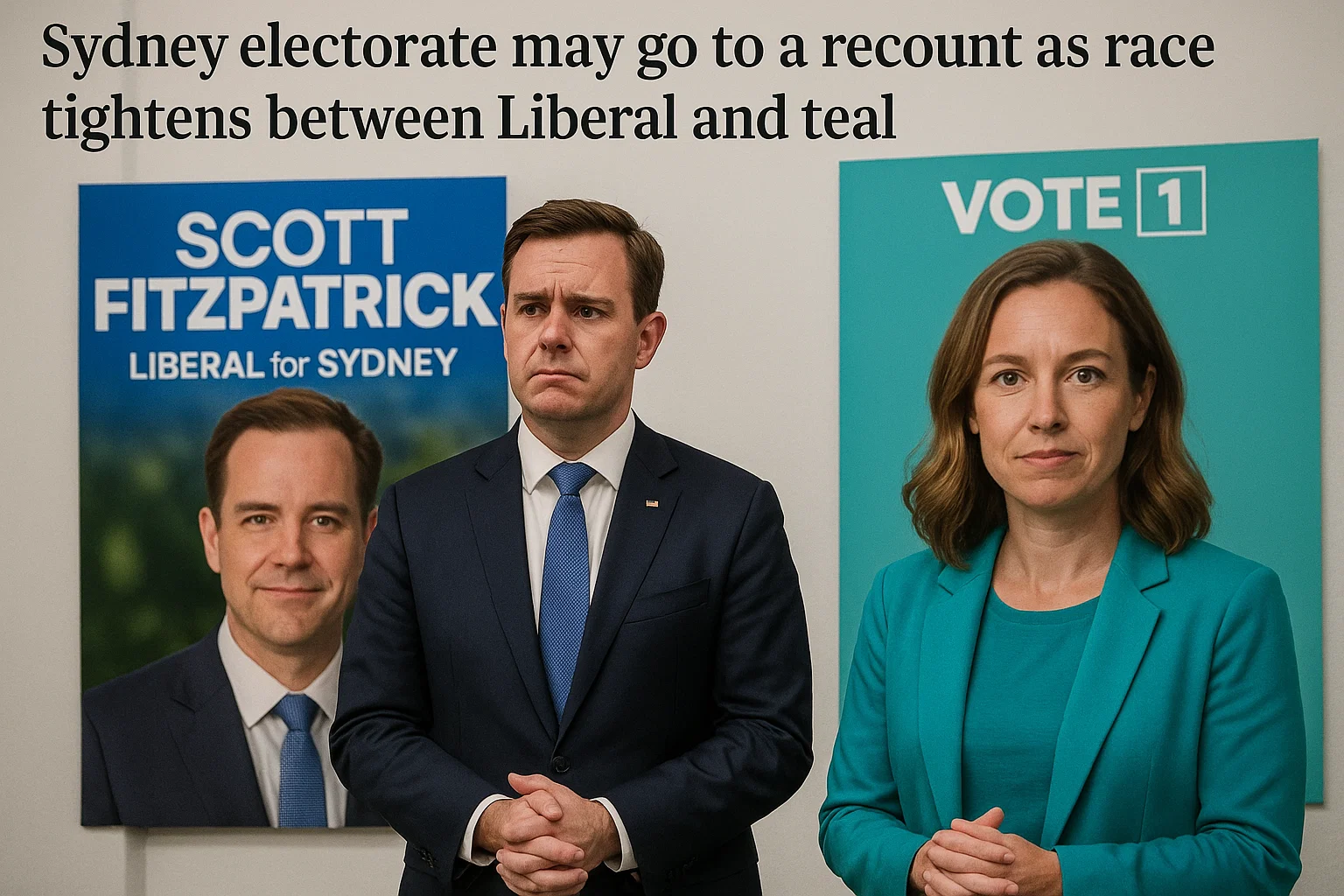
Bradfield Election Result Goes Down to the Wire
Bradfield, long considered the Liberal Party’s safest urban seat, has become one of the tightest races in the 2025 federal election.
After the full count of primary votes, an indicative preference tally shows independent candidate Nicolette Boele narrowly defeating Liberal contender Gisele Kapterian by just 39 votes.
This close outcome has come as a surprise, especially since independents typically don’t perform strongly in Postal, Absent, and Pre-Poll Declaration votes. Ms Boele’s primary vote was also relatively weak. However, strong performances by Labor and the Greens in those same categories helped boost Boele’s position after preferences — giving her a narrow lead in her second attempt to win Bradfield.
Next Step: Official Preference Distribution
Despite her current lead, Boele’s 39-vote advantage is based on an indicative preference count. This method, introduced in 1993, is used to provide an early sense of the outcome by nominating two likely final candidates and reallocating other candidates’ preferences to one of them.
However, the formal and official preference distribution — the one used to declare a winner — still needs to be conducted. This involves eliminating the lowest-polling candidates one at a time, redistributing their preferences to remaining candidates, until only two are left. This full count is expected to take about a week, with scrutineers overseeing the process closely.
Recount Rules
If the final margin exceeds 100 votes and no recount is requested, the Australian Electoral Commission (AEC) will return the writ with the declared winner. If the margin is under 100 votes, a recount is automatic. Even if it’s above that threshold, a candidate can request a recount if they have valid reasons.
A recount involves checking all formal and informal votes for accuracy and repeating the distribution of preferences. Only one recount is permitted. Once complete, the winner is officially declared and may take their seat in Parliament, even if a legal challenge is filed.
In the rare case of a tie, a supplementary election would be required.
Legal Challenges and Court of Disputed Returns
The election result can also be contested in the Court of Disputed Returns. The legal argument would be that the person named on the returned writ should not have been elected, due to either misconduct or significant errors in the election process.
Proving that mistakes occurred isn’t enough; the petitioner must show that the errors were significant enough to cast doubt on the final result. In extreme cases, such as proven corruption, the court could void the result immediately.
Though the court has the power to declare a different winner, it more commonly either upholds the original result or orders a new election.
Will a Challenge Be Filed?
Whether the losing side chooses to challenge will depend on the political calculus: is there a realistic chance of winning a re-run? History shows that parties sometimes decline to challenge tight results if they believe the political climate is not in their favor.
For instance, Labor lost Hawker by 14 votes in 1990 but did not challenge, believing it would not win a re-election. Conversely, successful challenges have occurred in other cases, such as the 1995 Queensland state election, where a court-ordered re-election shifted the balance of power and changed the premiership.
If Ms Boele’s lead holds through the recount, the Liberal Party must decide whether it is worth contesting the outcome — especially if a by-election might not work in their favor. Likewise, if Kapterian pulls ahead after the recount, Boele would need to consider whether she has the resources and backing to mount a legal challenge.
Given how razor-thin the margin is in Bradfield, any fresh election would come at a significant cost — financially and politically.
