


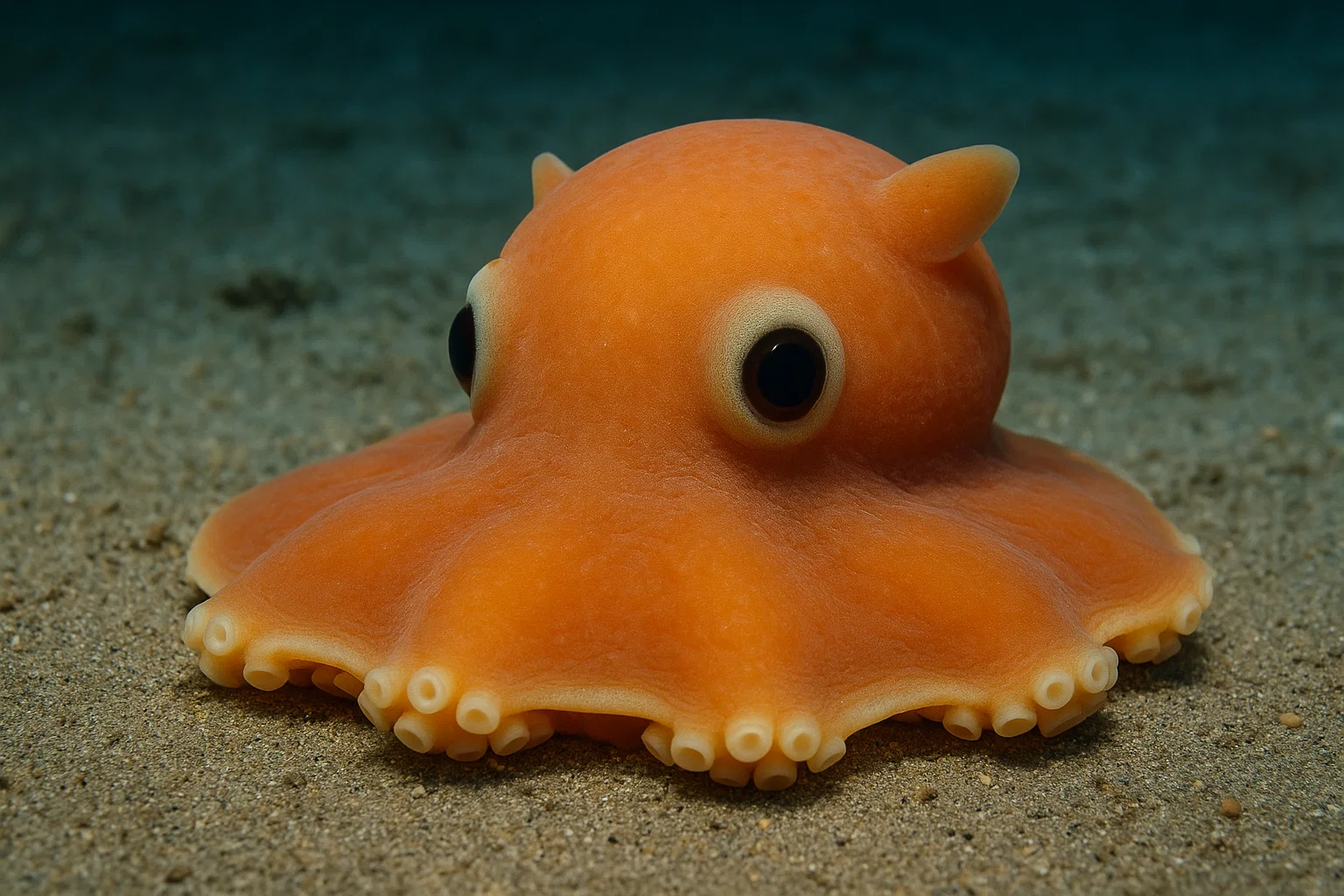
Tiny Deep-Sea Octopus Species Discovered Off WA Coast
Scientists have identified a new deep-sea species — the Carnarvon flapjack octopus (Opisthoteuthis carnarvonensis), a small, gelatinous creature with large eyes and vivid red tentacles, discovered off Western Australia.
First collected in 2022 during a CSIRO research voyage in Carnarvon Canyon Marine Park, the species was officially named only last week. This newly classified octopus grows to just 4 centimetres in length and has the unique ability to flatten its body, mimicking a pancake — a signature trait of the flapjack group.
The Carnarvon flapjack is a type of cirrate or “dumbo” octopus, named for the ear-like fins on top of its head which aid in swimming. These rare creatures reproduce and grow slowly. Unlike other octopus species, they lack the ability to produce ink or change colour.
Living more than 1,000 metres below the ocean’s surface, their large eyes help them locate prey like worms and small crustaceans in the dark.
Naming a New Species: A Detailed and Precise Process
Tristan Verhoeff, a volunteer systematic taxonomist at the Tasmanian Museum and Art Gallery, was responsible for naming the species. He described the year-long process as “fun” but meticulous, requiring careful comparisons of physical traits and existing scientific literature.
“It’s easy to assume you’ve found a new species when you haven’t,” Dr Verhoeff said, highlighting the need for precision. The process involved detailed measurements, sucker counts, internal dissections, and high-resolution imaging.
Boosting Knowledge of Deep-Sea Biodiversity
Dr Verhoeff has named six other cirrate octopus species since 2021, some of which had gone unclassified in museum collections for years. He noted these discoveries help enhance scientific understanding of deep-sea biodiversity and Australia’s marine ecosystems.
He also revealed that Australia has more cirrate octopus diversity than any other country, with 15 of the 50 known species found in its waters.
Because the Carnarvon flapjack is unique to north-western Australia, Dr Verhoeff said its discovery underscores the ecological value of the region’s recently declared marine parks.
Part of a Surge in Deep-Sea Discoveries
The flapjack octopus is the 10th new species discovered during the 2022 CSIRO voyage. Others include the painted hornshark and the parallel-spine scorpionfish.
Using cutting-edge underwater cameras and sampling tools like nets and sleds, scientists surveyed the ocean floor thousands of metres deep. Since then, research teams and museum partners have been working to formally identify and describe the collected specimens.
CSIRO Marine National Facility’s Venetia Joscelyne said these discoveries support better marine conservation efforts by providing crucial insights into the richness of Australia’s underwater life.
