


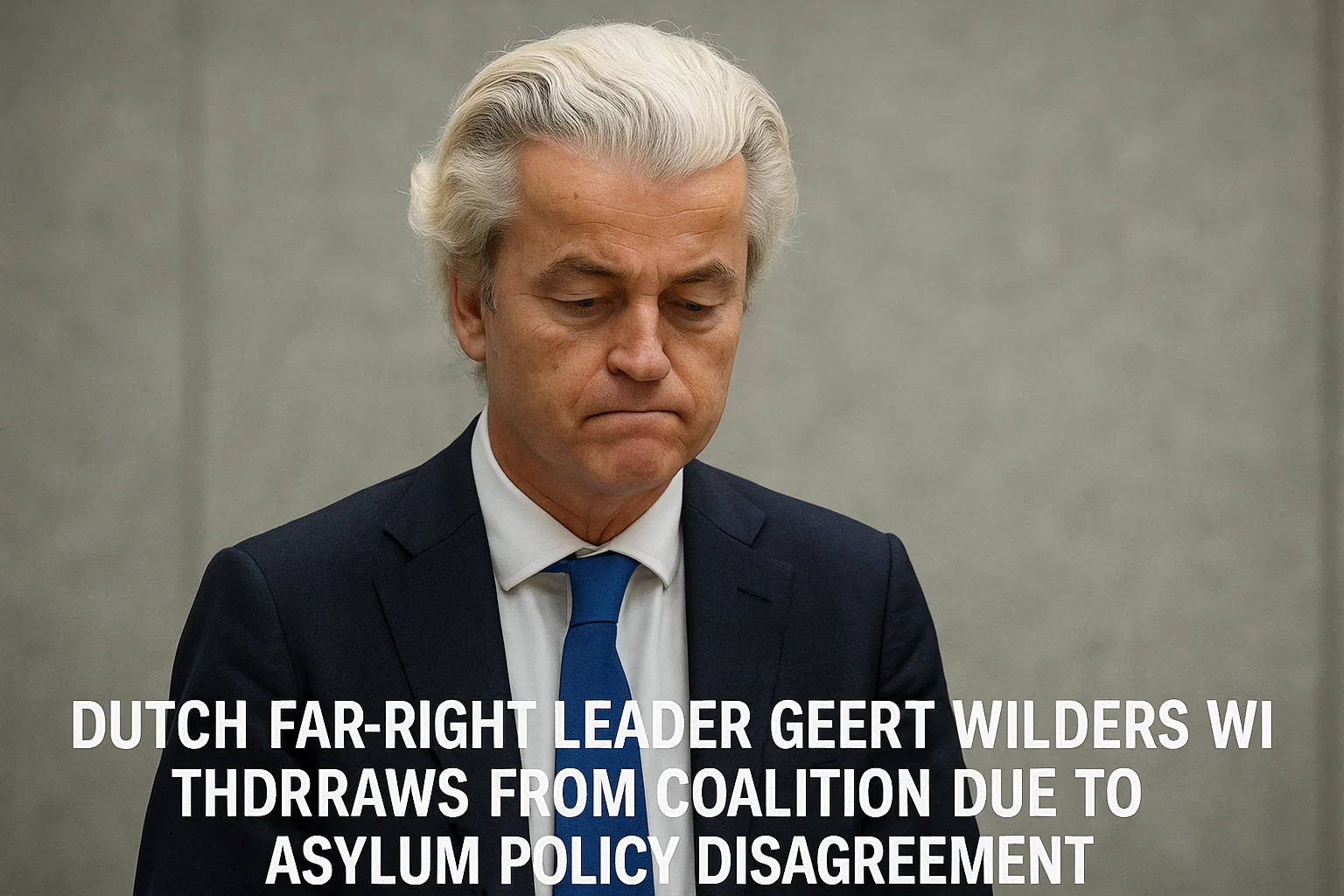
On Tuesday, Dutch far-right leader Geert Wilders announced that his PVV party would exit the ruling coalition, causing the collapse of the right-wing government and likely triggering new elections.
Wilders, an anti-Muslim populist who secured the largest share in the recent Dutch elections, last week demanded immediate backing for his proposals to fully stop asylum migration, deport Syrian refugees, and shut down asylum shelters.
He stated that his coalition partners refused to accept his plans to halt asylum migration.
“No agreement on our asylum plans. The PVV is leaving the coalition,” Wilders posted on X following a brief meeting of the four coalition party leaders in parliament.
He informed Prime Minister Dick Schoof that all PVV ministers would resign after he decided to withdraw from the coalition.
“I committed to the toughest asylum policy, not the collapse of the Netherlands,” Wilders told reporters.
Dilan Yesilgöz, head of the right-wing People’s Party for Freedom and Democracy, said before the meeting that Prime Minister Schoof had urged leaders to act responsibly. “The prime minister reminded us this morning of the immense international challenges we face — a war on our continent and the possibility of an economic crisis,” Yesilgöz said.
However, minutes later, the meeting ended, as did Wilders’s role in the government.
“Yes, I’m shocked,” Yesilgöz commented, labeling Wilders’s decision “super-irresponsible.”
“This is unbelievable,” said Nicolien van Vroonhoven, leader of the centrist NSC party. “It’s irresponsible to topple the government now.”
With the PVV’s exit, the remaining parties could theoretically attempt to govern as a minority, though they are unlikely to do so and have yet to confirm their plans.
New elections expected
Wilders’s unexpected departure dissolves a fragile coalition that has struggled with consensus since it formed last July.
New elections are anticipated within months, delaying decisions on a potentially historic boost in defense spending to meet NATO requirements and increasing political uncertainty in the eurozone’s fifth-largest economy.
Additionally, the Netherlands will be governed by a caretaker cabinet when it hosts NATO leaders for a summit on these targets later this month.
A snap election would occur amid rising hard-right influence across Europe. It would be closely observed as a gauge of whether public frustration over migration and living costs could weaken European unity on handling Russia and boost support for US President Donald Trump.
Opposition leader Frans Timmermans said new elections are the only viable option.
“I see no alternative for forming a stable government,” said the Labour/Green coalition leader.
Declining support
Wilders won the November 2023 election with a substantial 23% of the vote, but recent polls show a decline in his support since joining the government.
Current polls place the PVV around 20%, roughly equal with the Labour/Green coalition, the second-largest parliamentary bloc.
Last week, Wilders demanded immediate endorsement of a 10-point plan, including sealing borders to asylum seekers, deporting Syrian refugees, and closing asylum shelters.
Other proposals involved expelling migrants convicted of serious crimes and deploying the military to reinforce border controls.
Wilders, convicted in 2016 for discrimination against Moroccans, was not himself a minister or prime minister.
He only secured a coalition agreement with three conservative parties after failing to gain enough support to become prime minister.
Instead, the cabinet is led by Dick Schoof, an independent and unelected career bureaucrat who previously headed the Dutch intelligence agency AIVD.
