
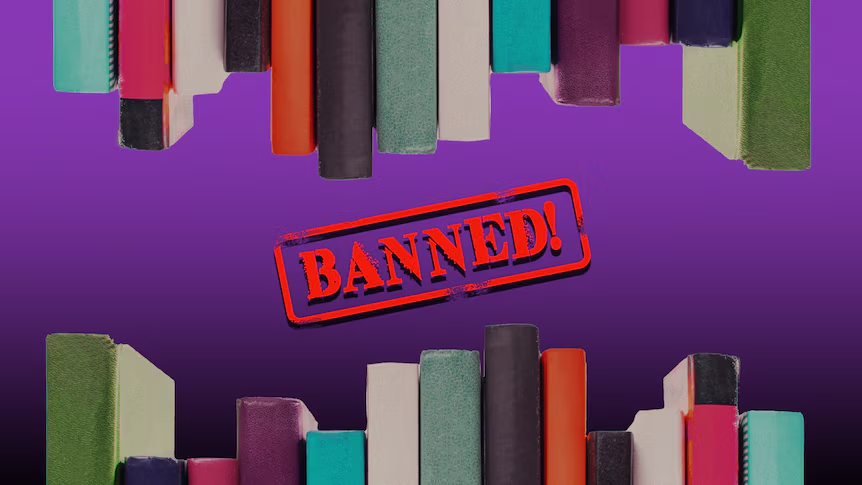
Dozens of female writers in China have been summoned by police as part of a widespread crackdown on the “boys love” (BL) genre—romantic fiction featuring male same-sex relationships—after being accused of publishing and sharing such content online.
Those charged may face detention, fines, or even prison terms if convicted.
Many of the writers had posted their work on Haitang, a Taiwanese platform popular among BL fans, known for including sexually explicit scenes. Several have since shared their experiences online, revealing the toll of the investigations.
One university student, writing under the pen name Sijindejin, said she was ordered to report to police in Gansu province—nearly 1,000 km from her home in Chengdu—after receiving a summons in May. She described making her first-ever flight, on a budget ticket, to comply with the demand.
China’s legal system allows police in any region to summon individuals for questioning based on complaints, regardless of where the individual lives.
Despite having earned only 4,000 yuan (about $857 AUD) over years of writing, Sijindejin said she never imagined her work could be considered criminal.
“I thought writing could change my future, but I didn’t realise that future might lead to prison,” she wrote on social media.
Widespread Detentions and Uncertainty
Another BL author expressed her disbelief after being interrogated, describing the experience as confronting.
“I never imagined this day would come—having every word I wrote thrown back in my face,” she posted on Weibo.
Most of the affected writers are women, many of them university students with limited resources and no legal support.
Three lawyers representing some of the accused noted that the crackdown was extensive, estimating over 100 writers had been targeted. According to Radio Free Asia, police in Gansu province had summoned dozens, some of whom were later fined, detained, or charged under laws that could result in jail time.
Obscenity Laws and Legal Backdrop
China’s obscenity laws, last updated in 2010, criminalise the production or distribution of content deemed obscene if it attracts over 5,000 views or earns more than 5,000 yuan.
A notorious precedent came in 2018, when writer Liu Yuanyuan received a 10-year sentence for her BL novel Occupy, which generated over 150,000 yuan in revenue.
Some critics argue that classifying all BL content as obscene is unjust. One writer, known as Elsa, questioned why only same-sex romance is being targeted, despite homosexuality being legal in China.
“Love—real or fictional—should be respected in all its forms,” she said.
“It’s not right to judge these works under outdated standards.”
Accusations of “Offshore Fishing”
The crackdown has sparked widespread backlash online. Many users have accused local authorities of “offshore fishing,” a term used when police summon suspects from other regions, often for financial benefit.
The phrase itself was quickly censored on Chinese social media platforms like WeChat and Weibo.
The Haitang website, where much of the content was hosted, has also been taken offline until July 8. A spokesperson said the platform is working on “service improvements.”
Motivations Behind the Crackdown
Tang Hongyang, a lawyer who defended BL writers last year, said the situation is escalating. However, another Beijing lawyer, Zhang Dongshuo, argued that financial motives might not explain the latest wave of detentions.
“Some writers come from poor backgrounds and haven’t made much money. This doesn’t look like a profit-driven move,” he told the ABC.
Zhang speculated the renewed effort may relate to government attempts to promote traditional gender roles and reverse declining birth rates.
“Authorities may believe these stories influence young people’s sexual orientation and hinder fertility goals,” he said.
Still, he believes China’s digital obscenity laws are outdated and should be reformed.
Subculture Under Surveillance
Professor Wang Pan, an expert in Chinese digital culture at the University of New South Wales, said the popularity of BL fiction in China—particularly among young women—has brought it under increased scrutiny.
“As the genre’s audience grows, so does government censorship,” she said.
“These authors, many of whom are underprivileged, now face serious legal risks despite earning very little.”
Wang said the crackdown was not just a blow to LGBTQ+ representation but also to creative freedom more broadly.
“It reflects expanding state surveillance over youth subcultures and fiction communities.”
Writers in Fear and Uncertainty
Elsa, the BL writer, said she was devastated by the arrests of her peers.
“It’s hard not to feel anxious and disheartened,” she said.
Though she has paused her writing temporarily, she insists she won’t quit. But she believes it’s unjust that those who didn’t write explicit scenes or profit significantly are being criminalised.
“For those who earned little and shared their stories just for love of the genre, getting a criminal record is simply unfair.”
