


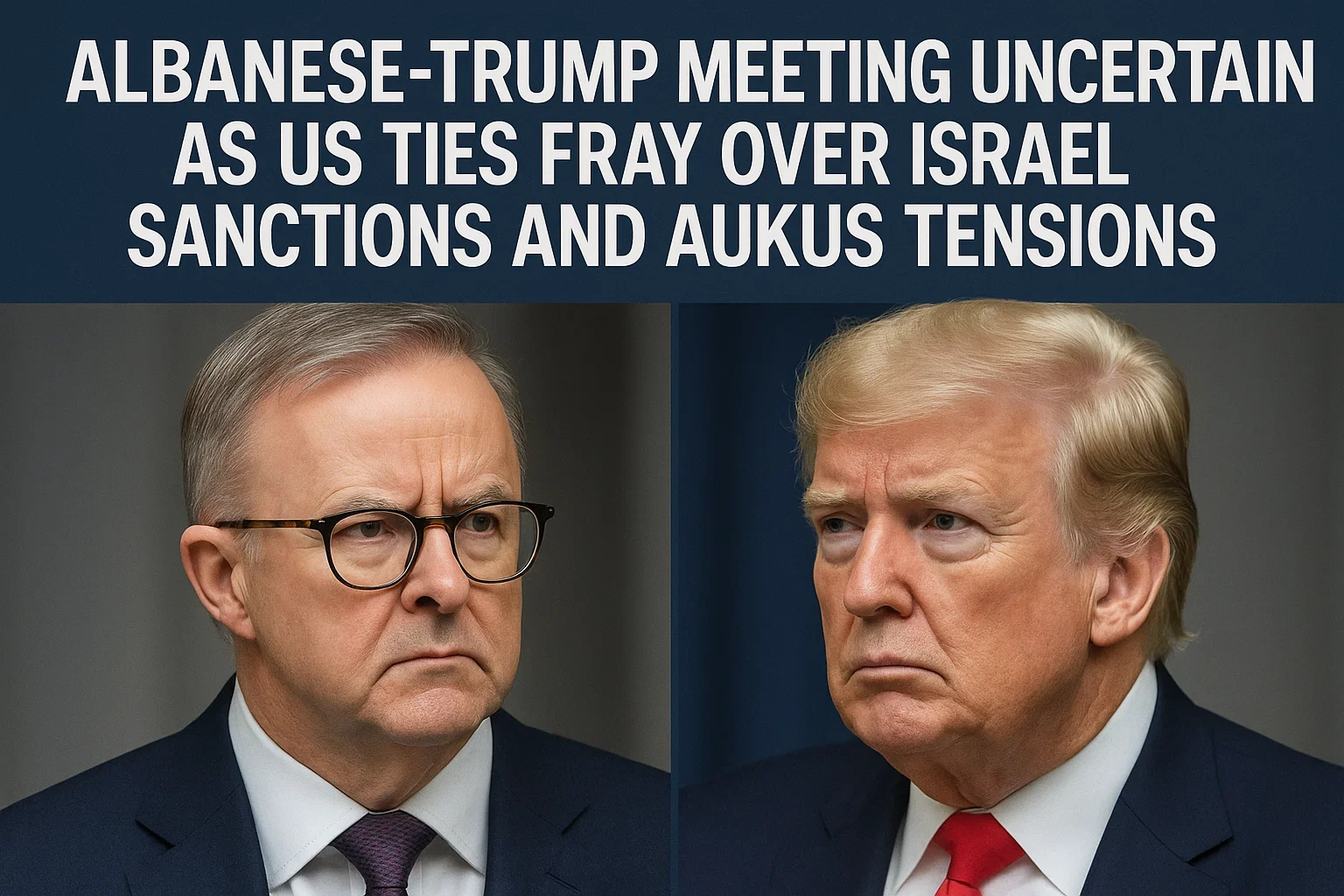
Prime Minister Anthony Albanese may not meet with US President Donald Trump during next week’s G7 summit in Canada, as diplomatic tensions grow between Canberra and Washington.
The strained relationship comes after Australia imposed sanctions on two far-right Israeli ministers and amid fresh uncertainty surrounding the AUKUS defence agreement, following US concerns over Australia’s defence spending.
Although a face-to-face meeting on the sidelines of the June 15–17 summit in Alberta is still possible, sources told the ABC the situation remained fluid, with “lots of moving parts” and no confirmation yet.
Mr Albanese will travel to North America on Friday, where he is expected to raise key issues with Mr Trump—including trade tariffs on Australian steel and defence cooperation. However, there is growing awareness within both governments that sanctions imposed by Australia on Israeli cabinet members Itamar Ben-Gvir and Bezalel Smotrich may provoke an unpredictable response from Mr Trump.
Donald Trump’s administration has voiced clear opposition to the sanctions.
(Reuters: Nathan Howard)
The sanctions, also adopted by Canada, the UK, Norway, and New Zealand, were criticised by US Secretary of State Marco Rubio, who labelled them “counterproductive to peace”. Mr Albanese dismissed Rubio’s remarks as “predictable”.
Albanese Faces Key Foreign Policy Test
Sanctioning Israeli officials represents a major foreign policy moment for Mr Albanese, who has spent much of his prime ministership developing his diplomatic credentials.
While he attempted to downplay the political consequences, Albanese defended the sanctions, stating that Israel must uphold its international legal obligations.
The sanctions clash comes alongside a disagreement over Australia’s defence spending. This week, reports emerged that the Pentagon is reviewing whether the AUKUS pact aligns with Mr Trump’s “America-first” priorities.
Earlier this month, Mr Albanese rejected a request by US Defense Secretary Peter Hegseth for Australia to boost its military spending to 3.5% of GDP—up from just over 2%.
Although it’s unclear if Mr Trump will ultimately agree to meet, some within the US administration acknowledge he has his own tensions with Israeli Prime Minister Benjamin Netanyahu, especially over the war in Gaza.
Sanctions Spark Mixed Political Reaction
Labor’s decision to target Israeli ministers has received a mixed reaction at home.
The Greens called the move “extremely late”, while the opposition criticised it outright. Liberal senator Andrew Bragg argued it was inappropriate to use Magnitsky-style sanctions against democratically elected ministers.
The Australia/Israel & Jewish Affairs Council (AIJAC) labelled the move “unprecedented”, though it acknowledged the ministers’ controversial reputations.
“We find many of Smotrich and especially Ben-Gvir’s statements unacceptable and share the government’s concern over settler violence,” said AIJAC executive director Colin Rubenstein.
However, Rubenstein questioned the consistency of Australia’s approach, pointing out that inflammatory rhetoric also comes from leaders in the Palestinian Authority, Iran, Turkey, and Qatar—none of whom have faced similar sanctions.
